

Ebook Info
- Published: 2009
- Number of pages: 693 pages
- Format: PDF
- File Size: 22.31 MB
- Authors: Bhag Singh Guru
Description
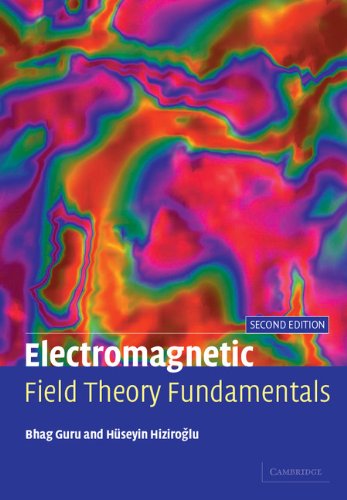
Guru and Hiziroglu have produced an accessible and user-friendly text on electromagnetics that will appeal to both students and professors teaching this course. This lively book includes many worked examples and problems in every chapter, as well as chapter summaries and background revision material where appropriate. The book introduces undergraduate students to the basic concepts of electrostatic and magnetostatic fields, before moving on to cover Maxwell’s equations, propagation, transmission and radiation. Chapters on the Finite Element and Finite Difference method, and a detailed appendix on the Smith chart are additional enhancements. MathCad code for many examples in the book and a comprehensive solutions set are available at www.cambridge.org/9780521830164.
User’s Reviews
Reviews from Amazon users which were colected at the time this book was published on the website:
⭐This review applies to the first edition.It contains very broad and moderately deep coverage of the subject. This is probably around a junior-level book — the reader should have a working knowledge of differential and integral calculus, vector calculus, etc. The introduction is interesting in that it starts with basic measurements: mass, distance, time, charge, etc. — and quickly and concisely develops the math and physics background needed for the remainder of the book. These first 60 pages can’t really prepare the uninitiated (and hence it isn’t a beginner’s book), but it can serve as a checklist for familiarity with prerequisite areas before delving into the main subject (for example, it may suggest that the Div, Grad, and Curl book might be handy). The same coverage of electromagnetics can be found in many books — this one just seems a bit more thoughtful and deliberate than many. I purchased this as a used book, and in that form is a very good value.
⭐I really like and appreciate the approach this author has taken. The “easy” way is to toss Maxwell’s equations at the reader then explaining everything in terms of them. This is backwards. The reader has to have some clue as to where Maxwell.s equations came from. This book does exactly that. Well worth the investment.
⭐Fantastic addition to my Kindle.
⭐good
⭐Makes an otherwise complex subject seem simple by the way it is presented.I found it to be an exceptionally well written text, and would encourage anyone who is interested in the subject to buy it. A great book!
⭐Dieses Buch ist ein wahres Juwel zwischen den unzähligen Büchern, die sich mit elektromagnetischen Feldern befassen. Es sticht durch die sehr gute Didaktik der beiden Autoren hervor, die sich auch in der Sprache des Textes wiederspiegelt, und die damit verbundene gute Lesbarkeit. Die mathematischen Grundlagen (Vektoranalysis, etc.) werden nach Möglichkeit aus anschaulichen, geometrischen Vorstellungen entwickelt, so dass am Ende nicht bloß eine komplex wirkende Formel bleibt, sondern sich Seite für Seite ein mathematisches Gerüst entwickelt, das die Autoren mit physikalischem Verständnis füllen. Unterstützt wird die Anschaulichkeit durch eine große Menge an Grafiken und ausführlich durchgerechneten Beispielen. Einige Themen bekommen auch gerne mal eine Mehrzahl an Beispielrechnungen spendiert, die mit steigendem Schwierigkeitsgrad die Anwendung der vorher eingeführten Theorie aufzeigen. Dabei hat man nie das Gefühl, dass Dinge aus heiterem Himmel auf die Seiten fallen. Der rote Faden ist immer zu erkennen. Abgerundet werden die Kapitel mit eine großen Menge an Verständnisfragen (teilweise auch im Stil eines Lückentextes) und Übungsaufgaben. Die Lösungen zu den Übungsaufgaben sind online über den Verlag zu erreichen.Das Inhaltsverzeichnis sieht wie folgt aus:1. Electromagnetic field theory2. Vector analysis3. Electrostatics4. Steady electrical currents5. Magnetostatics6. Applications of static fields7. Time-varying electromagnetic fields8. Plane wave propagation9. Transmission lines10. Waveguides and cavity resonators11. Antennas12. Computer-aided analysis of electromagnetic fieldsAppendix A. Smith chart and its applicationsAppendix B. Computer programs for various problemsAppendix C. Useful mathematical tables;Das Themenspektrum dieses Buches deckt sich in etwa mit dem einer Grundlagenvorlesung zur Elektrodynamik und durch Kapitel zu ebenen EM-Wellen, Leitungstheorie und Antennen auch mit dem einer Vorlesung zur theoretischen Elektrotechnik und Hochfrequenztechnik. Primär soll dieses Buch Studenten der Elektrotechnik ansprechen, denen gerade an deutschen Hochschulen, in Zeiten von Bachelor und Master, vom Umfang her leider viel zu wenig oder gar nicht die physikalischen Grundlagen ihres Fachs vermittelt werden. Auf Grund der sehr guten Anschaulichkeit ist es aber auch ideal für Studenten der Physik und für das Selbststudium geeignet.Excelente libro. Muy recomendado. En algunas partes es mas claro que Sadiku.Ho trovato questo libro di testo veramente utile, sia per chi inizia ad avvicinarsi alla materia, sia per chi è già esperto e vuole un manuale di consultazione rapido ed efficace sui fondamenti teorici e pratici dell’elettromagnetismo. Consiglio vivamente.Very good text book for ECE students. Must have as a reference book.
Keywords
Free Download Electromagnetic Field Theory Fundamentals 2nd Edition in PDF format
Electromagnetic Field Theory Fundamentals 2nd Edition PDF Free Download
Download Electromagnetic Field Theory Fundamentals 2nd Edition 2009 PDF Free
Electromagnetic Field Theory Fundamentals 2nd Edition 2009 PDF Free Download
Download Electromagnetic Field Theory Fundamentals 2nd Edition PDF
Free Download Ebook Electromagnetic Field Theory Fundamentals 2nd Edition