

Ebook Info
- Published: 2005
- Number of pages: 288 pages
- Format: PDF
- File Size: 2.14 MB
- Authors: Volodimir Simulik
Description
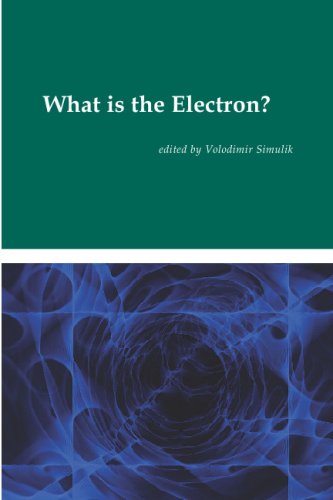
What is the electron?, brings together papers by a number of authors. The main purpose of the book is to present original papers containing new ideas about the electron. What is the electron? presents different points of view on the electron, both within the framework of quantum theory and from competing approaches. Original modern models and hypotheses, based on new principles, are well represented. A comparison of different viewpoints (sometimes orthogonal) will aid further development of the physics of the electron. More than ten different models of the electron are presented here. More than twenty models are discussed briefly. Thus, the book gives a complete picture of contemporary theoretical thinking (traditional and new) about the physics of the electron.
User’s Reviews
Editorial Reviews: About the Author Volodimir Simulik was born in Uzhgorod, Transcarpathia, Ukraine, USSR, and is a graduate of Uzhgorod State University. He became a Candidate in the Physical and Mathematical Sciences in 1987, and in 2000 obtained a Doctorate of Physical and Mathematical Sciences. He joined the Institute of Electron Physics of the Ukrainian National Academy of Sciences as a Senior Research Associate in 1994. In 2000, he was promoted to Principal Research Associate. His areas of scientific interest are quantum field theory, electrodynamics, relativistic equations, symmetries, and conservation laws. He has published 95 scientific papers, including more than 40 in refereed journals. A former subject editor of Apeiron, he currently serves on the editorial board of the International Journal of Pure and Applied Physics.
Reviews from Amazon users which were colected at the time this book was published on the website:
⭐I believe it was Einstein (or may Feynman?) who said that he would be happy if he could only understand the nature of the electron. Apparently that is still an open question but there are many points of view in this book and plenty of food for thought.
⭐Still don’t really know
⭐The answer to date, of the question asked in the title, appears to be, “nobody knows.”To be fair, entire swaths of modern science have opinions on the matter. Sometimes (in free flight) the electron seems to be a point particle – every other “basic” particle in the Standard Model seems to have a radius greater than zero, as displayed by collision experiments. Not the electron. OTOH, when the electron is trapped in an atom (outside the nucleus, but in the neighborhood and with insufficient energy to escape) it seems to manifest itself as a “cloud” – a bit like a nerf ball – that tapers off [asymtotically] to near-nothing at more than a couple Angstroms out. It’s said to have “spin” (it has a magnetic moment – and everything else in the larger world we know gets its magnetism from charges going around in circles) but only 1/2 as much as its bigger cousins (our Samarium magnets) so its spin is 1/2. Huh. In some energy states in an atom, it’s said to have rotational momentum – others not. And yet the rotation that such momentum implies (again, from our macro-world experience) doesn’t result in the electromagnetic radiation we expect – the emission of which would cause the atomic structure of every atom to collapse inside of a microsecond, and the universe wouldn’t exist as we know it – and we wouldn’t be there to know it.Albert Einstein, when complemented on all he knew and had discovered, famously quipped, “I’d just like to be able to understand the electron.” Just so, Albert. I learned all the above (and considerably more) in college chemistry, and in Strength of Materials. Rules for behavior of electrons, taught to us by rote. Even the physicists at the cutting edge today (the former associates of Richard Feynman, and their descendants) note that the electron and its wave/particle duality, and all that comes from that, is at best “weird” and at worst “unbelievable” because it seems self-inconsistent. The math that serves as “map” to the electron-behavior “territory” is equally fractured, even today.Did anybody mention “quantum entanglement”? If you run toward “unsolved questions” like a moth to a flame, this book is one of several that probably belong in your “read right away” stack. Good luck, and good hunting…
⭐Heavy on the mathematics to the extent that only advanced mathematicians could possible interpret it!
Keywords
Free Download What is the Electron? in PDF format
What is the Electron? PDF Free Download
Download What is the Electron? 2005 PDF Free
What is the Electron? 2005 PDF Free Download
Download What is the Electron? PDF
Free Download Ebook What is the Electron?