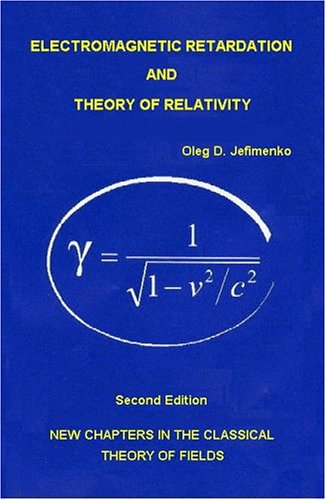
Ebook Info
- Published: 2004
- Number of pages: 352 pages
- Format: PDF
- File Size: 16.90 MB
- Authors: Oleg D. Jefimenko
Description
This book presents a comprehensive exposition of the theory of electromagnetic retardation and offers a significant novel approach to the formulation, development and use of the theory of special relativity. The book is divided into two parts. The first part, Chapters 1 to 5, presents the fundamentals of the theory of electromagnetic retardation with emphasis on recently developed electromagnetic relations and mathematical techniques. Employing as the starting point the retarded electromagnetic field integrals rather than the traditional Lienard- Wiechert potentials and using the newest mathematical methods for operations with retarded integrals, the theory is presented in a clear and logical manner, and the applications of the theory are demonstrated by numerous well-chosen original illustrative examples. As Professor Jefimenko shows, the theory of electromagnetic retardation leads to, and duplicates, many electromagnetic relations that are customarily considered to constitute consequences of relativistic electrodynamics. Much of the first part of the book is devoted to establishing a bridge between the theory of electromagnetic retardation and the theory of relativity. In the second part of the book, Chapters 6 to 11, all the fundamental equations of the special relativity theory, including equations of relativistic electrodynamics and mechanics, are derived in a natural and direct way from equations of electromagnetic retardation and from electromagnetic force and energy equations without any postulates, conjectures, or hypotheses. As a result, the theory of special relativity acquires a new physical and mathematical base and becomes united with Maxwellian electromagnetism into one simple, clear, and harmonious theory of electromagnetic phenomena and mechanical interactions between rapidly moving bodies. Numerous well-chosen original illustrative examples demonstrate various applications of the relativistic electrodynamics and relativistic mechanics developed in this part of the book. The new approach to the formulations of the theory of relativity presented in this book makes it necessary to reexamine the conventional interpretation of some of the key aspects of the special relativity theory. One of the most significant results of this reexamination is that, although the idea of Lorentz length contraction played an important part in Einstein’s approach to the formulation of the theory of relativity, this idea is not an integral part of the theory of relativity itself. Another equally significant result of this reexamination, based on an analysis of a dozen elementary electromagnetic clocks, is that the rate of the moving clocks depends both on the velocity and on the construction of the clocks, so that although all the clocks examined in the book run slow when in motion, only some clocks conform to Einstein’s time-dilation formula; others do not. Finally, the novel approach to the formulation of the special relativity theory developed in this book leads to the conclusion that gravitational phenomena are subject to essentially the same relativistic relations as are the electromagnetic phenomena. Based on this conclusion, a covariant formulation of Newton-Heaviside’s gravitational theory is developed and presented in the last chapter of the book. An Appendix to the book contains an analysis of the physical nature of electric and magnetic forces and presents a novel interpretation of the “near-action” mechanism of electromagnetic interactions.
User’s Reviews
Editorial Reviews: From the Author This book is a sequel to my books “ELECTRICITY AND MAGNETISM” and “CAUSALITY, ELECTROMAGNETIC INDUCTION, AND GRAVITATION”. It is a result of a further exploration of the classical theory of fields in search of heretofore overlooked relations between physical quantities and heretofore overlooked applications of the theory. As is known, electromagnetic fields propagate with finite velocity. Therefore there always is a time delay before a change in electromagnetic conditions initiated at a point of space can produce an effect at any other point of space. This time delay is called electromagnetic retardation. The purpose of this book is to formulate a detailed theory of electromagnetic retardation and of the associated electromagnetic phenomena and to explore the basic consequences of the theory. A very significant result of the electromagnetic retardation theory developed in this book is the derivation of all essential equations of the special relativity theory directly from the fundamental equations of the theory of electromagnetic retardation (retarded electromagnetic field integrals). As a result of this derivation, the special relativity theory acquires a new physical and mathematical base and is now seen in a perspective not previously apparent. Although the book presents the results of original research, it is written in a textbook format and contains numerous illustrative examples and derivations demonstrating various applications of the theory developed in the book. About the Author The author is a Professor of Physics at West Virginia University, USA
Reviews from Amazon users which were colected at the time this book was published on the website:
⭐I had just completed the standard physics undergraduate E&M two semester course when I purchased this book. I had earlier purchased the classic Jeffimenko’s textbook “Electricity and Magnetism” as one of my backup books to help me through the course. I found that book to be very useful and realized that Jefimenko’s vector analysis (calculus) treatment of the subject was extensive and his tables and derivations of vector equations provided details that were missing or assumed intuitively obvious in the text I was using for my E&M course. (It should be pointed out as well that the so called Jefimenko Equations derived in his original text provide a powerful coordinate free expression for Electric and Magnetic fields in which electromagnetic radiation or propagation is directly manifest in the terms. Feynman provides a similar equation in his Physics Lectures vol II. textbook and also by Heaviside in early days of wireless.) So I was expecting good things from his new book.The first chapters of his new book, using retardation vector equations, develops the E&M transformation equations and serves to update his original texbook which ended with a chapter on radiation. However, things go wrong starting with chapter 10, “The Rate of Moving Clocks.” Here, Jefimenko takes the principle of relativity as developed in the previous chapter and applies them to various “thought experiment” type clocks. These experiments are labeled, clock#1 through clock#12. A given clock number corresponds to a certain simple geometric configuration of fixed charges or fixed charge distribution in a specific moving frame such as a charged ring and a single point charge that is free to oscillate in the field produced by the fixed charges. Example: A negative charge oscillating in a plane perpendicular and equidistant to two positive charges moving parallel to the x-axis. (Because this is a thought experiment, it is assumed that the free charge is constrained by invisible frictionless guides to oscillate in the perpendicular plane so that it cannot be trapped by either of the fixed charges.) For these clocks, the single frictionless oscillating charge is a counter that serves as an accurate time keeping mechanism.The idea is to figure out how the oscillating charge changes frequency when the whole clock is moving at relativistic speed with respect to a “stationary” observer. The first six clocks defined by Jefimenko are called “Einsteinian Clocks” because they behave exactly as defined by the Special Theory of Relativity and slow down with respect to the observer when traveling at relativistic speeds. Clocks 7 through 12 are called “Non-Einsteinian Clocks” because although they slow down, they do not follow the time dilation factor given by Einstein. Jeffimenko is attempting to used these thought experiments as a way to show that time dilation is not dependent solely on relativistic velocity and that the effect is really explained through an analogy to retardation and is therefore not really a relativistic effect at all (Page 262).In the text, clock#3 (Einsteinian) is the same as clock#7 (Non-Einsteinian) except that clock#7 is moving in a direction perpendicular to the direction specified for clock#3. At first when I looked at this, Jeffimenko’s argument and equations looked correct. However, I noticed that for clock#7 he did not take into effect the Lorentz contraction of the fixed charges in the system. When I made this change I got the same results for time dilation as clock#3 and in perfect agreement with Einstein.I can see no reason to ignore the Lorentz contraction, so I conclude that this represents a serious flaw in Jefimenko’s analysis. However, this book might be worth purchasing for the footnotes and bibliography at the end of each chapter. Jefimenko references many papers written by all the famous players of E&M theory. This provides a cornicopia of information for the person interested in following the early history and development of E&M and also the controversy that surrounded this early development.Jack
⭐This is a very nicely written, interesting, and thought provoking book. The author has written extensively over the decades (both published articles and books) on the concept of retardation in electromagnetism — basically, the idea is just that “information” about the charges/currents that give rise to E&B fields propagates at the speed of light, so that the fields at a given point can be calculated in terms of integrals over the charge/current distributions but using the “retarded time” — i.e., integrals over all the little bits of charge/current at the locations they were at when they were sending out the “information” that arrives at the field point in question now.The point of this book is to construct a detailed argument that much or most of what is usually considered “relativity” can be inferred directly from a consistent application of the concept of retardation. This is all very much in the spirit of Lorentz’s approach to (what, post-Einstein, came to be called) relativity, and indeed something basically identical to Lorentz’s “theorem of corresponding states” plays a central role in Jefimenko’s argument. The idea is to explain (so-called) relativistic phenomena (such as moving clocks running slow, etc.) dynamically rather than kinematically. Harvey Brown’s recent book (“Physical Relativity”) is an excellent additional source for a more philosophical and historical look at this same project. I am sympathetic to this project (and tired of the vitriolic hostility that most physicists show toward it). Indeed, there is some reason to think Einstein himself was sympathetic to it — he all but confessed as much when he described his own relativity theory as a “principle theory”, a category which he contrasted with “constructive theories”. (The clearest example, which Einstein uses, is that classical thermodynamics is a principle theory, while Boltzmannian stat mech — which gives an underlying causal explanation for the principles, viz the 2nd law, which classical thermo simply accepts as an axiomatic principle — is a constructive theory.) So think of Jefimenko’s goal in this book as doing for special relativity what Boltzmann did for classical thermo. This is a completely valid and quite important project that more people should be less dismissive about!Now, does Jefimenko succeed? Whether he does or not, this is a serious and important work. Instead of really answering my own question, let me simply address some of the dismissive comments of earlier reviewers. One reviewer suggested that Jefimenko stupidly forgot the Lorentz/length contraction in one of the clocks he analyzes in chapter 10, thus getting the “wrong” (slowed) ticking rate for the moving clock. I haven’t gone through the math carefully enough to be certain that Jefimenko’s calculations for all of these clocks are right, but I know this criticism isn’t fair. First off, there are several other clocks in the Chapter which also give “wrong” (non-Einsteinian) ticking rates when in motion, for which the simple “length contraction” fix suggested by the reviewer clearly wouldn’t convert the result into the Einsteinian rate. (For some, all the relevant lengths are perpindicular to the direction of motion, so there would be no length contraction.) Plus, this reviewer was apparently spacing out during the earlier chapter where Jefimenko gives an extended and quite fascinating argument that there is no such real effect as length contraction! So it’s not that Jefimenko “forgot” to include this effect; he had just proved that there is no such effect to conclude. Now, I grant, it’s remotely possible that something is flawed with this earlier proof. But no such flaw was apparent to me. In sum, this particular criticism by the earlier reviewer is not valid.The other negative reviewer bases his whole criticism on the fact that Jefimenko uses (in the same chapter on the ticking rates of various moving “toy clocks”) the ideas of relativistic (specifically, longitudinal and transverse) mass. But this isn’t a valid objection. Jefimenko himself makes very clear in an earlier chapter that one probably shouldn’t take these concepts too seriously (i.e., as real and distinct properties carried by the particle), but whether one does or doesn’t, the laws of motion (the relativistic version of F=ma, if you like) are what they are, and that’s all Jefimenko is using in the Clocks chapter. In short, it’s the same equations no matter what words (like “transverse mass”) you do or don’t use to talk about them. So the fact that Jefimenko uses these terms is, at worst, a minor aesthetic flaw — it is certainly not a valid argument that the computations in that chapter are flawed.Let me finally state my own reservations and criticisms of the book, which perhaps the author can address in future work. First, the claim that several of these simple toy clocks slow down by something other than the usual relativistic “time dilation” factor, is — if true — extremely important. Jefimenko should slow down and establish the truth of this more carefully, and then consider its implications more carefully. For example, the assumption that there are these “frictionless guides” which hold the charges along the appropriate axis (while they “tick” back and forth in the “clock”) raises some questions. Isn’t this rather similar to the assumption that Jefimenko (in an earlier chapter) so deftly showed to be at the root of confusion over the “right angle lever”? In that paradox, it is precisely leaving such “other” forces off-stage that gives rise to an apparent contradiction. Could it be that the same thing is happening here, and that, if only the physical details of these “frictionless guides” were made more explicit, it would be found that they somehow affect the ticking rate, and perhaps restore the regular Einsteinian “dilation” factor? Also, if some of these different clocks really do tick at different rates when moving, couldn’t we use this to determine the state of motion of the ether? Assume some initial frame (call it the ether frame) in which Maxwell’s equations are true. Now construct two of the clocks so they tick at the same rate in that frame. Now set them both in motion. Jefimenko argues in the book that they’ll tick at different rates (which should be a frame-invariant fact) by an amount that depends on how fast they’re moving. So an observer in a spaceship (who didn’t know which frame was the initial ether frame) could just look at two such clocks and determine immediately (a) that he is moving and (b) how fast he is moving — with both of these read: relative to the ether. For this reason, I’m very suspicious of the claims that the different clocks tick at different rates (which is what made me think of the possibility that those “frictionless guides” shouldn’t be left so far offstage). The point is, if this claim is right, it appears to give rise to the possibility of an empirical refutation of the principle of relativity. Maybe I’ve got that wrong, but the author should confront the issue and explain things more clearly instead of just moving on to the next topic.My other complaint was about the gravity chapter at the end. Probably this shouldn’t be here at all. But given that it is here, the author needs to back up some of the speculations with actual calculations. I’m thinking in particular of the speculation that maybe his alternative Maxwell-like theory of gravity could account for the anomalous precession of Mercury. He develops the equations by which the anomalous precession can actually be calculated, but instead of actually calculating it he just says “this is different than the expressions for plain Newtonian gravity which made people eventually reject that theory.” Sure, it’s different, so “maybe” it’ll be consistent with the actual orbit. But that “maybe” is pretty empty. Why not just calculate the darn thing? If people could do it 100 years ago for Newtonian gravity and GR, then he should be able to do it today for his theory pretty easily. If it matches (and can account for other things that are usually considered triumphs for GR, such as the orbital decy rate of binary pulsars) that would be a huge sign that things were settled too quickly 100 years ago and that this theory should be taken quite seriously. More likely, it won’t work, and then Jefimenko should just let it go and quit including it as a teaser at the end of books on other topics.Those reservations aside, I would definitely recommend the book for anyone who wants to really understand electromagnetism and relativity.
⭐This book develops the Maxwell equations using retarded vector potentials. Prof. Jefimenko goes on to show that Einstein’s idea of time dilation (the Lorentz transformation) is incorrect. Prof. Jefimenko provides several simple electrodynamic examples where moving charges are used as simple clocks. They do not always obey the (1 – v^2/c^2)^-1/2 time dilation rule. For example, many obey a (1 – v^2/c^2)^-3/4 rule, while others obey a (1 – v^2/c^2)^-5/4 rule, which by the way, has nothing to due with time itself, but rather, how fundamental electric charges interact due to the retarded field potentials.
Keywords
Free Download Electromagnetic Retardation and Theory of Relativity: New Chapters in the Classical Theory of Fields, Second Edition 2nd Edition in PDF format
Electromagnetic Retardation and Theory of Relativity: New Chapters in the Classical Theory of Fields, Second Edition 2nd Edition PDF Free Download
Download Electromagnetic Retardation and Theory of Relativity: New Chapters in the Classical Theory of Fields, Second Edition 2nd Edition 2004 PDF Free
Electromagnetic Retardation and Theory of Relativity: New Chapters in the Classical Theory of Fields, Second Edition 2nd Edition 2004 PDF Free Download
Download Electromagnetic Retardation and Theory of Relativity: New Chapters in the Classical Theory of Fields, Second Edition 2nd Edition PDF
Free Download Ebook Electromagnetic Retardation and Theory of Relativity: New Chapters in the Classical Theory of Fields, Second Edition 2nd Edition