

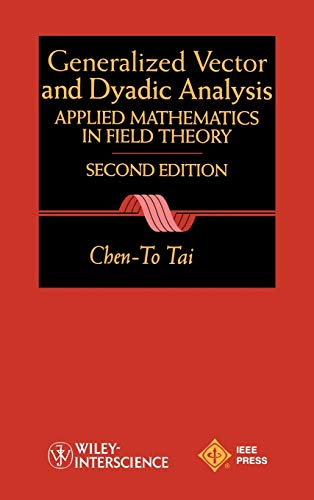
Ebook Info
- Published: 1997
- Number of pages: 208 pages
- Format: PDF
- File Size: 11.63 MB
- Authors: Chen-To Tai
Description
Unmatched in its coverage of the topic, the first edition of GENERALIZED VECTOR AND DYADIC ANALYSIS helped revolutionize the treatment of boundary-value problems, establishing itself as a classic in the field. This expanded, revised edition is the most comprehensive book available on vector analysis founded upon the new method symbolic vector. GENERALIZED VECTOR AND DYADIC ANALYSIS presents a copious list of vector and dyadic identities, along with various forms of Green’s theorems with derivations. In addition, this edition presents an historical study of the past mis-understandings and contradictions that have occurred in vector analysis presentations, furthering the reader’s understanding of the subject. Sponsored by: IEEE Antennas and Propagation Society.
User’s Reviews
Editorial Reviews: From the Inside Flap Electrical Engineering/Electromagnetics Generalized Vector and Dyadic Analysis Applied Mathematics in Field Theory Second Edition A volume in the IEEE/OUP Series on Electromagnetic Wave Theory Donald G. Dudley, Series Editor Unmatched in its coverage of the topic, the first edition of Generalized Vector and Dyadic Analysis helped revolutionize the treatment of boundary-value problems, establishing itself as a classic in the field. This expanded, second edition is the most comprehensive book available on vector analysis founded upon the new method of symbolic vector. Generalized Vector and Dyadic Analysis presents a copious list of vector and dyadic identities, along with various forms of Green’s theorems with derivations. Features include: New operational notations for divergence and curlDetailed derivations of theorems and identitiesCoverage of new topics, such as surface vector analysis and dyadic analysisIn-depth treatment of invariance theorem for general symbolic expressions Generalized Vector and Dyadic Analysis is an excellent general reference book for advanced undergraduate and graduate courses in the field. The subject matter is essential to learning electromagnetic theory and hydrodynamics. About the IEEE/OUP Series on Electromagnetic Wave Theory Formerly the IEEE Press Series on Electromagnetic Waves, this joint series between IEEE Press and Oxford University Press offers outstanding coverage of the field, with new titles as well as reprintings and revisions of recognized classics that maintain long-term archival significance in electromagnetic waves and applications. Designed specifically for graduate students, practicing engineers, and researchers, this series provides affordable volumes that explore electromagnetic waves and applications beyond the undergraduate level. See page ii of the front matter for a listing of books in this series. From the Back Cover Electrical Engineering/Electromagnetics Generalized Vector and Dyadic Analysis Applied Mathematics in Field Theory Second Edition A volume in the IEEE/OUP Series on Electromagnetic Wave Theory Donald G. Dudley, Series Editor Unmatched in its coverage of the topic, the first edition of Generalized Vector and Dyadic Analysis helped revolutionize the treatment of boundary-value problems, establishing itself as a classic in the field. This expanded, second edition is the most comprehensive book available on vector analysis founded upon the new method of symbolic vector. Generalized Vector and Dyadic Analysis presents a copious list of vector and dyadic identities, along with various forms of Green’s theorems with derivations. Features include: New operational notations for divergence and curlDetailed derivations of theorems and identitiesCoverage of new topics, such as surface vector analysis and dyadic analysisIn-depth treatment of invariance theorem for general symbolic expressions Generalized Vector and Dyadic Analysis is an excellent general reference book for advanced undergraduate and graduate courses in the field. The subject matter is essential to learning electromagnetic theory and hydrodynamics. About the IEEE/OUP Series on Electromagnetic Wave Theory Formerly the IEEE Press Series on Electromagnetic Waves, this joint series between IEEE Press and Oxford University Press offers outstanding coverage of the field, with new titles as well as reprintings and revisions of recognized classics that maintain long-term archival significance in electromagnetic waves and applications. Designed specifically for graduate students, practicing engineers, and researchers, this series provides affordable volumes that explore electromagnetic waves and applications beyond the undergraduate level. See page ii of the front matter for a listing of books in this series. About the Author About the Author Chen-To Tai is Professor Emeritus at the University of Michigan, where he received the EKN Outstanding Faculty Award from the Department of Electrical Engineering and Computer Science in 1971 and 1977; the Tau-Beta-Pi Outstanding Faculty Award from the College of Engineering in 1974; and the Distinguished Achievement Award from the University in 1975. He also received the IEEE Centennial Award in 1984 and the Distinguished Achievement Award from the IEEE Antennas and Propagation Society in 1986. He is a Life Fellow of IEEE, and a member of the National Academy of Engineering of the United States of America. Read more
Reviews from Amazon users which were colected at the time this book was published on the website:
⭐Excellent copy of the textbook, and excellent service by Amazon.
⭐If you ever came across the need of expressing vector operators in curvilinear coordinates, while writing numerical codes or solving PDEs in generalised coordinates, then you might have felt the need of a rigourous presentation of the subject.Rigorous yet usable, I would say. This is not a book for pure mathematicians (the theorem you need is at pag. 435 consisting of one line saying the proof follows from the 2000 previous Lemma-theorem-corollary scattered all around…). The author has the physical problems well in his mind (he’s Emeritus at Univ of Michigan, dept of Electrical Engineering) and makes frequent references to where in physics or geometry you will encounter such mathematical entities.Chapter 8, devoted to the history of vector analysis, makes you clear why you haven’t been able to find a neat rigorous presentation so far. This digression (I’m reluctant to use this expression for it’s not a minor chapter in my opinion) gives you an even sharper feeling of what’s the core of the matter by comparing critically different approaches.The first introductory chapters on geometry, coordinate systems, dyadics provide a sound general background, presenting derivatives of vectors in generalised coordinate system from the beginning, resulting in a powerful and unifying exposition of the matter. All is extremely clear, a characteristic of the book in its whole.The author always stress upon the transformation properties of the objects which have been defined, thus clarifying their meaning and mathematical character.The appendix on vector analysis in the special theory of relativity is enjoyable and makes you clear how E and B can be treated as vectors even if they transform like the components of a tensor (OK, you already knew that, but you were using tensor analysis from the start, didn’t you?).There is much more in this book, which I would suggest to keep as a reference to any physicist, applied mathematician, biologist, engineer, numerical people and (even!) mathematician (developing communication skills…). First years students, which are always a bit confused on why one should use vectors at all and having accepted that think that everything is a vector, which is not, should definitely start with this book. Next time I will be asked to teach anything related to mechanics, I will adopt this book for the fundamental mathematics (but also check the excellent Biscari-Poggi-Virga Mechanics Notebook, 1999 Liguori ed. Napoli (IT) ).It’s also an excellent way to approach what you want next, which is likely to be tensor analysis which this book, unfortunately, cannot cover (can you hear me, Professor Tai?…).
Keywords
Free Download General Vector and Dyadic Analysis: Applied Mathematics in Field Theory 2nd Edition in PDF format
General Vector and Dyadic Analysis: Applied Mathematics in Field Theory 2nd Edition PDF Free Download
Download General Vector and Dyadic Analysis: Applied Mathematics in Field Theory 2nd Edition 1997 PDF Free
General Vector and Dyadic Analysis: Applied Mathematics in Field Theory 2nd Edition 1997 PDF Free Download
Download General Vector and Dyadic Analysis: Applied Mathematics in Field Theory 2nd Edition PDF
Free Download Ebook General Vector and Dyadic Analysis: Applied Mathematics in Field Theory 2nd Edition