Ebook Info
- Published: 2009
- Number of pages: 286 pages
- Format: PDF
- File Size: 1.66 MB
- Authors: Joseph L. McCauley
Description
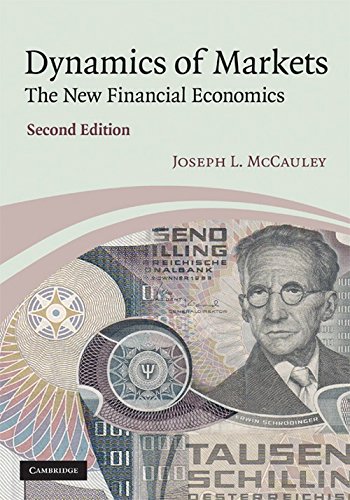
This second edition presents the advances made in finance market analysis since 2005. The book provides a careful introduction to stochastic methods along with approximate ensembles for a single, historic time series. The new edition explains the history leading up to the biggest economic disaster of the 21st century. Empirical evidence for finance market instability under deregulation is given, together with a history of the explosion of the US Dollar worldwide. A model shows how bounds set by a central bank stabilized FX in the gold standard era, illustrating the effect of regulations. The book presents economic and finance theory thoroughly and critically, including rational expectations, cointegration and arch/garch methods, and replaces several of those misconceptions by empirically based ideas. This book will be of interest to finance theorists, traders, economists, physicists and engineers, and leads the reader to the frontier of research in time series analysis.
User’s Reviews
Editorial Reviews: Review “A thought provoking book. It does not only argue convincingly that the ‘King – of orthodox economic theory – is naked’, but offers a challenging economic alternative interpretation regarding especially the dynamics of financial markets.” Giovanni Dosi, Laboratory of Economics and Management, Sant’Anna School of Advanced Studies, Pisa”The heart of McCauley’s book is a closely-reasoned critique of financial-economic mathematical modeling practice. McCauley’s demonstration of the incompatibility between the assumptions of market-clearing equilibrium and informational efficiency is stunning, and sheds much-needed light on the mathematical modeling failures revealed by the financial melt-down. His unvarnished criticisms of neoclassical economic doctrine deserve equal attention. McCauley opens the windows of the self-referential world of economics to the fresh air of a mathematical physics point of view grounded in economic history and common sense. Neither monetarist, neoclassical, nor Keynesian schools of economics will take much comfort from McCauley’s work, but they all have a lot to learn from it.” Duncan K. Foley, Leo Model Professor, New School for Social Research and External Professor, Santa Fe Institute”McCauley’s mathematically and empirically rigorous Dynamics of Markets is one of those rare works which is challenging, not only to an intellectual orthodoxy (neoclassical economics), but also to its fledgling rival (econophysics). Neoclassical economics and finance theory receive justifiably dismissive treatments for failing empirically, but some econophysics contributions also distort empirical data–notably McCauley shows that “fat tails” in data can be the result of applying an unjustified binning process to nonstationary data. McCauley’s essential messages for the future of economics after the Global Financial Crisis is that “There is no statistical evidence for Adam Smith’s Invisible Hand”, and that the hand that does exist and must be understood is both non-stationary and far from equilibrium.” Steve Keen, School of Economics and Finance, University of Western Sydney”That material of the book has been deeply reorganized and new chapters on foreign exchange markets, globalization, and macroeconomics have been added. Several parts have been rewritten and new research results have been included. The book is a rather good introduction to economic and financial concepts from a perspective that is rarely present in more-orthodox economic books. For this reason it constitutes a good read for physicists aiming to improve their knowledge of economics. The book is also an interesting read for scholars in economics who want to challenge their views,” Fabrizio Lillo for Mathematical Reviews Book Description Second edition, now explains the history leading up to the biggest economic disaster of the 21st century. About the Author Joseph L. McCauley is Professor of Physics at the University of Houston, and is an advisory board member for the Econophysics Forum. He has contributed to statistical physics, the theory of superfluids, nonlinear dynamics, cosmology, econophysics, economics and finance theory. Read more
Reviews from Amazon users which were colected at the time this book was published on the website:
⭐Awesome! The technical portions of the book are non-trivial and really require advanced training in mathematics and / or physics. However, the implications are clear and their exposition relatively approachable give the technical content. More economists should read this!
⭐So, I am an economist. I have sympathies with the econophysics literature and community. However, this book is guilty of the worst vices of that community. There are two I wish to point out.The book’s treatment of neoclassical economics is awful! Truly awful. The author concedes that his understanding of neoclassical economics is based on Hal Varian’s Intermediate Microeconomics textbook. There is no admission that this is the textbook economists use to introduce the formalism of neoclassical economics. It is the first textbook students will see that treats utility and profit maximization. Varian’s book spends almost all its time on static consumer and producer problems, which are not realistic. But, you don’t introduce students to the cutting edge research that attempts to handle all the realistic details that we currently can. You simplify the crap out of everything so that students can develop aptitude and sophistication. Yet, our author accuses economists of believing that Varian’s Intermediate Micro represents what we believe.He makes some glaring claims that are categorically false. For instance, neoclassical economics can’t handle capital accumulation. If one looked at Acemoglu’s Intro to Modern Economic Growth Theory, Aghion and Howitt’s Endogenous Growth Theory, Romer’s Advanced Macro or any other graduate textbook, you would see that neoclassical economics does handle capital accumulation. Our Author is ignorant of the Solow model, which handled capital accumulation in the 1950s. He also claims that neoclassical econ can handle money. This is also disingenuous at best. Walsh’s textbook on Monetary policy and theory is definitely in the neoclassical tradition. It handles money.The summary here is that readers should skip chapter 2. There are some tidbits that I agree with (the existence of equilibrium is not enough; how we get there from where we are is important too), but there are lots of just sloppy statements (economists assume equilibrium exists; no we prove equilibrium exists when certain conditions are satisfied. We assume that the market is in that equilibrium), ignorant claims (We can’t empirically construct utility functions; economists have known this since the 1950s), or downright falsehoods (see the above paragraph). So, skip chapter 2. It is not worth reading.My second point of contention is that econophysicists don’t realize that their notation is different from what everyone else uses. They also have very sloppy derivations of many mathematical statements. Economists learned stochastic calculus from mathematicians. Mathematicians are marvelously pedantic when it comes to notation. Physicists are not; they are actually somewhat infamous for sloppy notation. This book is no exception to that trend. Econophysicists could go a long way to remedy this situation by just putting a glossary of notations they use and explaining their derivations a lot better.I personally think the econophysics research program should be more influential in economics and finance. The issues outlined above keep economists from trying to learn any of what the econophysicists are putting out. It is a shame. There is value in the collaboration. But, physicists, much like economists, are arrogant and stubborn and refuse to actually learn any of the economics that is done.
⭐good book
Keywords
Free Download Dynamics of Markets: The New Financial Economics 2nd Edition in PDF format
Dynamics of Markets: The New Financial Economics 2nd Edition PDF Free Download
Download Dynamics of Markets: The New Financial Economics 2nd Edition 2009 PDF Free
Dynamics of Markets: The New Financial Economics 2nd Edition 2009 PDF Free Download
Download Dynamics of Markets: The New Financial Economics 2nd Edition PDF
Free Download Ebook Dynamics of Markets: The New Financial Economics 2nd Edition