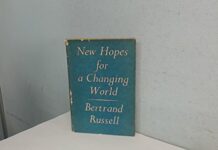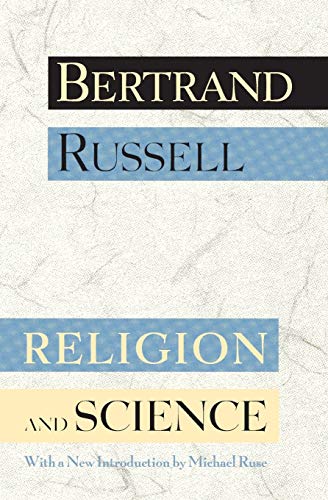
Ebook Info
- Published: 1997
- Number of pages: 272 pages
- Format: PDF
- File Size: 3.53 MB
- Authors: Bertrand Russell
Description
In this timely work, Russell, philosopher, agnostic, mathematician, and renowned peace advocate, offers a brief yet insightful study of the conflicts between science and traditional religion during the last four centuries. Examining accounts in which scientific advances clashed with Christian doctrine or biblical interpretations of the day, from Galileo and the Copernican Revolution, to the medical breakthroughs of anesthesia and inoculation, Russell points to the constant upheaval and reevaluation of our systems of belief throughout history. In turn, he identifies where similar debates between modern science and the Church still exist today. Michael Ruse’s new introduction brings these conflicts between science and theology up to date, focusing on issues arising after World War II. This classic is sure to interest all readers of philosophy and religion, as well as those interested in Russell’s thought and writings.
User’s Reviews
Editorial Reviews: Review Praise for earlier editions:”Mr. Russell succeeds in investing the subject with a fresh interest….Even on the points on which one disagrees–and in a book of this type there will necessarily be many–the discussion is always acute and illuminating. Mr. Russell has endeavored to state opposing points of view with fairness.”–Henry Hazlitt, The New York Times About the Author The late Bertrand Russell, English philosopher and mathematician, was a Fellow of Trinity College, Cambridge University, where he taught for many years. He also lectured widely in the United States. Winner of the 1950 Nobel Prize for Literature, he is the author of many books including the influential Principia Mathematica, with Alfred North Whitehead, and The Autobiography of Bertrand Russell 1872-1967, published in three volumes. Michael Ruse is Professor of Philosophy and Zoology at the University of Guelph, Ontario. He is the author of many books, including Evolutionary Naturalism and The Darwinian Paradigm.
Reviews from Amazon users which were colected at the time this book was published on the website:
⭐Bertrand Russell reflects on the conflicts of science and religion by outlining the history of each. Although Russell is a renowned critical thinker and agnostic proponent of science, his presentation is closer to a historical account rather than a one-sided argument. He finds faults and praise for both science and religion and views their respective conflicts in relation to the thought process of societies at their respective time periods.Religion has been mainstream for at least two millenniums and as Russell points out it has only been in the last two centuries that science has gained considerable influence. For two thousand years even Aristotle’s views on falling objects was considered unquestionably valid until simple scientific experiments proved his faulty lines of reason. The history of religion has also evolved throughout the ages, but unlike science there are no definitive tests that influence the lines of reason, there are only common accepted beliefs and faiths. Russell asserts it is this difference that is as the core of the conflict of between science and religion; a clash made most famous by Galileo’s persecution for his pronouncement that the earth was not the center of the universe.Russell’s’ philosophical views are as relevant today as in the early parts of the 20th century when this piece was written. He capably conveys the importance of looking back into history to better grasp the integrity of our own views. Anyone with an interest in these subjects will find Religion and Science worthwhile and enjoyable.
⭐Only discusses Christianity and science. No other religion seems to be brought up. Book should be renamed “Christianity and Science”
⭐However this book I couldn’t put down. He makes a lot of sense. Now keep in mind since Betrand Science and Religion has changed a lot. But the perspective he has is valuable.
⭐Not sure that this book needs a review. It is a seminal work on the topic. Russell is an avowed agnostic, so it shouldn’t come a surprise that he views this topic from a “conflict theory” perspective. He lays out the usual arguments, but provides a nice wrap up with his lucid arguments in favor of a huminist/rational ethic. It was a very easy read, nothing too heavy, but engrossing.
⭐Bertrand Russell’s Religion and Science is a beautifully concise and surprisingly accurate book for being quite a short book. The scope of his work is very well layed out. Upon reading Michael Ruse’s introduction I have to agree that Russell’s vast knowledge of philosophy shines halfway through the book, when he delves into the philosophical arguments for various topics. His first portion of the book deals mostly with the history of the relationship between Religion and Science. His arguments against the soul from an analytical perspective are extremely original in my view as I am unaware of anyone else who prosposed his objections. I recommend this book from a philosophical and historical perspective and I feel that this book is still hugely relevant in our modern times.
⭐This was a somewhat rare book in the hardback. It was first published in 1936, though this was a 1956 reprint. Given this, it was reasonably priced. It arrived quickly. It was well packaged. And it was in the condition advertised.
⭐Necessary to understand the conflict theory of religion and science, but perhaps out of date.
⭐Excellent
⭐This is a well-written book that briefly explores the aspects of the history of ideas and institutions relating to both religion and science. Russell writes in an engaging manner, always lucid and highly logical, and focuses on religion and science in the modern western world. As such, by ‘religion’ Russell is concerned with Christianity; and by ‘science’ he’s interested in the natural and physical sciences (such as physics and astronomy). In consequence, this rather short book omits much that might have been embraced under the given title (such as other religions and the social sciences). Nonetheless, what Russell does examine is insightfully discussed.Russell has presented his personal views on religion in another publication – see
⭐Why I am not a Christian: And Other Essays on Religion and Related Subjects (Routledge Classics)
⭐- and here he adopts a more objective position. His aim is to explore the developments that have taken place in Christian thinking and practice during recent centuries, looking at the impact of the developments that have occurred in the sciences. And the central thesis is that as scientific knowledge has grown, and as scientific practice has become a common feature of life in modern society, so the Christian religion has declined – becoming increasingly superfluous. The inconsistencies and contradictions that exist between religion and science are highlighted, and Russell advances the merits of an atheist position.Overall, I enjoyed reading this short book. Yet it’s now rather dated … given that it was written some 70-odd years ago. Additionally, I would have preferred a more in-depth exploration and analysis. As it is, Russell tends to briefly describe things – rather than presenting a detailed critique. Nonetheless, I do recommend this book.
⭐Excellent easily understood without being condescending. I enjoyed this book as it coveredEverything I needed to know about this subject.
⭐Book condition was ok.
Keywords
Free Download Religion and Science in PDF format
Religion and Science PDF Free Download
Download Religion and Science 1997 PDF Free
Religion and Science 1997 PDF Free Download
Download Religion and Science PDF
Free Download Ebook Religion and Science