

Ebook Info
- Published: 2010
- Number of pages: 240 pages
- Format: PDF
- File Size: 1.42 MB
- Authors: Weifeng Liu
Description
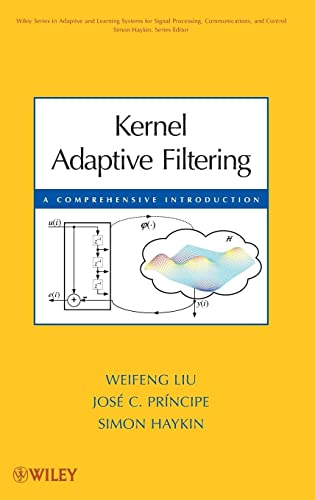
Online learning from a signal processing perspectiveThere is increased interest in kernel learning algorithms in neural networks and a growing need for nonlinear adaptive algorithms in advanced signal processing, communications, and controls. Kernel Adaptive Filtering is the first book to present a comprehensive, unifying introduction to online learning algorithms in reproducing kernel Hilbert spaces. Based on research being conducted in the Computational Neuro-Engineering Laboratory at the University of Florida and in the Cognitive Systems Laboratory at McMaster University, Ontario, Canada, this unique resource elevates the adaptive filtering theory to a new level, presenting a new design methodology of nonlinear adaptive filters.Covers the kernel least mean squares algorithm, kernel affine projection algorithms, the kernel recursive least squares algorithm, the theory of Gaussian process regression, and the extended kernel recursive least squares algorithmPresents a powerful model-selection method called maximum marginal likelihoodAddresses the principal bottleneck of kernel adaptive filters—their growing structureFeatures twelve computer-oriented experiments to reinforce the concepts, with MATLAB codes downloadable from the authors’ Web siteConcludes each chapter with a summary of the state of the art and potential future directions for original researchKernel Adaptive Filtering is ideal for engineers, computer scientists, and graduate students interested in nonlinear adaptive systems for online applications (applications where the data stream arrives one sample at a time and incremental optimal solutions are desirable). It is also a useful guide for those who look for nonlinear adaptive filtering methodologies to solve practical problems.
User’s Reviews
Editorial Reviews: From the Inside Flap Online learning from a signal processing perspectiveThere is increased interest in kernel learning algorithms in neural networks and a growing need for nonlinear adaptive algorithms in advanced signal processing, communications, and controls. Kernel Adaptive Filtering is the first book to present a comprehensive, unifying introduction to online learning algorithms in reproducing kernel Hilbert spaces. Based on research being conducted in the Computational Neuro-Engineering Laboratory at the University of Florida and in the Cognitive Systems Laboratory at McMaster University, Ontario, Canada, this unique resource elevates the adaptive filtering theory to a new level, presenting a new design methodology of nonlinear adaptive filters.Covers the kernel least mean squares algorithm, kernel affine projection algorithms, the kernel recursive least squares algorithm, the theory of Gaussian process regression, and the extended kernel recursive least squares algorithmPresents a powerful model-selection method called maximum marginal likelihoodAddresses the principal bottleneck of kernel adaptive filters—their growing structureFeatures twelve computer-oriented experiments to reinforce the concepts, with MATLAB codes downloadable from the authors’ Web siteConcludes each chapter with a summary of the state of the art and potential future directions for original researchKernel Adaptive Filtering is ideal for engineers, computer scientists, and graduate students interested in nonlinear adaptive systems for online applications (applications where the data stream arrives one sample at a time and incremental optimal solutions are desirable). It is also a useful guide for those who look for nonlinear adaptive filtering methodologies to solve practical problems. From the Back Cover Online learning from a signal processing perspectiveThere is increased interest in kernel learning algorithms in neural networks and a growing need for nonlinear adaptive algorithms in advanced signal processing, communications, and controls. Kernel Adaptive Filtering is the first book to present a comprehensive, unifying introduction to online learning algorithms in reproducing kernel Hilbert spaces. Based on research being conducted in the Computational Neuro-Engineering Laboratory at the University of Florida and in the Cognitive Systems Laboratory at McMaster University, Ontario, Canada, this unique resource elevates the adaptive filtering theory to a new level, presenting a new design methodology of nonlinear adaptive filters.Covers the kernel least mean squares algorithm, kernel affine projection algorithms, the kernel recursive least squares algorithm, the theory of Gaussian process regression, and the extended kernel recursive least squares algorithmPresents a powerful model-selection method called maximum marginal likelihoodAddresses the principal bottleneck of kernel adaptive filters—their growing structureFeatures twelve computer-oriented experiments to reinforce the concepts, with MATLAB codes downloadable from the authors’ Web siteConcludes each chapter with a summary of the state of the art and potential future directions for original researchKernel Adaptive Filtering is ideal for engineers, computer scientists, and graduate students interested in nonlinear adaptive systems for online applications (applications where the data stream arrives one sample at a time and incremental optimal solutions are desirable). It is also a useful guide for those who look for nonlinear adaptive filtering methodologies to solve practical problems. About the Author Weifeng Liu, PhD, is a senior engineer of the Demand Forecasting Team at Amazon.com Inc. His research interests include kernel adaptive filtering, online active learning, and solving real-life large-scale data mining problems. José C. Principe is Distinguished Professor of Electrical and Biomedical Engineering at the University of Florida, Gainesville, where he teaches advanced signal processing and artificial neural networks modeling. He is BellSouth Professor and founder and Director of the University of Florida Computational Neuro-Engineering Laboratory.Simon Haykin is Distinguished University Professor at McMaster University, Canada.He is world-renowned for his contributions to adaptive filtering applied to radar and communications. Haykin’s current research passion is focused on cognitive dynamic systems, including applications on cognitive radio and cognitive radar. Read more
Reviews from Amazon users which were colected at the time this book was published on the website:
⭐This is a first-of-a-kind book on this emerging topic. Kernel adaptive filtering will reshape the field of adaptive nonlinear signal processing.The nice thing about this book is it follows closely the classical adaptive filtering theory (AFT). Therefore, you will find no difficulty to follow the material if you are already familiar with the classical AFT. It will be an excellent “mind-opening” complimentary textbook or reference for those who want to learn AFT.It comes with many matlab simulations which demonstrate the power of kernel adaptive filters step-by-step. The matlab code can be downloaded from the author’s website ([…]) and can be readily used to solve your own problems in a few days.The reason I give it four-star rating is only because there are a few things untouched by the book. For example, the book doesn’t discuss about pruning techniques which are very important in my opinion. Of course, this field is so new and we only feel lucky to have this one so timely.
⭐Das Buch basiert auf der Dissertation von Weifeng Liu. Liu hatte eine sehr gute Idee. Man transferiert den Input mit Hilfe eines Kernels in den RKHS (Reproducing Kernel Hilbert Space). Auf die tranformierten Daten wendet man einen üblichen Filter (im einfachsten Fall LMS) an um das Signal zu prognostizieren bzw. zu filtern. Durch den Kernel-Trick erhält man einen nichtlinearen Filter der zumindest in der Theorie jede beliebige stetige Funktion approximieren kann. RKHS klingt nach hard-core Mathematik. Ist es auch. Aber speziell der Kernel-LMS Algo ist enttäuschend einfach und effektiv. Er lässt sich in 10 Zeilen C implementieren.Ich habe KLMS für ein mild nichtlineares Problem ausprobiert. Man will aus dem VIX sowie dem VIX-Return (Volatility-Index auf S&P-500 Futures) den Daily-Spread zwischen Dow- und Russel-2000 vorhersagen. KLMS liefert brauchbare Werte, allerdings ist der Predictor etwas schlechter als LOESS (Local-Linear Regression). Der Zusammenhang zwischen dem VIX und dem Spread hat in erster Näherung den Verlauf eines Sigmoids. Mit derartigen Nichtlinearen Effekten kommt LOESS sehr gut zurecht. KLMS tut sich insbesondere schwer wenn die unabhängige Variable (VIX) einen neuen Wertebereich annimmt. Konkret explodiert der VIX im Crash-2008. KLMS findet in dieser Situation keine ähnlichen Muster in der Vergangenheit. LOESS kommt mit diesem Randproblem wesentlich besser zurecht.Im Buch wird die Effektivität der Kernel-Schätzer an Hand der Mackey-Glass Zeitreihe demonstiert. Die ist ausgeprägt (chaotisch) nichtlinear, schwingt aber hin- und her. D.h. man hat nach ein paar Schwingungen kein Randproblem mehr. Die Kernel Schätzer schneiden bei Mackey-Glass sehr gut ab. Für viele Anwendungen ist aber eher das VIX/Spread Verhalten typisch. In diesem Fall ist das auch leichter interpretierbare LOESS wahrscheinlich die bessere Methode.Auf der homepage des Autors gibt es MatLab-Kode für die Schätzer und die Testfunktionen. Der Kode ist sauber geschrieben, ein paar zusätzliche Kommentare bzw. ein Readme hätten aber nicht geschadet.Das Buch ist – angesichts der Komplexität des Themas – relativ verständlich. Man darf sich nur durch RKHS nicht abschrecken lassen.Einziger Kritikpunkt: Am Titel stehen 3 Autoren. Ich kann keinen wissenschaftlichen Beitrag von J.Principe und S.Haykin erkennen. Die stehen offensichtlich nur drauf, weil sie wichig sind.Nachtrag: Eher zufällig bin ich auf einen Artikel [1] von E.Parzen aus dem Jahre 1963!! gestossen. Parzen beschreibt detailliert wie man praktisch alle Schätz-, Vorhersage- und Glättungsverfahren auf Reproducing Kernel Hilbert Space Methoden zurückführen kann. Allerdings ist es eher ein abstrakt-mathematischer Artikel ohne unmittelbare praktische Folgerungen. Trotzdem hätte man die im Buch beschriebenen Methoden schon 1965 erfinden können. Wie so oft in der Wissenschaftsgeschichte müssen bahnbrechende Ideen gut abliegen bevor sie aufgegriffen und weiterentwickelt werden.[1] E.Parzen: A New Approach to the Synthesis of Optimal Smoothing and Prediction Systems.
Keywords
Free Download Kernel Adaptive Filtering: A Comprehensive Introduction 1st Edition in PDF format
Kernel Adaptive Filtering: A Comprehensive Introduction 1st Edition PDF Free Download
Download Kernel Adaptive Filtering: A Comprehensive Introduction 1st Edition 2010 PDF Free
Kernel Adaptive Filtering: A Comprehensive Introduction 1st Edition 2010 PDF Free Download
Download Kernel Adaptive Filtering: A Comprehensive Introduction 1st Edition PDF
Free Download Ebook Kernel Adaptive Filtering: A Comprehensive Introduction 1st Edition