

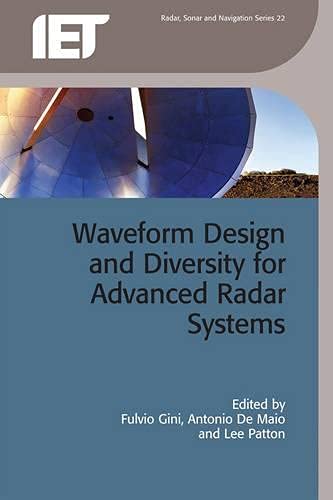
Ebook Info
- Published: 2012
- Number of pages: 576 pages
- Format: PDF
- File Size: 14.68 MB
- Authors: Fulvio Gini
Description
The phrase ‘waveform design and diversity’ refers to an area of radar research that focuses on novel transmission strategies as a way to improve performance in a variety of civil, defense and homeland security applications. Three basic principles are at the core of waveform diversity. First is the principle that any and all knowledge of the operational environment should be exploited in system design and operation. Second is the principle of the fully adaptive system, that is, that the system should respond to dynamic environmental conditions. Third is the principle of measurement diversity as a way to increase system robustness and expand the design trade space. Waveform design and diversity concepts can be found dating back to the mid-twentieth century. However, it has only been in the past decade or so, as academics and practitioners have rushed to exploit recent advances in radar hardware component technology, such as arbitrary waveform generation and linear power amplification, that waveform diversity has become a distinct area of research. The purpose of this book is to survey this burgeoning field in a way that brings together the diverse yet complementary topics that comprise it. The topics covered range from the purely theoretical to the applied, and the treatment of these topics ranges from tutorial explanation to forward-looking research discussions. The topics treated in this book include: classical waveform design and its extensions through information theory, multiple-input multiple-output systems, and the bio-inspired sensing perspective; the exploration of measurement diversity through distributed radar systems, in both cooperative and non-cooperative configurations; the optimal adaptation of the transmit waveform for target detection, tracking, and identification; and more. This representative cross-section of topics provides the reader with a chance to see the three principles of waveform diversity at work, and will hopefully point the way to further advances in this exciting area of research.
User’s Reviews
Editorial Reviews: About the Author Fulvio Gini is Full Professor at the University of Pisa. His research interests include modeling and statistical analysis of radar clutter data, non-Gaussian signal detection and estimation, parameter estimation and data extraction from multichannel interferometric SAR data.Antonio De Maio is an Associate Professor at the University of Naples ‘Federico II’. His research interest lies in the field of statistical signal processing, with emphasis on radar detection and optimization theory applied to radar signal processing.Lee Patton is a Senior Research Engineer with Matrix Research, Inc. His research interests include radar signal processing and system design, with a special emphasis on waveform diversity and design.
Reviews from Amazon users which were colected at the time this book was published on the website:
⭐Every radar design book from Skolnik on down treats the design and analysis of radar waveforms. These days waveforms are everything, as radars have nearly exhausted to parameters of power and duty cycle in trying to achieve improvements in range, Doppler capability, resolution, and reduced false-alarm rate. So what is left to improve lies mainly in the realm of mathematics. It goes over the basics of various types of pulse coding, adds an information-theory approach, and treats multi-static and passive bi-static geometries. Then it takes an interesting tour through biological radar systems (which are surprisingly sophisticated), followed by a thorough treatment of auto radar sonar systems. Then back to sophisticated approaches to pulse compression, space-time diversity, waveform performance in target classification and tracking. Finally there is a discussion of signal-dependent clutter, and how to optimize the receiver for it. This British IET book is written by various authors, so the treatment is slightly uneven, but in general the level of treatment is high.
⭐
Keywords
Free Download Waveform Design and Diversity for Advanced Radar Systems (Radar, Sonar and Navigation) in PDF format
Waveform Design and Diversity for Advanced Radar Systems (Radar, Sonar and Navigation) PDF Free Download
Download Waveform Design and Diversity for Advanced Radar Systems (Radar, Sonar and Navigation) 2012 PDF Free
Waveform Design and Diversity for Advanced Radar Systems (Radar, Sonar and Navigation) 2012 PDF Free Download
Download Waveform Design and Diversity for Advanced Radar Systems (Radar, Sonar and Navigation) PDF
Free Download Ebook Waveform Design and Diversity for Advanced Radar Systems (Radar, Sonar and Navigation)