

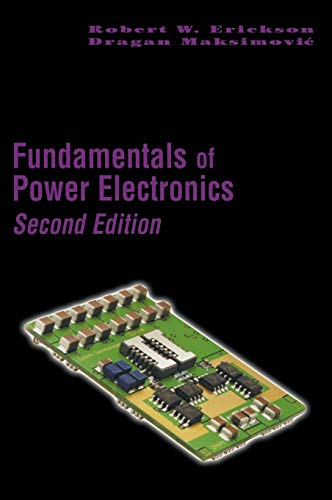
Ebook Info
- Published: 2001
- Number of pages: 904 pages
- Format: PDF
- File Size: 69.10 MB
- Authors: Robert W. Erickson
Description
Fundamentals of Power Electronics, Second Edition, is an up-to-date and authoritative text and reference book on power electronics. This new edition retains the original objective and philosophy of focusing on the fundamental principles, models, and technical requirements needed for designing practical power electronic systems while adding a wealth of new material. Improved features of this new edition include: A new chapter on input filters, showing how to design single and multiple section filters; Major revisions of material on averaged switch modeling, low-harmonic rectifiers, and the chapter on AC modeling of the discontinuous conduction mode; New material on soft switching, active-clamp snubbers, zero-voltage transition full-bridge converter, and auxiliary resonant commutated pole. Also, new sections on design of multiple-winding magnetic and resonant inverter design; Additional appendices on Computer Simulation of Converters using averaged switch modeling, and Middlebrook’s Extra Element Theorem, including four tutorial examples; and Expanded treatment of current programmed control with complete results for basic converters, and much more. This edition includes many new examples, illustrations, and exercises to guide students and professionals through the intricacies of power electronics design. Fundamentals of Power Electronics, Second Edition, is intended for use in introductory power electronics courses and related fields for both senior undergraduates and first-year graduate students interested in converter circuits and electronics, control systems, and magnetic and power systems. It will also be an invaluable reference for professionals working in power electronics, power conversion, and analogue and digital electronics.
User’s Reviews
Reviews from Amazon users which were colected at the time this book was published on the website:
⭐The content is presented in a clear and well-paced manner. But the digital download has some noticeable flaws that may bother many of you. My overall experience is a good one, however. The authors start off by explaining everything you need to know in order to understand the equations. They start out simple and build-up in greater complexity as you progress through the material. This area of engineering is fairly broad and they do a good job of breaking up the content; it’s well organized, too. I give then five stars; great job people! But I can’t say the same for the people responsible for creating the digital version. The digital download has too many flaws to keep count of: the subscripts sometimes are wrong or there is a large amount of space between the letters of a subscript; some words appear like Cuk and there are large amounts of space between words in places; and the font is too large. If you want to save time and money and you’re tolerant like me then this might be your best bet to get a handle on this sub-discipline of electrical engineering. If you are a student and just starting out in electrical engineering I wouldn’t recommend this book. You may become frustrated and waste your time and money. You should know basic circuit analysis, some theory behind electronic devices, electromagnetics, and understand some basic techniques like network analysis and the per-unit system / transformer turns-ratio elimination. And for those with no electrical engineering background I’d avoid this one unless you’re exceptionally driven and self-motivated. I gave four stars because the authors, not Amazon, deserve a good rating on their work. The book is a great and interesting read; it’s easily digested if you have the background.
⭐I have several power electronics textbooks, and this is the best book I’ve found to use as a reference. I have also used Krein’s book, which is a good introduction if you’re taking his class at UIUC, but not as useful for reference.This book really takes you through all the main topics with pretty thorough coverage. At CU it’s used for several courses, so it’s more than just an introductory book. The first few chapters cover the basics, and then it gets into the more advanced topics (which are more practical for reference once you have learned the basics). I’m now taking those courses online and finding that Erickson follows his book pretty closely, so you get the added benefit of seeing it all twice whether you are a visual or audio learner.I was impressed that he devoted about 100 pages to magnetics design, which is really helpful. Not the same as having McLyman’s book, but it will do if just need a fairly straight-forward inductor or transformer designed.Bottom line: I already have this book and am considering buying another copy to have one at home and the other at the office.
⭐Fundamentals of Power Electronics (2nd Ed) is one of the most readable engineering texts I’ve ever come across. This text was required for a power electronics graduate course. The course covered about 80% of the book. Given it’s 850+ pages, I expected that I’d be skimming most of it to pick out the important topics as fast as I could, but I ended up reading every page. The topics are presented in a clear concise manner, and the references are very useful. If you’ve been out of school for a while like I have, you may want to peruse an introductory circuit theory text first. Though, I found that I only had to reference the basics once or twice while reading this book. Keep in mind that while this text does touch on some “practical” points (specifying components, for example), it is primarily an introductory text on the theory of switching converters. My only complaint is that within the first month of owning this book, the binding ripped, and so I had to glue/tape it back together. But the content is outstanding (provided you’re looking for a text book on the theory of switching converters).
⭐NOTE: I have only completed the first 6 of 20 chapters in this book, but I will give my review based on my experience so far.As a graduate student in Electric Power Engineering, this is one of the best books I have purchased in all of my university studies. As long as you have taken an introductory circuits course in your undergraduate curriculum, Dr. Erickson does a great job at explaining power electronics in a way that anyone can understand. I have been assigned books in many of my classes that contain poor explanations/example problems, unorganized structure, or even missing material that is vital to understanding the subject. However, this is not one of those textbooks. Although my current professor does a phenomenal job at teaching the material, I honestly feel that I could fully understand the course material by only reading this textbook. For me, as someone who prefers learning in-lecture, this is a rare instance. Do not hesitate to purchase this textbook!
⭐The print quality is terrible, and mine arrived slightly damaged. The author’s own website suggests the copies being sold on Amazon may be illegal copyright violating rip-offs, so I would suggest purchasing directly from the academic publisher listed on the author’s website.
⭐The book was a bit crumble in corners.
⭐Goes over the basics and mentions the more interesting topics as well. Far above most textbooks on Power Electronics in terms of content and writing in my opinion.Just be careful of the binding under heavy use. Although I’ve had no problems up till now, it does not inspire the most confidence.
⭐This book explains right from the basics to the control system differential equations for different converters. It is written in a lucid manner.If you are a power electronics fan or are into designing power electronic stuff, then just grab a copy without a second thought!The print quality of “equations” is just average, rest of the text is is fine.
⭐This is a simply awesome book by Dr Robert Erickson if you are a student wanting to have an in-depth knowledge of Power Electronics. There are many essential topics which are very clearly explained making understanding very easy. I would highly recommend this book if you want to know more about Power Electronics !!
Keywords
Free Download Fundamentals of Power Electronics 2nd Edition in PDF format
Fundamentals of Power Electronics 2nd Edition PDF Free Download
Download Fundamentals of Power Electronics 2nd Edition 2001 PDF Free
Fundamentals of Power Electronics 2nd Edition 2001 PDF Free Download
Download Fundamentals of Power Electronics 2nd Edition PDF
Free Download Ebook Fundamentals of Power Electronics 2nd Edition