

Ebook Info
- Published: 2020
- Number of pages: 798 pages
- Format: PDF
- File Size: 11.84 MB
- Authors: Michael Margolis
Description
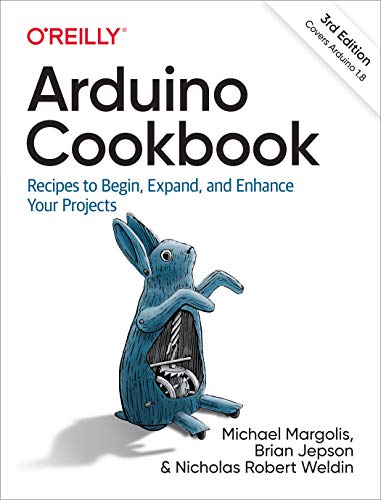
Want to create devices that interact with the physical world? This cookbook is perfect for anyone who wants to experiment with the popular Arduino microcontroller and programming environment. You’ll find more than 200 tips and techniques for building a variety of objects and prototypes such as IoT solutions, environmental monitors, location and position-aware systems, and products that can respond to touch, sound, heat, and light.Updated for the Arduino 1.8 release, the recipes in this third edition include practical examples and guidance to help you begin, expand, and enhance your projects right away—whether you’re an engineer, designer, artist, student, or hobbyist.Get up to speed on the Arduino board and essential software concepts quicklyLearn basic techniques for reading digital and analog signalsUse Arduino with a variety of popular input devices and sensorsDrive visual displays, generate sound, and control several types of motorsConnect Arduino to wired and wireless networksLearn techniques for handling time delays and time measurementApply advanced coding and memory-handling techniques
User’s Reviews
Editorial Reviews: About the Author Michael Margolis is a technologist in the field of real time computing with expertise in developing and delivering hardware and software for interacting with the environment. He has more than 30 years of experience at senior levels with Sony, Microsoft, and Lucent/Bell Labs. He has written libraries and core software that are part of the official Arduino 1.0 distribution.Brian Jepson is a content manager at LinkedIn Learning, where he manages design and engineering courses. He is also the co-organizer of Providence Geeks, a founding member of the National Maker Faire planning and production team, and coproducer of the Providence Mini Maker Faire. He shares and spreads knowledge of electronics and digital fabrication through hands-on events and workshops, working closely with AS220, a nonprofit community arts center, and with the Rhode Island Computer Museum (both Rhode Island-based nonprofits).Nick works at the Rix Centre based at the University of East London, looking into technology that may help people with learning difficulties to get involved in what is happening online and on the computer in front of them. He is also Senior Technologist for Tinker It! working on various technology projects, often related to Arduino, an open-source electronics prototyping platform based on flexible, easy-to-use hardware and software. Other projects include work with Paddington Arts, Oily Cart Theatre Company and Deafinitely Theatre.
Reviews from Amazon users which were colected at the time this book was published on the website:
⭐I have reviewed dozens if not hundreds of Arduino titles (not kidding, I really have). And this is one of the two books I purchased. This is one is a cut above all the rest. If you have only a little room on your bookshelf or budget for only a small number of Arduino books — make this one of them.
⭐I can’t say enough good things about this book. It’s well written, very informative but not overwhelming. Yes, there are thousands of guides and tutorials online for free but unless you understand the basics you’ll quickly become overwhelmed just using internet tutorials. Start here and save yourself a lot of frustration.
⭐I was expecting just a list of fun Arduino projects, but this book focuses on what’s happening “under the covers” — how the Arduino IDE works, finer points of how you should code for Arduinos, how to debug various issues, how the compilation/build process works, etc. A MUCH BETTER BOOK than I hoped for. It’s also very well written. I got the Kindle version.
⭐Amazing. Definitely a MUST READ
⭐Product keeps it clear and concise as to what you’re having issues achieving with an Arduino and presents a simple solution to achieve your desired output. I’ll be on the lookout for other “cookbook” related programming books in the hopes they keep the same format.
⭐This is my second book of the same title. I gave my original to my son so that he and my grandson can learn and enjoy the Arduino platform as much as I do. The book has easy to understand projects as well as serving as a reliable reference with examples.
⭐I have been working with Arduino for many years. This book was recommended to me by another engineer and am very pleased with it. You think you know a product but going through a book like this really opens up many new ideas of functions and projects I never had thought of. A good book to have access to.
⭐This is the best “cookbook” yet. I read one of the first “cookbooks” TTL cookbook and loved it (45 years ago) and have read many since. No disappoints in any but this is the best so far. I am new to arduino and could not have found a better text to jumpstart me into the power of the platform. right topics, good examples, well written, practical with the right amount of theory.
⭐Good range of projects and tutorials, clearly explained – Recommended…
⭐Excellent book, bought after completing the arduino starter kit, it’s just the right level for a beginner/newbie. It gives you all the tools to start building.
⭐Creo que este libro está dirigido a un usuario intermedio de arduino. No tiene fotos si no que muestra los diagramas del circuito. Esto puede ser más complicado para alguien que se inicia de cero. Es como un libro de recetas, donde encuentras soluciones para muchos de los problemas o dudas que te puedes encontrar al trabajar con arduino, desde los mas sencillos a los mas complicados. Un libro grueso, que abarca multitud de temas de una manera clara.
⭐
⭐Parmi les meilleurs livres sur Arduino dans une collection connue pour son professionnalisme.La bible 😉 dans un anglais – certes technique – mais accessible à toute personne ayant côtoyé la langue.Quelques erreurs vite corrigées : consultez cependant le site Errata de O’Reilly éditions et la page dédiée(Recherche = “o’reilly errata arduino cookbook isbn=0636920033653”)Les auteurs sont très réactifs et vous pouvez trouver les corrections soit sur le site errata, soit – si nécessaire sur github (avec les exemples du livre).(Recherche = “github arduino cookbook 3rd”)La seule chose qui manque – AMHA – est un chapitre plus complet (4.13 = 8 pages) dédié aux échanges Arduino -Raspberry Pi tel que l’on peut le trouver dans le “Raspberry Pi Cookbook” de Simon Monk.Perfectible sur le chapitre IIC : n’aborde pas les aspects “multi-master” ni l’IIC ‘logique’ (programmation sur des pins #) et pourrait indiquer (in “3.3-volt devices with 5-volt board”) en sus de la connexion via un “logic level translator” la technique utilisant directement des résistances.Un exemple d’utilisation conjointe des modes SPI et I2C aurait été un plus.Note : j’avais antérieurement acquis la seconde édition (2013), mais la 3e (2020) est encore plus complète.En particulier, aborde les modules ESP (chapitre WiFi and Internet)À recommander fortement. Un must.4* : ” J’aime beaucoup”
⭐
⭐Almost all Arduino books are for beginners but this book goes into depth for many advanced concepts of programming.It’s a must to anyone that want to push one step further their Arduino knowledge.
Keywords
Free Download Arduino Cookbook: Recipes to Begin, Expand, and Enhance Your Projects 3rd Edition in PDF format
Arduino Cookbook: Recipes to Begin, Expand, and Enhance Your Projects 3rd Edition PDF Free Download
Download Arduino Cookbook: Recipes to Begin, Expand, and Enhance Your Projects 3rd Edition 2020 PDF Free
Arduino Cookbook: Recipes to Begin, Expand, and Enhance Your Projects 3rd Edition 2020 PDF Free Download
Download Arduino Cookbook: Recipes to Begin, Expand, and Enhance Your Projects 3rd Edition PDF
Free Download Ebook Arduino Cookbook: Recipes to Begin, Expand, and Enhance Your Projects 3rd Edition