

Ebook Info
- Published: 2008
- Number of pages: 1543 pages
- Format: PDF
- File Size: 17.02 MB
- Authors: Ulrich Tietze
Description
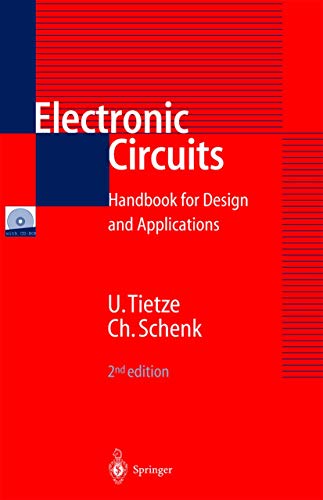
Electronic Circuits covers all important aspects and applications of modern analog and digital circuit design. The basics, such as analog and digital circuits, on operational amplifiers, combinatorial and sequential logic and memories, are treated in Part I, while Part II deals with applications. Each chapter offers solutions that enable the reader to understand ready-made circuits or to proceed quickly from an idea to a working circuit, and always illustrated by an example. Analog applications cover such topics as analog computing circuits. The digital sections deal with AD and DA conversion, digital computing circuits, microprocessors and digital filters. This editions contains the basic electronics for mobile communications. The accompanying CD-ROM contains PSPICE software, an analog-circuit-simulation package, plus simulation examples and model libraries related to the book topics.
User’s Reviews
Editorial Reviews: Review From the reviews”An enormously successful (also translated into five other languages), comprehensive and practical text for students, engineers, and scientists that covers all important aspects and applications of analog and digital circuit design, emphasizing the most modern integrated circuits.” SciTech Book NewsFrom the reviews of the second edition:”Tietze (Univ. of Erlangen, Germany) and colleagues have written … one of the most extensive resources on electronics available. … This volume can be used for academic course work and as a reference for engineers … . Summing Up: Highly recommended. Upper-division undergraduate through professional collections.” (S. T. Karris, Choice, Vol. 46 (2), October, 2008)”This book was written for anybody who needs to understand or use electronic circuits. … it will help you to understand everything originating from electronics. … The book is accompanied by a CD, which contains simulations in PSPICE of many design examples. This book can fill the immediate needs of a university or research laboratory. I recommended that students, Ph.D.s and even researchers peruse these pages.” (Mircea Dragoman, Optics and Photonics News, July/August, 2009) Review From the Back Cover This book is written for students, practicing engineers and scientists. It covers all important aspects of analog and digital circuit design. Part I describes semiconductor devices and their behavior with respect to the models used in circuit simulation. Basic analog circuits are analyzed in four steps: large-signal transfer characteristic, small-signal response, noise and distortion. The treatment of digital circuits starts with the internal circuitry of logic gates and continues with combinatorial and sequential circuit design.Part II describes low frequency circuit design in various applications using operational amplifiers. The circuitry of A/D and D/A converters and their use in different signal sampling scenarios are considered. This part also presents the theory and design of analog and digital filters.Part III describes circuits for analog and digital communications over wireless channels. It includes comprehensive background information in terms of analog and digital modulations, radio frequency transmitters and receivers. The high-frequency behavior of passive components and the design of high-frequency filters, matching circuits, amplifiers and mixers are presented.The accompanying CD-ROM contains data sheets and simulation software. For analog circuit design the PSpice simulation suite, a tutorial and various examples are provided. This handbook and CD package offers a uniquely comprehensive and authoritative self-learning and reference resource. About the Author Read more
Reviews from Amazon users which were colected at the time this book was published on the website:
⭐Nothing compares with this book. 100% German science!!!
⭐I have the German 2002 Edition – it’s not presented by the editor as a handbook and rather as a textbook without exrcises and its direct translation is “Semiconductor Circuit Technique”. My take is that the English edition closely resembles it, and these comments are based on the German text (2002). In a nutshell this is the best book on Electronics that I have come to know and will forever remain a classic in its subject area.This book is by far the most extensive text on Electronics and probably also the most complete in terms of subjects covered. It can be used as a textbook and as a reference for electrical engineers who need information to substantiate their projects with a solid engineering background.The amount and the depth of “science” and math used is just right – not overly rigorous and not watered down, something quite common with books that address the same areas covered by this one. Make no mistake – this is not a text for someone who is lookingg for recipes. It’s written for engineers with a solid background and for students who are serious about learning.It’s almost criminal that the editor did not bother to list the contents of this book. After all it has more than 1500 pages using medium-small font and you would expect that its size and its price had better show its worth. You will not be deceived – every single page is worth its use (except for a few ones in the appendix that list basic data on some selected components and semiconductor manufacturers). Here is a brief description of the areas it covers:1. Fundamentals: 10 chapters (711 pages) on diodes, transistors (BJTs), FETs, Amplifiers (discrete, integrated), switches, basic digital circuits / building blocks, digital logic (combinatorial, sequential), memory cells, etc2. Applications: 13 chapters (about 420 pages) on linear / non-linear analog computer circuitry, impedance converters, voltag/current sources,active filters, signal generators, power amplifiers, power generation / supplies, signal generators, AD / DA converters, digital filters, metering circuitry, voltage / current regulators, optoelectronics, sensor interfacing (“Sensorik”), etc3. Communications: 5 chapters (about 420 pages) covering fundamentlas (theoretical introduction to basic topics such as transmition channels, S-parameters, modulation / demodulation), transmitters / receivers, mixers, passive components and their high-frequency models, high-freq amplifiers,, etcThe appendix contains an quite comprehensive introduction to P-Spice programming and RLC networks plus some additional information on components which I think could be omitted to make the physical volume a little less bulky.Overall I think that if one were to have a single book on electronic circuit design, this would be the one without a doubt.
⭐It was recommended by a friend. He had the german version. The english one is equally good. I recommend as a reference point in electronic design
⭐
⭐
⭐
Keywords
Free Download Electronic Circuits: Handbook for Design and Application 2nd Edition in PDF format
Electronic Circuits: Handbook for Design and Application 2nd Edition PDF Free Download
Download Electronic Circuits: Handbook for Design and Application 2nd Edition 2008 PDF Free
Electronic Circuits: Handbook for Design and Application 2nd Edition 2008 PDF Free Download
Download Electronic Circuits: Handbook for Design and Application 2nd Edition PDF
Free Download Ebook Electronic Circuits: Handbook for Design and Application 2nd Edition