

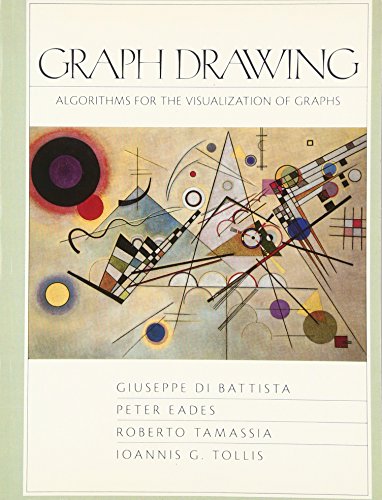
Ebook Info
- Published: 1998
- Number of pages: 416 pages
- Format: PDF
- File Size: 9.20 MB
- Authors: Ioannis G. Tollis
Description
This book is designed to describe fundamental algorithmic techniques for constructing drawings of graphs. Suitable as a book or reference manual, its chapters offer an accurate, accessible reflection of the rapidly expanding field of graph drawing.
User’s Reviews
Editorial Reviews: From the Back Cover This book is designed to describe fundamental algorithmic techniques for constructing drawings of graphs. Suitable as a book or reference manual, its chapters offer an accurate, accessible reflection of the rapidly expanding field of graph drawing.
Reviews from Amazon users which were colected at the time this book was published on the website:
⭐In other reviews I saw that the book is too mathematical and difficult to understand. I cannot share this point of view. For me it was possible to understand what authors wanted to say. Yes, this book does not contain any pseudo code. It covers mathematical background of the presented algorithms.
⭐The book has a solid theoretical explanation of most of the popular graph drawing algorithms. So, if you want an explanation of these algorithms from a mathematical point of view, this book is for you.If you are like me, and want to approach these problems from an ‘algorithmic’ viewpoint. I.e I want to know how to write planarization, Orthogonal layout algorithms… This book will disappoint you big time…Most of the algorithms are presented in a mathematical form (not a psuedocode form).. It is a huge leap to convert algorithms in this book to code.Overall, I rate this book a 3 because, it is the ONLY book on this subject. Therefore, I cant compare it with anything else.My advice is :- math major = BUY, computer major = PASS, after all this book is not cheap –
⭐I’m giving this book 4 stars only because it is dramatically better than the other books that are available on this topic. If there were better competition I would give it 3 stars since it has a range of flaws. The major flaw has been mentioned by other reviewers; it gives only terse and highly mathematical descriptions of the algorithms and the effort to convert anything in this book into an actual algorithm is huge. However on the plus side, the book is mostly well written and is actually much *less* mathematical than almost every other book on the topic. Most other planar graph drawing books just lay down some formulas and assume implementation is obvious (very far from true in this topic). However, this book does at least give a nod to the algorithm side and lays out a general framework for an implementation of most of the important layout types. The book also gives a strong foundation for almost the entire field; probably because the authors represent some of the strongest contributors to this field. So the bottom line is that, as of today you almost have to buy this book if you want to work on this type of software since no other book comes close to explaining as much and does it as well as this book.
⭐This graph drawing book is, according to my lecturer, one of the few books on this subject. There is a different book too, written by some japanese authors. The drawback of the latter book is that it is too technical sometimes, while this book discusses intuitively understandable algorithms.But, there are also some major drawbacks concerning this book. Not all chapters are equally good: some are horrible to read while others are very understandable.Furthermore, the book is not printed anymore, so you just purchase a black-and-white copy of the original book with some fancy cover. Since the book is just copied, some pictures do not look like the way they should and one picture isn’t shown at all. This results in some difficulties understanding the pictures and discussed material. I purchased one of the cheaper variants of the book, maybe the more expensive ones are printed versions.Also, the book is absolutely not free of mistakes!To conclude: the book is probably OK for understanding the basics of graph drawing, considering what’s for sale. But beware of the drawbacks of this book and use it with care.
⭐Worth reading, if a little dated now. These guys all know their stuff, as one would expect from such distinguished writers in the field. Can’t wait for the second edition.
⭐To me the book is not useful, because I need to draw graphs in which the distance between two connected vertices is fixed. The book doesn’t mention any method to handle graphs with such a restriction, although the chapter on force-directed methods inspired me to use something similar. If you draw graphs without that restriction, the book might be useful to you – that’s why I’m careful and give it 4 stars.I disagree with Viv. R who said it doesn’t contain pseudo code, because the book contains quite some of it, though not in every chapter. But even lack of pseudo code doesn’t bother me, because for an experienced mathematical programmer that should be no problem.
Keywords
Free Download Graph Drawing: Algorithms for the Visualization of Graphs 1st Edition in PDF format
Graph Drawing: Algorithms for the Visualization of Graphs 1st Edition PDF Free Download
Download Graph Drawing: Algorithms for the Visualization of Graphs 1st Edition 1998 PDF Free
Graph Drawing: Algorithms for the Visualization of Graphs 1st Edition 1998 PDF Free Download
Download Graph Drawing: Algorithms for the Visualization of Graphs 1st Edition PDF
Free Download Ebook Graph Drawing: Algorithms for the Visualization of Graphs 1st Edition