

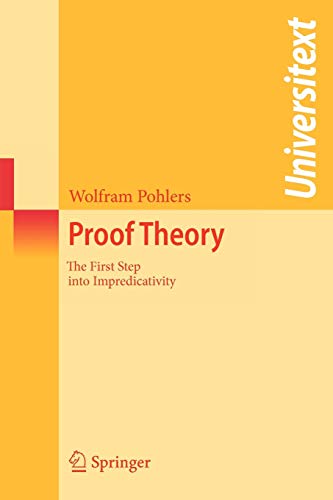
Ebook Info
- Published: 2008
- Number of pages: 388 pages
- Format: PDF
- File Size: 3.42 MB
- Authors: Wolfram Pohlers
Description
The kernel of this book consists of a series of lectures on in?nitary proof theory which I gave during my time at the Westfalische ¨ Wilhelms–Universitat ¨ in Munster ¨ . It was planned as a successor of Springer Lecture Notes in Mathematics 1407. H- ever, when preparing it, I decided to also include material which has not been treated in SLN 1407. Since the appearance of SLN 1407 many innovations in the area of – dinal analysis have taken place. Just to mention those of them which are addressed in this book: Buchholz simpli?ed local predicativity by the invention of operator controlled derivations (cf. Chapter 9, Chapter 11); Weiermann detected applications of methods of impredicative proof theory to the characterization of the provable recursive functions of predicative theories (cf. Chapter 10); Beckmann improved Gentzen’s boundedness theorem (which appears as Stage Theorem (Theorem 6. 6. 1) in this book) to Theorem 6. 6. 9, a theorem which is very satisfying in itself – though its real importance lies in the ordinal analysis of systems, weaker than those treated here. Besides these innovations I also decided to include the analysis of the theory (? –REF) as an example of a subtheory of set theory whose ordinal analysis only 2 0 requires a ?rst step into impredicativity. The ordinal analysis of(? –FXP) of non- 0 1 0 monotone? –de?nable inductive de?nitions in Chapter 13 is an application of the 1 analysis of(? –REF).
User’s Reviews
Editorial Reviews: Review From the reviews:”Proof Theory takes various axiom systems … that treat induction in different ways and analyzes them from the ordinal viewpoint to gauge their relative strengths. … This new version includes several developments in the field that have occurred over the twenty years since the original. Although the current book, appearing in the Universitext series, claims to be ‘pitched at undergraduate/graduate level,’ an undergraduate course out of Proof theory would be ambitious indeed.” (Leon Harkleroad, The Mathematical Association of America, March, 2009)”The book is addressed primarily to students of mathematical logic interested in the basics of proof theory, and it can be used both for introductory and advanced courses in proof theory. … this book may be recommended to a larger circle of readers interested in proof theory.” (Branislav Boricic, Zentrablatt MATH, Vol. 1153, 2009) “This is a textbook―an excellent one―on proof theory, starting from the very elementary (heuristic accounts of sets, ordinals, logic, etc.), and going into a sophisticated area (impredicativity). … The author’s main tool is enquiry into truth complexity and ordinal analysis.” (M. Yasuhara, Mathematical Reviews, Issue 2010 a) From the Back Cover This book verifies with compelling evidence the author’s intent to “write a book on proof theory that needs no previous knowledge of proof theory”. Avoiding the cryptic terminology of proof theory as far as possible, the book starts at an elementary level and displays the connections between infinitary proof theory and generalized recursion theory, especially the theory of inductive definitions. As a “warm up” Gentzen’s classical analysis of pure number theory is presented in a more modern terminology, followed by an explanation and proof of the famous result of Feferman and Schütte on the limits of predicativity. The author also provides an introduction to ordinal arithmetic, introduces the Veblen hierarchy and employs these functions to design an ordinal notation system for the ordinals below Epsilon 0 and Gamma 0, while emphasizing the first step into impredicativity, that is, the first step beyond Gamma 0. This is first done by an analysis of the theory of non-iterated inductive definitions using Buchholz’s improvement of local predicativity, followed by Weiermann’s observation that Buchholz’s method can also be used for predicative theories to characterize their provably recursive functions. A second example presents an ordinal analysis of the theory of $/Pi_2$ reflection, a subsystem of set theory that is proof-theoretically equivalent to Kripke-Platek set.The book is pitched at undergraduate/graduate level, and thus addressed to students of mathematical logic interested in the basics of proof theory. It can be used for introductory as well as more advanced courses in proof theory. An earlier version of this book was published in 1989 as volume 1407 of the “Lecture Notes in Mathematics” (ISBN 978-3-540-51842-6). About the Author Wolfram Pohlers (born 1943) is Full Professor and Director of the Institute for Mathematical Logic and Foundational Resarch at the Westfälische Wilhelms-Universität in Münster, Germany. He received his scientific training at the University of Munich where he worked as an Associate Professor from 1980 to 1985. From 1989 to 1990 he was a visiting scholar at the MSRI in Berkley and in 2005 he taught at the Ohio State University in Columbus. Read more
Reviews from Amazon users which were colected at the time this book was published on the website:
⭐This book seems to be organized as a direct, self-contained approach to ordinal analysis as needed for impredicative theories. Unfortunately, the approach is so direct that much valuable information has been lost: there is very little motivation, explanation what the goals are, or coverage of related topics. I had a very hard time reading this book compared to other texts. Unless there is a particular ordinal analysis in this book you can’t find elsewhere, I would recommend using other texts instead of this.
⭐Pohlers’s book is supposed to be an introductory text on proof theory, with a focus on ordinal analysis. I’m glad he wrote this in the preface, because I’m not sure I’d know what the book was about otherwise. Almost nothing in the book is motivated, thus providing the reader with a sequence of definitions and theorems with very little context.The ordinal analysis of Peano Arithmetic is exemplary. The chapter is motivated with “This sections repeats Gentzen’s ordinal analysis for arithmetic as a paradigmatic example for an ordinal analysis.” Full stop. After defining PA and a definitional extension NT, the book proceeds with the proof of the upper bound, beginning, of course, with a lemma with no context– indeed, the first words are “We start this section by a simple observation.” This is followed immediately by a key theorem. Almost two pages into the section, the first bit of motivation is provided: exactly 8 simple sentences describing the structure of the subsequent proof. This is just over 1 sentence per page of the proof (~7 pages). Considering that Gentzen’s proof is so beautiful, so deep, and more importantly, not at all obvious, a measly 8 sentence description won’t cut it for an introductory text.Ah, so the book fails to be an introductory text, but perhaps is a good reference with no extra fluff? Nope. Things are defined in multiple places, some things are left undefined, and definitions are circuitous. Theorems and lemmas are often stated in an obtuse way, leaving the reader to wonder whether there’s a cleaner way to state the same things. There often is. In proofs, some key details are skipped as obvious (or skipped until 3 chapters later), while some obvious observations are proved at length.At the end of the day, I got much less out of reading this text than looking at my own incomplete, chaotic classnotes. There is, however, one redeeming quality: the exercises are quite good, and will help with key insights so long as you have another source to develop the theory.
⭐
Keywords
Free Download Proof Theory: The First Step into Impredicativity (Universitext) in PDF format
Proof Theory: The First Step into Impredicativity (Universitext) PDF Free Download
Download Proof Theory: The First Step into Impredicativity (Universitext) 2008 PDF Free
Proof Theory: The First Step into Impredicativity (Universitext) 2008 PDF Free Download
Download Proof Theory: The First Step into Impredicativity (Universitext) PDF
Free Download Ebook Proof Theory: The First Step into Impredicativity (Universitext)