Ebook Info
- Published: 1999
- Number of pages: 94 pages
- Format: PDF
- File Size: 13.43 MB
- Authors: David P. Blecher
Description
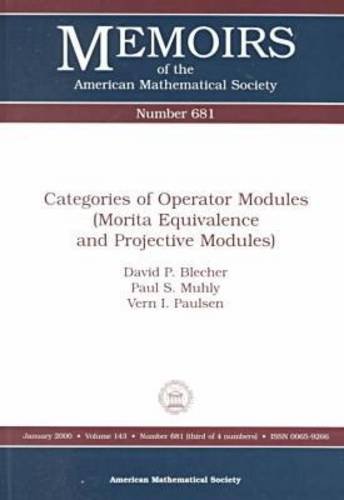
We employ recent advances in the theory of operator spaces, also known as quantized functional analysis, to provide a context in which one can compare categories of modules over operator algebras that are not necessarily self-adjoint. We focus our attention on the category of Hilbert modules over an operator algebra and on the category of operator modules over an operator algebra. The module operations are assumed to be completely bounded – usually, completely contractive. We develop the notion of a Morita context between two operator algebras $A$ and $B$. This is a system $(A,B,AXB,B YA,(cdot,cdot),[cdot,cdot])$ consisting of the algebras, two bimodules $AXB$ and $BYA$ and pairings $(cdot,cdot)$ and $[cdot,cdot]$ that induce (complete) isomorphisms between the (balanced) Haagerup tensor products, $X otimeshB Y$ and $Y otimeshA X$, and the algebras, $A$ and $B$, respectively.Thus, formally, a Morita context is the same as that which appears in pure ring theory. The subtleties of the theory lie in the interplay between the pure algebra and the operator space geometry. Our analysis leads to viable notions of projective operator modules and dual operator modules. We show that two C$*$-algebras are Morita equivalent in our sense if and only if they are $Cast$-algebraically strong Morita equivalent, and moreover the equivalence bimodules are the same. The distinctive features of the non-self-adjoint theory are illuminated through a number of examples drawn from complex analysis and the theory of incidence algebras over topological partial orders. Finally, an appendix provides links to the literature that developed since this Memoir was accepted for publication.
User’s Reviews
Reviews from Amazon users which were colected at the time this book was published on the website:
⭐This is a lovely little book. While the subject may be relatively specialized within mathematics, the presentation in the book is lively, and the book is likely to engage readers who are generally interested in math,– even if they might not, at the outset, recognize the words in the title of the book. And readers who are not already familiar with the subject, are likely to be surprised by the universality, the beauty, and power of the underlying idea. If they thought at first that the writing might be dry, they will instead find a page-turner (–at least relative to other specialized math books). The present authors do take great care in explaining the ideas in plain English. The co-authors are all masterful expositors who engage their readers. They are equally engaging and popular as speakers at confernces and workshops in mathematics.
⭐
⭐
⭐
⭐
⭐
⭐
Keywords
Free Download Categories of Operator Modules: Morita Equivalence and Projective Modules (Memoirs of the American Mathematical Society) in PDF format
Categories of Operator Modules: Morita Equivalence and Projective Modules (Memoirs of the American Mathematical Society) PDF Free Download
Download Categories of Operator Modules: Morita Equivalence and Projective Modules (Memoirs of the American Mathematical Society) 1999 PDF Free
Categories of Operator Modules: Morita Equivalence and Projective Modules (Memoirs of the American Mathematical Society) 1999 PDF Free Download
Download Categories of Operator Modules: Morita Equivalence and Projective Modules (Memoirs of the American Mathematical Society) PDF
Free Download Ebook Categories of Operator Modules: Morita Equivalence and Projective Modules (Memoirs of the American Mathematical Society)