

Ebook Info
- Published: 1996
- Number of pages: 222 pages
- Format: PDF
- File Size: 10.10 MB
- Authors: Malcolm Adams
Description
“…the text is user friendly to the topics it considers and should be very accessible…Instructors and students of statistical measure theoretic courses will appreciate the numerous informative exercises; helpful hints or solution outlines are given with many of the problems. All in all, the text should make a useful reference for professionals and students.”―The Journal of the American Statistical Association
User’s Reviews
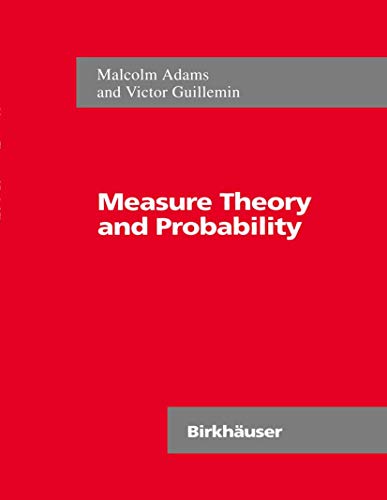
Editorial Reviews: Review “…the text is user friendly to the topics it considers and should be very accessible…Instructors and students of statistical measure theoretic courses will appreciate the numerous informative exercises; helpful hints or solution outlines are given with many of the problems. All in all, the text should make a useful reference for professionals and students.”―The Journal of the American Statistical Association From the Back Cover Measure theory and integration are presented to undergraduates from the perspective of probability theory. The first chapter shows why measure theory is needed for the formulation of problems in probability, and explains why one would have been forced to invent Lebesgue theory (had it not already existed) to contend with the paradoxes of large numbers. The measure-theoretic approach then leads to interesting applications and a range of topics that include the construction of the Lebesgue measure on R [superscript n] (metric space approach), the Borel-Cantelli lemmas, straight measure theory (the Lebesgue integral). Chapter 3 expands on abstract Fourier analysis, Fourier series and the Fourier integral, which have some beautiful probabilistic applications: Polya’s theorem on random walks, Kac’s proof of the Szegö theorem and the central limit theorem. In this concise text, quite a few applications to probability are packed into the exercises.”…the text is user friendly to the topics it considers and should be very accessible…Instructors and students of statistical measure theoretic courses will appreciate the numerous informative exercises; helpful hints or solution outlines are given with many of the problems. All in all, the text should make a useful reference for professionals and students.”―The Journal of the American Statistical Association
Reviews from Amazon users which were colected at the time this book was published on the website:
⭐Great book on measure theory and probability. As stated in the preface to the 1996 edition, this book is roughly 5 parts measure theory to 3 parts probability. Probability is an excellent motivation for measure theory, and if you can get through section 1.3, which the authors describe as “long and arid” in the preface of the first edition, the remainder of the book is less technical and more lively. The level of probability is probably elementary in a measure theoretic context, and serves mostly as motivation for learning measure theory. If you want to learn more than measure theory and the basics of measure theoretic probability (measure theoretic modeling, independence, random variables, expectation values, Law of Large Numbers, Central Limit Theorem), you are probably better served by picking up a different textbook.The book is used as a text in 18.103 (Introduction to Fourier Analysis) at MIT, and assumes a level of preparation equivalent to an undergraduate course on real analysis; at MIT, this preparation is typically the first 8 or so chapters of “baby” Rudin (Principles of Mathematical Analysis). Assuming a strong background in baby Rudin, the problems in this text are fairly straightforward, for the most part, with only a few that are especially challenging. I think the lower degree of difficulty is, in part, due to the excellent exposition in the book, and in part because more difficult problems are usually accompanied by hints.Towards the end of the book (mainly Sections 3.3 and onward), I started to notice typos. Some of these are small, but one or two seemed to materially affect results of exercises; all of them are easy to catch, and barely detract from what is a great textbook.
⭐At first one may think that this book has a lot to do with probability and not that with measure theory or real analysis. In fact, this thinking is not entirely wrong but, at least, is full of prejudice.The main point with this book is its consistency. By this I not only mean rigour or clarity. Most of its exercises are original and all of them can be solved with the theory you’ve developed by reading the book itself.If you want to understand clearly some convergence theorems like Fatou’s Lemma, or Lebesgue Dominated Convergence Theorem, or the Monotone Convergence Theorem, this book will help you a lot.Some people might disagree on the way it focuses measure theory: the development of Lebesgue Measure is only an example of a very general work. Also, it doesn’t follow the classical Caratheodory’s approach. It does not only define what means to a set to be measurable… It constructs the family of measurable sets in a totally intuitive way! (and not only in R, but in the most general case!).Fourier Analysis is not treated very deeply. Although, you will be able to understand and work with lots of stuff (maybe because there are already lots of thing to learn about Fourier stuff).And, talking of probability, I think that this book has a very good balance. I’m not a probability lover at all, and I think that some examples and theorems (The Law of Large Numbers!) are very rich and helpful to understand some stuff that a mathematician must know.I know that there are lots of prestigious real analysis’ books out there, but this little thing worths every dollar.
⭐This book is great. As an undergraduate I did an independent study using this book and learned lots of stuff. The exposition is nicely done and allows for a clear presentation of some very complicated ideas. There are also lots of great examples and applications, which can be really helpful when dealing with something as abstract as measure theory. The exercises mix well with the exposition and contain interesting results. You can learn a great deal from this book without needing to go to lectures, but it does help a lot to be able to ask somebody questions as the material gets quite tricky sometimes.One thing that could have been done better was Polya’s Theorem on random walks. The book didn’t get into what happens in dimensions above 2.It has a great intoduction to Fourier transforms which shows some interesting connections between Fourier series and Probability.This is a great book if you have some time between undergraduate real analysis and graduate real analysis. Also, you can learn this book right after an undergraduate real analysis course so that you can impress your friends by being the first kid on the block to know about cool stuff like “The Discrete Dirchlet Problem” or how to prove the Weierstrauss Approximation Theorem by using the Law of Large Numbers. It’s also cheap.
⭐I’m still in the process of reading it; normally I wait until I’m finished to review a book, but I think sometimes I forget things I dislike/like when I do that. I think this book has an exceptionally pedagogical development of measure theory and Lebesgue integration. It requires much thought to get through, but for me, that was good. I find it difficult to learn new math without being forced to reason things out on my own, so this was expected. Yet, it’s very easy to study and provides interesting examples and exercises.Overall, it’s an effectively concise book that does its subject justice, at least for newcomers.
⭐When I first looked through this book, I thought it was horrible. After looking through it more and more, I got to like it more. It’s not a bad book after all. The book says that it’s for undergraduates, but I think it’s for graduate students. This is the book used most often at URI for graduate measure theory and integration. I think many of the problems in the book are very challenging considering that the explanations in the book are not very detailed. I would rate this book 3 and 1/2 stars if possible, but I gave it four. It’s not the best, but it’s an alright book.
⭐
Keywords
Free Download Measure Theory and Probability (The Wadsworth & Brooks/Cole Mathematics Series) 1996th Edition in PDF format
Measure Theory and Probability (The Wadsworth & Brooks/Cole Mathematics Series) 1996th Edition PDF Free Download
Download Measure Theory and Probability (The Wadsworth & Brooks/Cole Mathematics Series) 1996th Edition 1996 PDF Free
Measure Theory and Probability (The Wadsworth & Brooks/Cole Mathematics Series) 1996th Edition 1996 PDF Free Download
Download Measure Theory and Probability (The Wadsworth & Brooks/Cole Mathematics Series) 1996th Edition PDF
Free Download Ebook Measure Theory and Probability (The Wadsworth & Brooks/Cole Mathematics Series) 1996th Edition