Ebook Info
- Published: 2007
- Number of pages: 304 pages
- Format: PDF
- File Size: 2.03 MB
- Authors: Donal O’Shea
Description
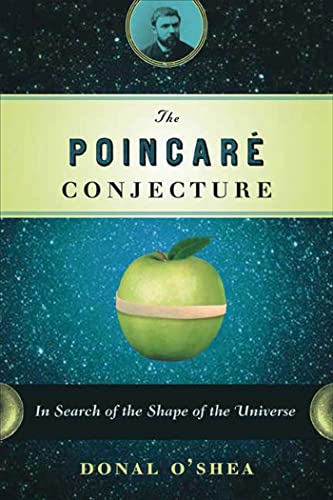
Henri Poincaré was one of the greatest mathematicians of the late nineteenth and early twentieth century. He revolutionized the field of topology, which studies properties of geometric configurations that are unchanged by stretching or twisting. The Poincaré conjecture lies at the heart of modern geometry and topology, and even pertains to the possible shape of the universe. The conjecture states that there is only one shape possible for a finite universe in which every loop can be contracted to a single point. Poincaré’s conjecture is one of the seven “millennium problems” that bring a one-million-dollar award for a solution. Grigory Perelman, a Russian mathematician, has offered a proof that is likely to win the Fields Medal, the mathematical equivalent of a Nobel prize, in August 2006. He also will almost certainly share a Clay Institute millennium award. In telling the vibrant story of The Poincaré Conjecture, Donal O’Shea makes accessible to general readers for the first time the meaning of the conjecture, and brings alive the field of mathematics and the achievements of generations of mathematicians whose work have led to Perelman’s proof of this famous conjecture.
User’s Reviews
Editorial Reviews: From Publishers Weekly The reclusive Russian mathematician Grigory Perelman became a minor media celebrity last summer when he refused the prestigious Fields medal, awarded every four years to a mathematician under the age of 40. Perelman had succeeded in solving the Poincaré conjecture, named for 19th-century French mathematician Henri Poincaré, and which contemporary cosmologists believe has implications for our understanding of the shape of the universe. O’Shea, a professor of mathematics at Mount Holyoke College, begins his account of the long and contentious search for a solution to the puzzle by looking at how we came to understand the shape of the Earth, beginning with the Greeks, in particular Pythagoras and Plato. Writing for generalist science buffs, O’Shea gives a brief course in geometry and in topology and the topological structures called manifolds that are the basis of Poincaré’s puzzle. Inexplicably, however, O’Shea doesn’t give readers a formal statement of the conjecture itself until well into the book. O’Shea describes mind-bending structures in topology as clearly as most of us can describe a cube, but readers will need to do a little Wikipedia-ing first to find out just what it is they’re reading about. Illus. (Mar.) Copyright © Reed Business Information, a division of Reed Elsevier Inc. All rights reserved. From Booklist Euclid’s Elements is historically the most popular mathematics book ever written, but one thing about it nagged its readers: its postulate that every line has exactly one line parallel to it. Doubt about the postulate’s truth is O’Shea’s starting point for this accessible if challenging presentation of a famous problem ultimately rooted in the parallel postulate. The great mathematician Henri Poincare (1854-1912) spent years investigating the implications of non-Euclidian space. Aided by diagrams and analogies, O’Shea, a professional mathematician, explains non-Euclidian spaces, populated by objects technically called manifolds and n-spheres (n means the number of dimensions), which leads to Poincare’s conjecture, verbatim: “Is it possible that the fundamental group of a manifold could be the identity, but that the manifold might not be homeomorphic to the three-dimensional sphere?” Readers defeated by such language, despite O’Shea’s valiant nonnumerical clarity, can yet digest the author’s connection of the conjecture to the shape of the universe, the biographical portraits that animate his text, and the drama of the conjecture’s proof, announced in 2006. Gilbert TaylorCopyright © American Library Association. All rights reserved Review “Donal O’Shea has written a truly marvelous book. Not only does he explain the long-unsolved, beautiful Poincaré conjecture, he also makes clear how the Russian mathematician Grigory Perelman finally solved it. Around this drama O’Shea weaves a tapestry of elementary topology and astonishing concepts, such as the Ricci flow, that have contributed to Perelman’s brilliant achievement. One can’t read The Poincaré Conjecture without an overwhelming awe at the infinite depths and richness of a mathematical realm not made by us.” ―Martin Gardner, author of The Annotated Alice and Aha! Insight“The history of the Poincaré conjecture is the story of one of the most important areas of modern mathematics. Donal O’Shea tells that story in a delightful and informative way–the concepts, the issues, and the people who made everything happen. I recommend it highly.” ―Keith Devlin, Stanford University, author of The Millennium Problems“In The Poincaré Conjecture, Mr. O’Shea tells the fascinating story of this mathematical mystery and its solution by the eccentric Mr. Perelman . . . Mr. O’Shea does a good job of explaining the mathematics involved in solving the conjecture . . . [He] avoids cliché (we’re spared the usual reference to coffee cups turning into doughnuts as an explanation of how surfaces might stretch without closing holes), and he tries to keep things lively.” ―Amir D. Aczel, The Wall Street Journal About the Author Donal O’Shea is professor of mathematics and dean of faculty at Mount Holyoke College. He has written scholarly books and monographs, and his research articles have appeared in numerous journals and collections. He lives in South Hadley, Massachusetts. Read more
Reviews from Amazon users which were colected at the time this book was published on the website:
⭐The Poincare conjecture has been around for over a hundred years but has only occupied the time of a relatively small number of researchers. It was originally stated in the context of three dimensions, but was extended to dimensions four or more a short time later. As the author discusses in this book, proofs of the conjecture in these higher dimensions were discovered a few decades ago, but the original resisted solution until a mathematician named Grigory Perelman posted a list of papers on a preprint server that many mathematicians have held to be a proof of the Geometrization conjecture, which implies the Poincare conjecture. The understanding of the proofs in higher dimensions is a challenge, but one that can be accomplished by anyone with a strong background in differential and geometric topology, and a large block of time. The author attempts in this book to introduce to the ‘popular audience’ the basic ideas and history behind the original conjecture, and to a large degree he succeeds. The book could be read by anyone who has a curiosity about the conjecture, but would probably be appreciated more by a reader with at least an undergraduate education in mathematics.There is much to be gained from reading the book, but there is a lot that the author has omitted, most of this dealing with the intricacies of three-dimensional topology and real analysis and also the unfortunate controversies surrounding Perleman’s proposed proof. And it is important that if one is going to write about the proof, one must study it in detail and not merely report what others have said about it, no matter how revered or respected they are in the mathematical community. But how many people, including the author, have actually studied the proof of the Poincare conjecture in order to assess whether or not it is indeed a valid proof? And if not, why are they willing to trust the opinion of “experts” that the proof has actually been found? Indeed, why should anyone trust the opinions of experts when the validity of a mathematical result is under consideration? An unquestioned loyalty to experts in fact violates the spirit of mathematical research, for it demands that the logical deduction behind a mathematical result be impeccable. If one is to be convinced of a mathematical result, this implies that each interested party should check it for themselves, just as each individual researcher must be confident of the results they derive, even in the face of harsh criticism. And this raises another question as to the imputed expertise of those who have said that the Poincare conjecture has been proved: Why did they not find the proof of the Poincare conjecture or at least make an effort to do so?As reported in the book, and widely reported in the press, Perelman rejected the Fields Medal at the International Congress of Mathematicians in Spain last summer. Without interviewing Perelman (the author should have but did not do so) or knowing him personally, it is difficult to know why he chose to reject the Fields Medal. The author reports that he also rejected an earlier prize granted by the European mathematical community. One explanation is that he feels comfortable with who he is, comfortable with the validity of his proof, and does not need others to tell him that that it is via awards or accolades. The author writes that Perelman is a shy person who eschews the limelight, but this conflicts with Perelman’s willingness to give lectures on his ideas to various audiences of mathematicians and students. Still another possibility is that Perelman really does not believe he has developed all of the details of the proof and therefore it would not be honorable to accept the prize. It is therefore an open question as to why he rejected it, and more careful scholarship on the author’s part would be necessary to give the reader insight into this question. The book would also have been a lot more valuable if the author had given a detailed account of the controversy surrounding the mathematicians who apparently made claims to the actual proof of the Poincare conjecture or of “filling in the details” of such proof (the author refers to this as “re-creation” in the book). And should those who filled in the details share in the Millennium Prize money? Apparently the author feels that the Clay Institute, which has sponsored the prize money, was instrumental in the finding of the detailed proof. If so, and these details were not given by Perelman, does he deserve the recognition from the Fields committee? These are questions that many want answered but it would seem Perelman could care less about them (and rightfully so).The controversy around the Poincare conjecture does not diminish the brilliance of modern mathematics, but it does raise some interesting issues, some of which have been around for many decades. One of these concerns the nature of mathematical proof and just what constitutes such a proof. There are some mathematicians who believe for example that all mathematical proofs must be “constructive”, i.e that they must not involve proof by contradiction. If the Perleman proof makes use of this common strategy, these mathematicians would reject it completely. Their philosophy of mathematical proof is just as respectable as one which freely uses the principle of proof by contradiction, and therefore should not be dismissed cavilierly. In addition, there is the issue of personal taste and “interestingness” that more often than not govern the choices of mathematical research. Some who have worked on the Poincare conjecture might object that introducing metrics and analytical techniques violates the spirit of the conjecture, since as originally stated it makes no assumption on the existence of a metric. Of course many results in topology could be proved more easily with analysis, but some mathematicians would refrain from using it since it departs from a particular research strategy that they have subjective preference for.Another issue that goes beyond the Perelman proof is the question as to why the techniques used to prove the Poincare conjecture are very different depending on the dimension. In five dimensions or more the proof involves Morse theory, whereas in dimension four it makes use of highly esoteric techniques called ‘flexible Casson handles’ and a calculus of such handles. Ricci curvature is used in dimension three, and in dimensions two or less the result follows from elementary classification theorems in two-dimensional geometric topology. It would be an interesting research project to find a methodology for unifying the proofs that make them independent of dimension. Such a project might be somewhat of a consolation to those who have spent a large portion of their life to resolving the three-dimensional Poincare conjecture. Or for such individuals a better consolation might be to refrain from reading the Perelman proof and continue to try and develop a proof of their own. This proof might be very different from Perelman’s, but it also might be simpler and have ramifications to geometric topology that go far beyond what has been done hitherto.
⭐Donal O’Shea’s “The Poincare Conjecture: In Search of the Shape of the Universe” is about Henri Poincare’s conjecture, which is “central to our understanding of ourselves and the universe in which we live.” The book is written for “the curious individual who remembers a little high school geometry.” The book traces “the history of geometry, the discovery of non-Euclidean geometry, and the birth of topology and differential geometry through five millennia…” What is the shape of the universe? With the proof of Poincare conjecture, we have a “method” to find out whether the universe is three-sphere or not. The method is “by using a complete atlas to check whether every closed loop could be shrunk to a point.” “… Space and matter are intimately related, and the assertion that the universe has an infinite amount of matter causes serious theoretical problems … The universe could have a boundary of some kind … Regarding the size and shape of the universe, we are almost in precisely the same position that Columbus was in 1492 … there was no complete atlas of the Earth in Columbus’s time, there is no complete atlas of the universe today. If we left the Earth on a very fast spaceship, headed out in a fixed direction … after a very long time, most cosmologists and mathematicians believe, we would come back close to where we started.” “… a two-dimensional manifold is a mathematical object that shares a key property with the surface of our earth [… all regions can mapped onto on a piece of paper] … The corresponding mathematical object that models our universe is a three-dimensional manifold, or thee-manifold. It is a set in which every point belongs to a region that can be mapped onto the points inside a clear aquarium or shoebox. In other words, the region around any point looks like space rather than a plane … an atlas is a collection of maps that is complete in the sense that every point belongs to some region that is covered by one of the maps. A three-manifold is the object that is covered by all the maps in an atlas … A three-dimensional manifold is called compact or finite if there is an atlas of it that is finite … The very simplest finite three-manifold is the three-dimensional sphere, or three sphere.” “Over the last century, many individuals have devoted their life’s work to furthering our understanding of three-manifold. But … all efforts … [arrive] at an answer: Among all those three-manifolds, is there anyone that is different from the three-sphere and that has the property that every path can be shrunk to a point? If there is no such manifold, then we could say for sure whether our universe is a three-sphere by using a complete atlas to check whether every closed loop could be shrunk to a point. The Poincare conjecture states that there is no such manifold. … the Poincare conjecture is the assertion that any compact three-manifold on which any closed path can be shrunk to a point, is the same topologically as (… homeomorphic to) the three-sphere…” “If the manifold is simply connected ( … every loop can be shrunk to a point), … Perelman proves that the Ricci flow [analogous to the diffusion of heat]… will eventually smooth out the extremes of curvature, giving a manifold with constant positive curvature homeomorphic the original manifold. Arguments that have been known for a long time show that a simply connected manifold with constant positive curvature is necessary the three-dimensional sphere. Therefore, Perelman’s work proves the Poincare conjecture.”
⭐Lee Carlson’s review casts some doubt about the validity of Perelman’s proof, but this is not what the mathematical community of experts is saying. Even the people who have filled in the details of Perelman’s proof agree that all the merit is his. As this book shows, Morgan clearly states in his address in the ICM in Madrid that Perelman proved the Poincaré’s conjecture and much more (Thurston’s conjecture) and introduced new methods that will be used by many mathematicians in the coming years.O’Shea’s book is a good complement to Szpiro’s. O’Shea is more encompassing and starts the history of the conjecture going back as far as Babylonic mathematics. It only gives the biography of Poincaré in page 111 and misses some of the details of the controversy provoked by Yau and explained in detail in an article in New Yorker and also in the book by Szpiro. It also has some more technical details, but both books are good reading for a mathematically educated reader.
⭐Amazing story, O’Shea does a nice job of mixing mathematical history and ideas to give outsiders a glimpse of what Poincare and Perelman were getting at. At times the history details felt too far from the big picture and lazy (some big block quotes in the middle of the book), and there are bits of unnecessary editorializing, but overall quite enjoyed it.
⭐This book performed the impossible. With it, I was able to understand the purpose of the field of topology much better than with the efforts of the professors who tried to teach me it. I don’t understand why mathematicians explain the beauty of mathematics in such obscure ways. This book capure the beauty of mathematics and makes them accessible to the general reader
⭐An excellent book with a ”smooth” introduction in a very complex albeit fcsinating mathematical field.
⭐This book delves into a topic that is much neglected in popular science: the curious story of the people, the cultures and the zeitgeists that shaped modern mathematics, and accessible information regarding the subject matter put into a scientific and historical context.
⭐O’Shea hat ein gutes Buch zu einem überaus komplexen Thema abgeliefert. Da ich kein Laie bin, kann ich nur bedingt beurteilen, wie gut der Zugang sonst wäre. Ich habe allerdings schon Material aus dem Buch sehr gut verwendet, um Vorträge vor Laienpublikum (unter anderem sogar vor Schülern der 9. Klasse) zu halten. Die Resonanz war bis dato immer sehr gut.O’Shea geht sehr detailliert auf die Geschichte der (algebraischen) Topologie ein. An einigen Stellen, wie ein anderer Rezensent das schon angemerkt hat, könnte man hier noch etwas raffen bzw. einen klareren roten Faden haben. Es ist an manchen Stellen nicht ganz ersichtlich, worauf O’Shea hinauswill.Ein weiterer Kritikpunkt ist eher, dass das Buch zu kurz ist. Wegen mir hätte man noch viel mehr über Perelmans Beweis bzw. seine Beweistechniken schreiben können. Ich vermute, dass das allerdings den Rahmen deutlich sprengen würde.Insgesamt ein gutes Buch — ob es für ein ebenso breites Publikum geeignet ist wie andere Werke, bezweifle ich allerdings. Wer es an Eltern verschenken möchte: Einfach gemeinsam durchgehen. Hat meinen Eltern und mir viel Spaß gemacht, endlich mal zu verstehen, was der Sohn so den lieben Arbeitstag über treibt.
⭐
⭐Fast paced read from Pythagoras to present.Well woven yarn of both societal history andthe evolution of math, geometry and topology.Having read “The Shape of Inner Space”: Yau;”The Fabric of the Cosmos”: Greene; andstumbled with “The Road to Reality”: Penrose;I found this book very easy to read andenabled me to grasp a clearer concept oftopology: metrics, tensors, three spheres,Riemannian geometry and manifolds, Ricci flow,you get the picture. A quick read with no math background willfill you with awe. A more contemplativeapproach will allow you to taste the beautyof higher dimensional mathematics.
⭐This tells the story of the solution to the Poincaré conjecture by mr. Perelman. Te author does it’s best to explain the context of the problem and even tries to explain what it is all about. He manages to do so with enough mathematical dept that there is something to learn and not too much to not shy away novices (like myself). It’s not only history here and definitely the kind of books I love;
Keywords
Free Download The Poincare Conjecture: In Search of the Shape of the Universe in PDF format
The Poincare Conjecture: In Search of the Shape of the Universe PDF Free Download
Download The Poincare Conjecture: In Search of the Shape of the Universe 2007 PDF Free
The Poincare Conjecture: In Search of the Shape of the Universe 2007 PDF Free Download
Download The Poincare Conjecture: In Search of the Shape of the Universe PDF
Free Download Ebook The Poincare Conjecture: In Search of the Shape of the Universe