

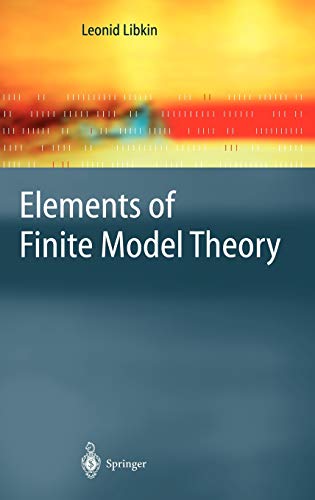
Ebook Info
- Published: 2004
- Number of pages: 332 pages
- Format: PDF
- File Size: 14.82 MB
- Authors: Leonid Libkin
Description
Emphasizes the computer science aspects of the subject.Details applications in databases, complexity theory, and formal languages, as well as other branches of computer science.
User’s Reviews
Editorial Reviews: Review From the reviews:Model theory is the study of the logical properties of mathematical structures. Finite model theory arises when we focus our attention on finite structures, such as finite graphs (graphs with a finite number of nodes). This book presents the most important results of finite model theory in an extremely readable, yet careful and precise manner. Libkin himself is a master of the art, and this shows in his beautiful presentation of the material.Ronald Fagin Manager, Foundations of Computer Science, IBM Almaden Research Center, San Jose, CA”This book is an introduction to finite model theory which stresses the computer science origins of the area. … In addition to presenting the main techniques … the book deals extensively with applications in databases, complexity theory, and formal languages, as well as other branches of computer science. … This book can be used both as an introduction to the subject, suitable for a one- or two-semester graduate course, or as reference for researchers who apply techniques from logic in computer science.” (PHINEWS, Vol. (7), 2005)”Libkin has managed to produce an interesting treatment, in spite of the competition … . I particularly liked the chapter on the locality of first order (FO) logic … . there is an excellent chapter on FO model checking. I liked the careful distinction between data, expression, and combined and fixed parameter complexity. … In summary, I welcome Libkin’s book as an interesting text from the database point of view.” (K. Lodaya, Computing Reviews, April, 2005)”Connections have emerged between finite model theory and various areas in combinatorics and computer science … . Leonid Libkin’s new book … is a beautiful introduction to these developments … . The exposition is lucid throughout … . The book is self-contained and makes an ideal text for self-study or for a ‘topics in logic course’ … . A noteworthy feature of the book from this perspective is its wealth of exercises … . Elements of Finite Model Theory is a wonderful text … .” (Steven Lindell and Scott Weinstein, Journal of Logic, Language and Information, Vol. 16 (2), 2007)”The present book stands out by its broadness of topics (while staying within the confines of finite model theory), its detailed exposition (with great attention to the relationships between the different topics), and its inclusion of more recent results and trends. This book provides the best overview of the field to date. … Every chapter ends with a set of exercises … . The book can be used as a research reference as well as for teaching at the advanced graduate level.” (Jan G. Van den Bussche, Mathematical Reviews, Issue 2007 a)”Finite model theory is the study of the expressive power and, more generally, the behaviour of logics on finite structures. … The audience of the book, as intended by the author, is formed by theoretical computer scientists. … This excellent book will be a great help for teachers and students of finite model theory, but also for researchers in other fields of mathematics or computer science that want to gain familiarity with the most important concepts and results from finite model theory.” (Heribert Vollmer, Zentralblatt MATH, Vol. 1060, 2006) From the Back Cover This book is an introduction to finite model theory which stresses the computer science origins of the area. In addition to presenting the main techniques for analyzing logics over finite models, the book deals extensively with applications in databases, complexity theory, and formal languages, as well as other branches of computer science. It covers Ehrenfeucht-Fraïssé games, locality-based techniques, complexity analysis of logics, including the basics of descriptive complexity, second-order logic and its fragments, connections with finite automata, fixed point logics, finite variable logics, zero-one laws, and embedded finite models, and gives a brief tour of recently discovered applications of finite model theory.This book can be used both as an introduction to the subject, suitable for a one- or two-semester graduate course, or as reference for researchers who apply techniques from logic in computer science. About the Author The author has been with the department of computer science at the University of Toronto since 2000. Prior to that, he was a researcher at Bell Laboratories, and he spent two years visiting INRIA in France. His research interests are in the areas of database theory and applications of logic in computer science.He is coauthor/editor of:Constraint DatabasesKuper, G., Libkin, L., Paredaens, J. (Eds.), 12.04.2000, ISBN 3-540-66151-4Finite-Model Theory and Its ApplicationsGrädel, E., Kolaitis, P.G. (et al.), 07.2004, ISBN 3-540-00428-9Semantics in DatabasesThalheim, B., Libkin, L. (Eds.), Vol. 1358, 25.02.1998, ISBN 3-540-64199-8 Read more
Reviews from Amazon users which were colected at the time this book was published on the website:
⭐For those who are not familiar with the topic of Model Theory, it is basically the theory of logical systems. This book covers how Model Theory relates to a broad range of topics in computer science including Formal Languages, Complexity Theory, and database queries. As the title states, the focus of this book is Finite Model Theory, since finite models are the most useful in computer science. It is packed with information and is relatively easy to understand if you already have a background in logic. However, this book seems to require a fair amount of foundation knowledge, at least in the first few chapters. Brushing up on topics in graph theory before starting this book might be a good idea. One area in which the book seems to be lacking is in applications. While this book is for the theoretical computer scientist, it wouldn’t hurt to discuss why the theory is useful.
⭐I would suggest that you purchase this book from the publisher as the offered paperback is printed at an Amazon’s (partner) facility and is low enough in paper (cardboard like) and print (scaled down to barely legible) quality to make it challenging to focus on content.
⭐Model theory is the study of the logical properties of mathematical structures. Finite model theory arises when we focus our attention on finite structures, such as finite graphs (graphs with a finite number of nodes). This book presents the most important results of finite model theory in an extremely readable, yet careful and precise manner. Libkin himself is a master of the art, and this shows in his beautiful presentation of the material.–Ronald Fagin Manager, Foundations of Computer Science, IBM Almaden Research Center, San Jose, CA
Keywords
Free Download Elements of Finite Model Theory (Texts in Theoretical Computer Science. An EATCS Series) 2004th Edition in PDF format
Elements of Finite Model Theory (Texts in Theoretical Computer Science. An EATCS Series) 2004th Edition PDF Free Download
Download Elements of Finite Model Theory (Texts in Theoretical Computer Science. An EATCS Series) 2004th Edition 2004 PDF Free
Elements of Finite Model Theory (Texts in Theoretical Computer Science. An EATCS Series) 2004th Edition 2004 PDF Free Download
Download Elements of Finite Model Theory (Texts in Theoretical Computer Science. An EATCS Series) 2004th Edition PDF
Free Download Ebook Elements of Finite Model Theory (Texts in Theoretical Computer Science. An EATCS Series) 2004th Edition