Ebook Info
- Published: 2007
- Number of pages: 272 pages
- Format: PDF
- File Size: 8.12 MB
- Authors: Alessandra Celletti
Description
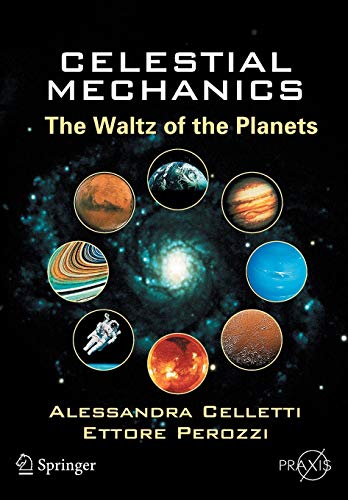
The aim of this book is to demonstrate to a wider audience, as well as to a more skilled audience, the many fascinating aspects of modern celestial mechanics. It sets out to do this without the use of mathematics. After giving the reader the technical tools needed for a basic understanding of the underlying physical phenomena (using only elementary mathematics), facts and figures are provided on historical events, modern discoveries and future applications. Contents are divided into major topics where the three “souls” of modern celestial mechanics (dynamical systems, Solar System and stellar systems, spaceflight dynamics) play a major role.
User’s Reviews
Editorial Reviews: Review From the reviews:”Celletti (Universita di Roma ‘Tor Vergata’) and Perozzi (Telespazio Rome) present a complicated subject in an engaging manner that is accessible to general readers. The writing is clear and authoritative, and the diagrams and tables help the nonexpert reader to visualize the key ideas without having to wade through the mathematics usually found in a book on this subject. … Summing Up: Recommended. General readers; lower- and upper-division undergraduates.” (T. Barker, CHOICE, Vol. 44 (11), August, 2007)”The celestial mechanics can be considered as the mathematical part of the astronomy, requiring a high level in mathematics and reserved to specialists … . The Waltz of the Planets offer a different insight, providing very basic mathematical tools to the reader, sufficient to enable him or her to understand the main topics of celestial planetary dynamics. The purpose is to present this discipline as accessible, interesting and amusing … . A book to recommand to students, astronomers … and celestial mechanicians.” (Anne Lemaître, Physicalia Magazine, Vol. 30 (1), 2008)
Reviews from Amazon users which were colected at the time this book was published on the website:
⭐I had always been curious about how and why things worked in our solar system. This book did a good job of answering my questions. As stated in the product description, only “elementary mathematics” are employed, but the instances of math usage are for illustrative purposes only, and are NOT essential for understanding the material presented. In fact – in my opinion – getting value from this book requires no practical application of mathematics on the part of the reader at all. However, I did find the text to be quite technical (as expected), and a basic understanding of astronomical terms and concepts is necessary in order to grasp the material. (Example glossary term: “Resonance: A commensurability among the periods of motion of two or more celestial bodies. The most common resonances are the mean motion resonances, which involve the revolution periods of different celestial bodies, and the spin-orbit resonances between the revolution and the rotation periods of the same celestial body.”) I give it five stars for telling me what I wanted to know. This is not only a good beginner’s book for someone who is interested in a further study of celestial mechanics, but it would also provide useful information for a beginning astronomer as well.
⭐As far as it goes, Celestial Mechanics ( The Waltz of the Planets) is interesting. But how can anyone possibly write a book reviewing this topic in 2007, without including any mention of the work of Milutin Milankovitch? Milankovitch’s application of celestial mechanics to long term variations in solar flux on the earth has revolutionized our understanding of past ice ages and the earth’s climate. His 100,000 year eccentricity cycle is not even mentioned in the book by Celletti and Perozzi, despite the fact that a clear 100,000 year temperature variation signal is found in Antarctic ice cores that go back 600,000 years.
⭐This book on celestial mechanics is very thorough and a good value.Though written by Italian astronomy colleagues it is in goodto excellent English. It has little mathematics except geometry and that was a disappointment to me. Good coverage of chaos theory as it applies to celestial mechanics. Primarily dealswith the Solar System.
⭐This was a most disappointing purchase. In particular, the authors have absolutely no understanding of ancient astronomy, aka mathematical astronomy, which is now recognized as including Coperniucs (he has described as “Ptolemy’s best disciple”) and they continually make false statements about the development of astronomy before Newton. It is difficult to believe that academics would have so little understanding of such a well known subject. The book is only useful as a catalogue of misconceptions about mathematical astronomy.
⭐It’s a great product and I really enjoy it. I also think it’s a really good deal as far as the money and the shipping speed.
⭐Celestial mechanics studies the motion of bodies (stars, planets, satellites, etc.) under gravity. This book provides a quick overview of the subject, focusing especially on recent developments. The book presumes some knowledge of astronomy, but it’s suitable for any amateur astronomer. (It contains virtually no math.) My primary objection to this book is that it doesn’t explain many of the phenomena that it mentions. The book includes both a glossary that defines jargon and a guide to further information.Contents:Ch. 1: history of the subject; terminology regarding orbitsCh. 2: chaotic orbits and the multi-body problemCh. 3: orbital resonances: their role in the motions of moons and asteroids, and their exploitation by interplanetary probesCh. 4: spin-orbit resonances: tidal forces; synchronous resonance; geosynchronous satellites; obliquity; precession and its exploitation in archaeoastronomyCh. 5: stability of the solar system; paths of comets, meteorites, and asteroidsCh. 6: danger of asteroids colliding with the EarthCh. 7: motions of the moon; eclipses; the moon’s role in the creation of life; novel trajectories to the moonCh. 8: spacecraft flight: “halo” orbits; space debris around Earth; interplanetary trajectories (Hohmann transfer orbits, gravity assists)Ch. 9: planetary rings: their structure; the Roche limit; shepherd satellitesCh. 10: newly discovered objects in the solar system (Centaurs, etc.)Ch. 11: planets around other stars and the search for them (nulling interferometry)
Keywords
Free Download Celestial Mechanics: The Waltz of the Planets (Springer Praxis Books) 2007th Edition in PDF format
Celestial Mechanics: The Waltz of the Planets (Springer Praxis Books) 2007th Edition PDF Free Download
Download Celestial Mechanics: The Waltz of the Planets (Springer Praxis Books) 2007th Edition 2007 PDF Free
Celestial Mechanics: The Waltz of the Planets (Springer Praxis Books) 2007th Edition 2007 PDF Free Download
Download Celestial Mechanics: The Waltz of the Planets (Springer Praxis Books) 2007th Edition PDF
Free Download Ebook Celestial Mechanics: The Waltz of the Planets (Springer Praxis Books) 2007th Edition