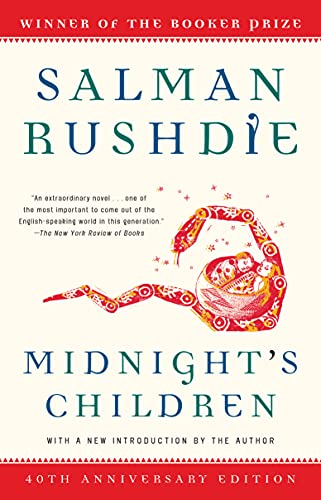
Ebook Info
- Published: 2006
- Number of pages: 536 pages
- Format: Epub
- File Size: 0.87 MB
- Authors: Salman Rushdie
Description
Saleem Sinai is born at the stroke of midnight on August 15, 1947, the very moment of India’s independence. Greeted by fireworks displays, cheering crowds, and Prime Minister Nehru himself, Saleem grows up to learn the ominous consequences of this coincidence. His every act is mirrored and magnified in events that sway the course of national affairs; his health and well-being are inextricably bound to those of his nation; his life is inseparable, at times indistinguishable, from the history of his country. Perhaps most remarkable are the telepathic powers linking him with India’s 1,000 other “midnight’s children,” all born in that initial hour and endowed with magical gifts.
User’s Reviews
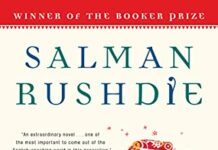
Review “Extraordinary . . . one of the most important [novels] to come out of the English-speaking world in this generation.”–The New York Review of Books“The literary map of India is about to be redrawn. . . . Midnight’s Children sounds like a continent finding its voice.”–The New York Times“In Salman Rushdie, India has produced a glittering novelist– one with startling imaginative and intellectual resources, a master of perpetual storytelling.”–The New Yorker“A marvelous epic . . . Rushdie’s prose snaps into playback and flash-forward . . . stopping on images, vistas, and characters of unforgettable presence. Their range is as rich as India herself.”–Newsweek“Burgeons with life, with exuberance and fantasy . . . Rushdie is a writer of courage, impressive strength, and sheer stylistic brilliance.”–The Washington Post Book World“Pure story–an ebullient, wildly clowning, satirical, descriptively witty charge of energy.”–Chicago Sun-Times
Reviews from Amazon users, collected at the time the book is getting published on UniedVRG. It can be related to shiping or paper quality instead of the book content:
⭐ I think the best word that can sum up my experience with this book was frustrating. I get that Rushdie can write (as he so blatantly proves to us), I get that there is an entire metaphor and symbolism running rampant throughout the book, and I get that there is this interconnectedness to the narrator’s story to India’s history and turbulence, but it was just so tedious to read this novel.Problem one is the narrator. There’s a certain level of pretentiousness from the narrator and the storytelling that annoyed me to no end. And speaking of annoying, the constant asides are maddening and distracting to no end. At many points, the narrator’s digressions and his “unreliability” are quite tiresome and irritating. He will mutter things like “Did it happen this way or no?” “Yes? No? Maybe? Hmmm?” “Should I ? Shouldn’t I?” “But wait….before I get to this…let me tell you about..” “Oh I forgot to mention…” How about get to the point already.Additionally, his “self-important “style of narration is irksome and tiring. He rambles on and on and on about his life for the first two hundred pages before he is even born. One way to make sure a reader doesn’t care about you is to say how important you are or how significant your story is. Much of the narrator’s “epicness “ waxed pretty artificial, in my opinion, like he was totally full of himself. Being along for the ride with this narrator is akin to being on a 10 hour flight next to a stranger who blabs on and on about every minute detail of their life and won’t stop.Problem two is the glacial pacing of the novel, with overabundance of everything thrown at the reader in an incoherent and scattered way, from characters, events, history, relatives, etc. at nauseum from every single angle and place. I don’t mind tons of characters, tons of subplots or narrative diversions if there is a point or if it is engaging.The magic in the book is a bit cartoonish, and so are the characters and situations. I get there a heavy dose of magical realism involved, but my gosh, this was a bit much to swallow, especially in the book’s final two hundred pages or so. Too much focus on body parts and bodily fluids and things coming out of bodies and just bizarre stuff.To me, the point of tying the narrator to India’s history into one big metaphor is there, but the “rewards” of this for the reader aren’t worth it in the long haul and the frustration of having to wade through so much nonsense.I know Midnight’s Children is lauded and praised, but I found this book to be pretty off putting in many ways.This was my first reading of Rushdie and if this is a sampling of the style of his other works, I don’t think I’ll be reading anything else anytime soon.
⭐ It’s taken me all this time to pick up my first Salmon Rushdie novel. What a writer and what an imagination!The writing is brilliant — fun, humorous, fantastical, entertaining, ambitious and meticulous. I, alas, fall far short of being a brilliant writer, so I’m not going to be able to capture the magic of his writing for you. But, I can give you a great tip: sample this book. Now. Just do it. Amazon will let Prime Customers (all customers??) download a sample that will either have you in agreement or waste a small amount of your time.Do yourself a favor. Just do it. It will cost you nothing and may well prove to be for you what it has been for me — a memorable and sublime reading experience.You read this all the way through. Silly you. You could have been reading “Midnight’s Children.” I read the first chapter aloud to my wife. This second reading pleased her and showed me how much I had missed on my first reading. I put this book right up there with my favorites: Catch-22 (deadly serious and uproariously funny), almost anything by Mark Twain, The Magus (a page-turner that delivered) , The Sound and the Fury, Harry the Rat with Women (a perfect short novel), The Stranger, Interview with a Vampire (the last chapter wowed me), The Naked and the Dead, the fast-paced novels of David Morrell, the wise-cracking investigator of Plum Island, and War and Peace (which I probably would never have read had it not been for a course). And, darn it, I know I’ve left out many others that I’ve found exceptional for one reason or another — such as much of Saul Bellows, Shogun (which blind-sided me by turning around my first impressions when I wasn’t looking) The Grapes of Wrath (with its innumerable outstanding vignettes), Our Town (my favorite play, especially with Hal Holbrook in his finest performance) and . . .
⭐ I had to give it up after 45 pages. From the awards and reviews I was expecting a serious book about a serious country in a serious time. If you don’t know, this book is mostly whimsy, odd humor, farce and inability to move the story. I’m sure Rushdie was in stitches as he wrote each page but his humor escapes me. If you want to read about a doctor with a huge nose, a hypochondriac woman who for modesty’s sake must be examined through a hole in a draped sheet, a boatman who never bathes and a group of elders that use a spittoon from great distances, then this is your book. It isn’t mine.If you want to read a very good book with Muslim mysticism try “Alif the Unseen.”
⭐ The Satanic Verses is arguably Rushdie’s most famous book, perhaps because it was the one that landed a fatwa on his head, but this one is my favorite. Every, single, word, is delicious. As a warning, my mother, who is my best reader friend, found his style too florid. I, however, could soak in it until my fingers get pruny, and never get tired. If you like sagas, sarcasm, fated coincidences, and utterly beautiful, imaginative, lustrous writing, read this right away in case you get hit by a bus tomorrow. One of my top favorite books of all time.
⭐ Rushdie’s books are always a challenge and this one was the hardest one that I have read. That being said, he gives excellent views on the Asian world from a personal standpoint. His narrative about the birth of Indian and Pakistan were very vivid and revealing to someone who has just read a few lines in a history book about these major events. He had covered living in every place from a well-to-do home to a slum shack. He makes allusions back and forth in time that can be confusing. Despite it being a labor to get through it, after I finished this book, I appreciated it for being an amazing narrative.
⭐ Rushdie mashes absurdity and reality together. His prose is unrelenting. His narrator gleefully rambles and digresses. The world of magic, the main story, and the parallel story of the Indian political landscape circle around one another till their inevitable collision. It’s easy to get lost in the multitude of characters, spanning across generations and nations. Just hold on — the pay off will come when Rushdie’s architecture of story and genealogy is revealed in a touching ending.
⭐ A beautiful book. Perhaps one of the most beautiful of all times. Its language gives me the chills; it’s like a slow-paced water that makes its way through every crevice of my brain. I am not a native English speaker, but I’m so glad I learned this language to read Midnight’s Children! I don’t think its suave beauty and deep meanings can ever be fully translated!
⭐ I don’t know if it’s just me, but I found this book virtually impossible to follow. I don’t know if it’s an ethnic difference, or just my inability to grasp Mr Rushdie’s prose and general style of writing. This novel just didn’t seem to follow a coordinated and cohesive path. Quite honestly– it seemed like a bunch of sentences just thrown together. Once again, that may be my interpretation of someone from another country and a different civilization from the one I relate to best. I’m not holding it against Mr Rushdie– I just had a hard time following along. The fact could simply be that his style of writing is just way over my head.
⭐ Just finished _Midnight’s Children_ by Salman Rushdie, which is a fictitious autobiography of a man born exactly when India became independent of Great Britain and whose life is tied to the country literally and metaphorically (so he says). This novel has many things I love: narratives spanning several generations and countries, full descriptions of the complicated web of backstories for a multitude of characters, and those characters are flawed in some way; however, I couldn’t get into the story. Perhaps the characters were too flawed, and there wasn’t enough redemption or evolution. I also sensed an undertone of misogyny in the treatment and description of female characters. I know I would have appreciated it more if I had a better sense of British/Indian/Pakistani history, and a better appreciation for magical realism, but if I hadn’t read it for a book club, I might not have finished it.
⭐ After reading the first few pages Rushdie’s words started flitting about my head like little birds. Rushdie is an amazing wordsmith but the book seems to have no purpose. It appears to be a collection of ramblings about various topics. Rule number 17 in the Strunk and White manual is to omit unnecessary words. Rushdie includes a lot of unnecessary words. If you enjoy being led down a winding path, you might enjoy this book.
Keywords
Free Download Midnight’s Children: A Novel (Modern Library 100 Best Novels) in Epub format
Midnight’s Children: A Novel (Modern Library 100 Best Novels) Epub Free Download
Download Midnight’s Children: A Novel (Modern Library 100 Best Novels) 2006 Epub Free
Midnight’s Children: A Novel (Modern Library 100 Best Novels) 2006 Epub Free Download
Download Midnight’s Children: A Novel (Modern Library 100 Best Novels) Epub
Free Download Ebook Midnight’s Children: A Novel (Modern Library 100 Best Novels)