

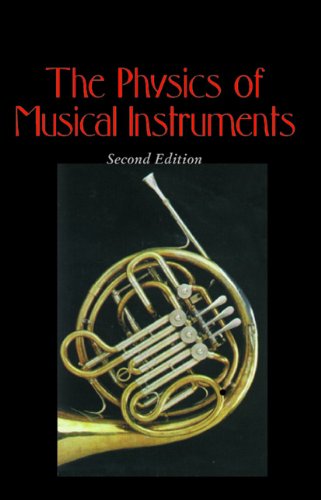
Ebook Info
- Published: 1998
- Number of pages: 776 pages
- Format: PDF
- File Size: 12.81 MB
- Authors: Neville H. Fletcher
Description
While the history of musical instruments is nearly as old as civilisation itself, the science of acoustics is quite recent. By understanding the physical basis of how instruments are used to make music, one hopes ultimately to be able to give physical criteria to distinguish a fine instrument from a mediocre one. At that point science may be able to come to the aid of art in improving the design and performance of musical instruments. As yet, many of the subtleties in musical sounds of which instrument makers and musicians are aware remain beyond the reach of modern acoustic measurements. This book describes the results of such acoustical investigations – fascinating intellectual and practical exercises. Addressed to readers with a reasonable grasp of physics who are not put off by a little mathematics, this book discusses most of the traditional instruments currently in use in Western music. A guide for all who have an interest in music and how it is produced, as well as serving as a comprehensive reference for those undertaking research in the field.
User’s Reviews
Editorial Reviews: Review “Essentially everything you have ever wanted to know about the physics of musical instruments” PHYSICS TODAY “a rigor, graphical detail, and verbal description.” AUDIO
Reviews from Amazon users which were colected at the time this book was published on the website:
⭐This is a one-of-a-kind book on the physics of musical instruments. However, be aware that it is a book about physics ONLY. There are no hints or exercises on how to model musical instruments, nothing on acoustics or psychoacoustics, synthesis, etc. In other words, do not expect an expanded version of Perry Cook’s book “Real Sound Synthesis for Interactive Applications”. If you can deal with these expectations, then this is a worthwhile read for those interested in the pure physics of musical instruments who are willing to do the work of implementing the synthesis themselves, if that is the reader’s ultimate goal. The first eight chapters of the book provide some pretty good background material on vibrating systems and sound waves that should be read sequentially. However, from chapter 9 through 21 the author just presents the physics of each instrument with no real organization by chapter, unless you count the fact that the physics of the instruments are presented in groups organized as either percussion, wind, or stringed instruments. There is a final chapter on materials and their properties that doesn’t really fit in with previous chapters. Each chapter has an extensive bibliography. I would recommend this book for anyone interested in the physics of musical instruments and has the necessary mathematical maturity to handle the material. The reader who has taken a year of college physics with maybe a specific class on acoustics and who also is comfortable with calculus and both partial and ordinary differential equations would be best qualified to make the most of the information in this book. Having had a course in the EE topic of Signals and Systems wouldn’t hurt either when it comes to the discussions of frequency analysis and response.The books that helped me get through the math and physics of this volume were Kinsler’s “Fundamentals of Acoustics”, “Introduction to Partial Differential Equations with Applications” by Zachmanoglou, and finally, an out-of-print work: “Schaum’s Outline of Acoustics” by Seto, ISBN 0070563284.
⭐I love this book! I can’t yet add anything beyond what others have written about the content, but I’ve learned a lot already and immensely enjoyed the depth and thoroughness of the material.But I have a major complaint about the format. The printer–Springer, who ought to know better–screwed up badly:* The paper is too small. Margins on the bound side of the pages are fine, but on the opposite sides, they range from 3-4 millimeters! There is nowhere to put your thumbs to hold the book open. Worse, there are at least a dozen diagrams that fall off the edge of the page. You can guess what the content is, since not much is cut off, but that’s ridiculous! The binding is stiff enough that you _need_ the generous inside margins so that the text lies on a relatively flat part of the page, so just shifting the printed page inward would not work. They desperately need to print on larger paper.* The paper is cheap, causing the fonts to look jagged. For a $100 book, you’d think they could have printed it on decent-quality paper. It looks only a small step up from a Dover Press economy edition that would cost $20.At least the typesetting is great–all in TeX, like any good physics text :)I don’t see how this could be isolated, but perhaps it is…?
⭐I’ve had this book for two weeks and already pages are falling out of it with *zero* glue even stuck to the edge of the pages. Looking along the binding edge, there is a ‘slotted’ pattern, indicating one in every five or so pages doesn’t reach the glue binding. So yeah, pretty soon I’m just going to have a disheveled stack of papers instead of a book.
⭐I have not read the book beginning to end simply because it is quite a tome. However, I have studied those areas that I have some interest and ability in. The book is concisely written with just enough mathematics to make the qualitative discussion understandable…and the qualitative discussions are quite concise and understandable. It provides detailed references for all of the assertions. I find it an excellent reference and am happy to have it in my library.
⭐A good introductory book for musical instrument builders. Presents basic concepts and pointers.
⭐This is a fantastic book that serves as an introduction to the physics of musical instruments, and a great reference for those who are practicing in the field. The authors use math where needed, but it is not overwhelming and should be easily readable by students with a basic level of calculus.
⭐Birthday present requested for my physicist husband, who tells me the book he borrowed from a friend is one he absolutely needs.
⭐satisfactory
⭐Unlike a lot of books on the physics behind musical instruments, this one actually has a decent amount of maths. It seems quite thorough and discusses a wide range of phenomena and instruments.I thoroughly recommend the book, but if I had to point out a weakness, it was written before computers became powerful and widespread, and it was written for someone who would not likely have had access to one. The field has probably changed a lot since then because of this.
⭐El libro vino y está genial, en perfecto estado. Estoy muy contenta con la compra, lo recomiendo, vale la pena.
⭐
⭐Ok
Keywords
Free Download The Physics of Musical Instruments 2nd Edition in PDF format
The Physics of Musical Instruments 2nd Edition PDF Free Download
Download The Physics of Musical Instruments 2nd Edition 1998 PDF Free
The Physics of Musical Instruments 2nd Edition 1998 PDF Free Download
Download The Physics of Musical Instruments 2nd Edition PDF
Free Download Ebook The Physics of Musical Instruments 2nd Edition