Ebook Info
- Published: 2020
- Number of pages: 130 pages
- Format: PDF
- File Size: 7.69 MB
- Authors: Don S. Lemons
Description
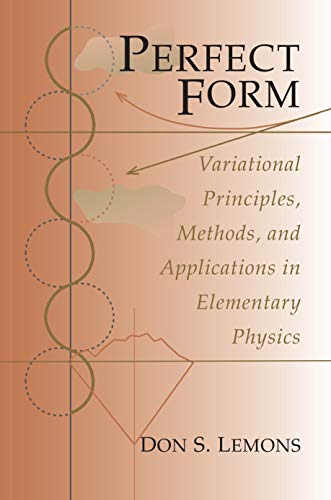
What does the path taken by a ray of light share with the trajectory of a thrown baseball and the curve of a wheat stalk bending in the breeze? Each is the subject of a different study yet all are optimal shapes; light rays minimize travel time while a thrown baseball minimizes action. All natural curves and shapes, and many artificial ones, manifest such “perfect form” because physical principles can be expressed as a statement requiring some important physical quantity to be mathematically maximum, minimum, or stationary. Perfect Form introduces the basic “variational” principles of classical physics (least time, least potential energy, least action, and Hamilton’s principle), develops the mathematical language most suited to their application (the calculus of variations), and presents applications from the physics usually encountered in introductory course sequences. The text gradually unfolds the physics and mathematics. While other treatments postulate Hamilton’s principle and deduce all results from it, Perfect Form begins with the most plausible and restricted variational principles and develops more powerful ones through generalization. One selection of text and problems even constitutes a non-calculus of variations introduction to variational methods, while the mathematics more generally employed extends only to solving simple ordinary differential equations. Perfect Form is designed to supplement existing classical mechanics texts and to present variational principles and methods to students who approach the subject for the first time.
User’s Reviews
Reviews from Amazon users which were colected at the time this book was published on the website:
⭐I just took an independent study in the calculus of variations out of Gelfand’s classic text. I covered the first four chapters which is a nice introduction. However the text is pretty technical and so Perfect Form (PF) was a great companion. Its laid back, accessible to a sophomore physics student and fine for self study. It has a range of physical problems from calculations to nice little problems to think about.Moreover, it motivates the material well. This is one of those books that keeps driving home a few, just a few points and avoids too many topics. For instance, I was never knew why the lagrangian should be the difference of kinetic and potential energies, this book will motivate this form.Finally, its a realistic book. I found no great effort in reading the entire book and working about 3/4 of the problems (some I just didn’t find interesting) on my own in a busy semester. This is just a fun little book that shows you some variational methods!
⭐this is a poor effort even for a sketchy introduction –it comes off as a rough draft of disjointed hackneyedexamples that have appeared ad nauseum for decadesin dozens of other books with similar titles –the professor gets an big F fromthe audience he swindled
⭐I don’t understand Mr. Lemons. It seems that he has assigned himself the task of writing watered down, dispensable versions of books that have already been written on the same subjects and for the same audience. Let me be more specific:- He has written ”
⭐.” This book is a puny version of the book by D. K. C. MacDonald, ”
⭐” (Dover, ~$11), hich is much better. This is not to mention the long list of textbooks and review papers on “introduction to stochastic processes.”- Then there is this one, “Perfect Form,” on the variational principle. Who the hell needs another book on this subject? Already in 1997, when this book was released, if you were looking for an introductory treatment, you could have picked the old and veritable 1925 book by G. A. Bliss, “Calculus of Variations,” the even older (1917) but excelent textbook by W. E. Byerly, “Introduction to the Calculus of Variations,” or the one by R. Weinstock, ”
⭐” (Dover, ~$11). More mathematical treatments are given by I. M. Gelfand and S. V. Fomin, ”
⭐,” (Dover, ~$8) or B. van Brunt, ”
⭐” (Springer, ~$60). Some of these texts are fully accessible to a junior college student. Now, if you just want to browse through the subject in a leisurely manner, I recommend S. Hildebrandt and A. Tromba, ”
⭐.” In summary, you don’t need another dumbed down book for dummies on such a beautiful subject, not even if you really are a dummy.A old teacher of mine once said that “the IQ of the human race is a conserved quantity, but the population keeps growing!” Now I understand Mr. Lemons better: he writes for the new humans!
⭐If you don’t mind eliding over technicalities or just can’t be bothered, then perhaps this book might be for you. But if you want a firm grasp of the theoretical foundations of the calculus of variations look elsewhere. My own favorite is Bolza’s “Lectures on the Calculus of Variations” but there are other technically sound treatments of the subject. Lemons’ book attempts to find a niche for itself between the mathematical methods book that cover the calculus of variations in a single perfunctory section and the full-length texts (such as Weinstock and Bolza). I find it difficult to recommend.
⭐For a third or fourth year student in physics this short book, Perfect Form, would be near perfect as either a short overview of variational methods, or as a supplementary text for an advanced classical physics course.I have occasionally encountered variational methods, but until reading Perfect Form I had not appreciated the significance and scope and even fascination of this topic. In a little more than one hundred pages Dr. Don Lemons does a credible job of introducing a wide range of physics problems amenable to variational methods.He begins with optics and Fermat’s Principle of Least Time and thereby motivates the derivation of the Euler-Lagrange equation. In later chapters he examines the principle of least potential energy, Lagrange multipliers, the principle of least action, and Hamilton’s principle, in both a restricted and more general form. The supplementary problems at the end of each chapter are few in number, but are carefully defined and are more like tutorials than standalone problems.In my experience textbooks dedicated to this topic – like Calculus of Variations by Robert Weinstock and Introduction to the Calculus of Variations by Hans Sagan – are difficult and require considerable mathematical maturity. Other texts – like Advanced Calculus of Several Variables (C. H. Edwards) and Advanced Mathematical Methods for Engineering and Science Students (Stephenson and Radmore) and Mathematics Applied to Continuum Mechanics (L. A. Segel) – often relegate this subject to a single (and often final) chapter.Most undergraduates are unlikely to have time for a formal course in calculus of variations. With this book Don Lemons has convinced me that this topic is too important and too interesting to ignore. I recommend that you acquire a copy of Perfect Form for self-study or as supplementary text.
Keywords
Free Download Perfect Form: Variational Principles, Methods, and Applications in Elementary Physics in PDF format
Perfect Form: Variational Principles, Methods, and Applications in Elementary Physics PDF Free Download
Download Perfect Form: Variational Principles, Methods, and Applications in Elementary Physics 2020 PDF Free
Perfect Form: Variational Principles, Methods, and Applications in Elementary Physics 2020 PDF Free Download
Download Perfect Form: Variational Principles, Methods, and Applications in Elementary Physics PDF
Free Download Ebook Perfect Form: Variational Principles, Methods, and Applications in Elementary Physics