Ebook Info
- Published: 2004
- Number of pages: 678 pages
- Format: PDF
- File Size: 27.19 MB
- Authors: P.A. Davidson
Description
Based on a taught by the author at the University of Cambridge, this comprehensive text on turbulence and fluid dynamics is aimed at year 4 undergraduates and graduates in applied mathematics, physics, and engineering, and provides an ideal reference for industry professionals and researchers. It bridges the gap between elementary accounts of turbulence found in undergraduate texts and more rigorous accounts given in monographs on the subject. Containing manyexamples, the author combines the maximum of physical insight with the minimum of mathematical detail where possible. The text is highly illustrated throughout, and includes colour plates; required mathematical techniques are covered in extensive appendices. The text is divided into three parts: Part I consists of a traditional introduction to the classical aspects of turbulence, the nature of turbulence, and the equations of fluid mechanics. Mathematics is kept to a minimum, presupposing only an elementary knowledge of fluid mechanics and statistics. Part II tackles the problem of homogeneous turbulence with a focus on describing the phenomena in real space. Part III covers certain special topics rarely discussed in introductory texts. Manygeophysical and astrophysical flows are dominated by the effects of body forces, such as buoyancy, Coriolis and Lorentz forces. Moreover, certain large-scale flows are approximately two-dimensional and this has led to a concerted investigation of two-dimensional turbulence over the last fewyears. Both the influence of body forces and two-dimensional turbulence are discussed.
User’s Reviews
Reviews from Amazon users which were colected at the time this book was published on the website:
⭐This text is well-written and presents a lot of advanced material in relatively short order. However, the mathematics involved are quite advanced and the book is certainly intended only for people with some background in fluids – it is far from an “introductory” text!
⭐Besides all other good stuff, I actually like the margins that allows my own deviation of heavy mathematics. Thank you!
⭐very explained
⭐Awesome book for engineers who are keen to understand the concepts behind mathematical equations. Very good explanation of topics. Chapter 3 a bit of early plunge tino the topic for beginners though…
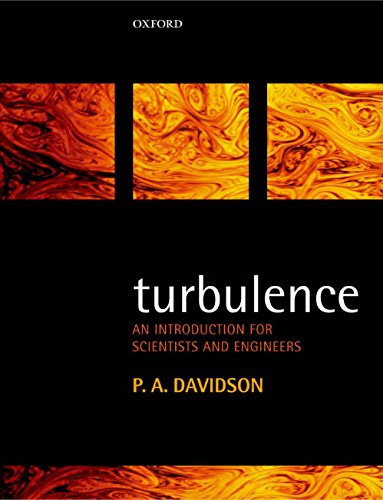
⭐I really liked the book. Especially the pretty pictures shown on the front and back covers.I see a 2nd Edition is available and its front and back covers are now blue.I really like blue.
⭐This book is great, especially for PHd students. It is very well explained, a lot of physical insights. I recommend this book as a first purchase for those engineers dealing with turbulence.
⭐This book is really great! The complex things in turbulence are explained in that way I’ve never seen it before. There are a lot of great figures that are explaining a lot of things – for example, vorticity dynamics is followed with great pictures. Main topic of this book is physical aspect of turbulence, and that’s great.If you’re dealing (better to say coping) with turbulence in some way, you should have this book – specially if you’re a novice in this area.
⭐a book covering many interesting topics and i believe a student of turbulence will be very well-equiped in the basics of modern understandings of turbulence after reading this book. but what a poor page layout. the fonts are small and the book undoubtedly is bulkier because so much space is wasted on the wide margins! i think i had read somewhere that these margins would make the book a good study tools. readers can write on them. what nonsense! they could have just used a conventional layout, save plenty of pages and reading it would be better for my eyes. i can write notes and work out the equations, etc, on some notepad i have. i think it worths minusing two stars for the layout. you can say i judge this book by its font size.
⭐Solid introduction to the field. Doesn’t assume any absurd level of familiarity with the material, and in fact takes pains to introduce even fairly basic material from thermofluids that most (though not all) people taking a turbulence course would be familiar with.The writing style is clear and just technical enough to communicate the concepts, without being impenetrable. Often light-hearted introductory quotes at the beginning of chapters is surprisingly effective at making the material feel less threatening than it does otherwise.
⭐As usual, no issues with the delivery of books from amazon. The book itself is a nice introduction into physics of turbulence. For me it has the right level of math and qualitative discussion of problems. As it should be the case for a good book, plenty of references can be found for further reading if more details are required. Anyway, a really well written book.
⭐Many thanks to the Author. The way the author speaks to the reader through the written material in the book makes the reader enjoy reading the book and the simplified way the equations have been presented helps in attracting the reader’s attention to read more about turbulence. This book is advisable for researchers working on turbulence models development, astrophysical and geophysical research projects. It can provide engineers with some introductory material on turbulence.Part I The classical picture of turbulenceChapter 1This chapter provides the reader with an introductory descriptive material about Turbulence and occasional life encounters. This chapter is easy and the reader should not go through much trouble in reading it.Chapter 2This chapter covers the Navier-Stokes equations and dissects them into different and discuses each one and its impact on the flow properties. Engineering student would find some difficulty in reading this chapter because engineering students focus is mostly on the Bernoulli’s equation due to its relation to the application side of things. Masters level and aerospace engineers won’t find much difficulty in reading this chapter but won’t be able to really get to the solving part of the equations. Mathematicians and physics research students can get through it because the majority have covered a module of computational PDEs. Therefore they would have an advantage over engineering students.Chapter 3This chapter covers the origin and nature of turbulence through the use of some statistical tools that is done through some coverage of real life cases.Chapter 4Turbulent shear flows and simple closure models, during the process of applying turbulence models to solve the Navier stokes a closure term to solve the equations is required. This chapter covers some of the encountered problems. The reader has to know that Turbulnce models are a variety of statistical and probability tools applied to the Navier Stokes equations in order to introduce new parameters that describe some physical phenomena.Chapter 5The phenomenology of Taylor, Richardson, and Kolmogorov, this chapter has been given lots of attention due to the importance of the theory of the energy cascade , in other words showing how energy is transferred from large scales to small scale turbulence structures.Part II Freely decaying, homogenous turbulenceChapter 6Isotropic turbulence (in real space) is covered where again this chapter covers the energy cascade theory simplifying the study by regarding the studied case as an isotropic turbulence case leading the reader to study the length scales dynamics and how different length scales interact between each other using different derived quantification parameters, some prior knowledge of probability, statistics and tensors is required in this chapter.Chapter 7The role of numerical simulations, no way it is applicable to solve the Navier Stokes equations without the direct influence of computers to the process, therefore this chapter exposes the importance of computers in the advancement process of turbulence models.Chapter 8Isotropic turbulence (in spectral space), Spectral space studies are always favoured by physicists and mathematicians due to their intensive use of spectral space to solve their problems while engineers would find some difficulty in understanding this chapter due to that they are unfamiliar with the use of spectral space tools.Part III Special TopicsChapter 9The influence of rotation, stratification, and magnetic fields on turbulence this chapter is related to astrophysical application of turbulence. It takes into account the effects of electromagnetic fields on turbulence.Chapter 10This chapter covers two dimensional turbulence which is something not avoidable after the reader has gone through the book , this introduces the reader to a more complex problem in turbulnce which introduces new factors to take into account.Praying for you not to encounter much turbulence while reading in this field, I hope that was helpful and good luck
⭐きれいな本で、すぐによんでみたくなりました。読めばよむほど保管がいいと思います
⭐
Keywords
Free Download Turbulence: An Introduction for Scientists and Engineers 1st Edition in PDF format
Turbulence: An Introduction for Scientists and Engineers 1st Edition PDF Free Download
Download Turbulence: An Introduction for Scientists and Engineers 1st Edition 2004 PDF Free
Turbulence: An Introduction for Scientists and Engineers 1st Edition 2004 PDF Free Download
Download Turbulence: An Introduction for Scientists and Engineers 1st Edition PDF
Free Download Ebook Turbulence: An Introduction for Scientists and Engineers 1st Edition