Ebook Info
- Published: 2002
- Number of pages: 536 pages
- Format: Epub
- File Size: 0.44 MB
- Authors: Joseph Conrad
Description
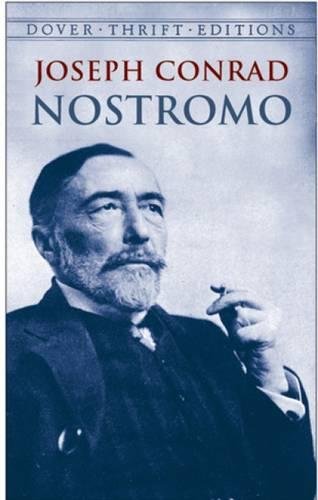
Joseph Conrad’s 1904 adventure novel, set amid the mist-covered mountains of a fictional South American republic, spins a colorful tale of capitalist exploitation and rebellion. The story begins halfway through the revolution, employing flashbacks and glimpses of the future to depict the lure of silver and its effects on men — corrupting and destroying some, revealing the strengths of others. Conrad’s deep moral consciousness and masterful narrative technique are at their best in Nostromo, one of his greatest works.
User’s Reviews
Joseph Conrad (1857–1924) was fluent from birth in French as well as his native Polish. He learned his third language, English, as an adult, and it was in English that he wrote his evocative stories and novels. Conrad drew upon his experiences in the British and French navies to portray the struggles of humanity amid the world’s vast indifference.
Reviews from Amazon users, collected at the time the book is getting published on UniedVRG. It can be related to shiping or paper quality instead of the book content:
⭐ While it is mostly thanks to _Heart of Darkness_ (1899) that Conrad secured a place for himself in the canon, most critics cite _Nostromo_ (1904) as his masterpiece. Having grown up in Latin America, I’d been wanting to read this novel for quite some time, but other Conrad books kept falling into my hands before this one did. I can now say that I agree with the consensus when it comes to _Nostromo_. It is evident from the very first pages that the author had found a story, a topic, a series of themes, and a tone that allowed him to produce the highest expression of his narrative art.A story of revolt in colonial Latin America set in the imaginary republic of Costaguana (an accurate composite of Hispanic American nations), _Nostromo_ is divided into three parts. The first part, “The Silver of the Mine,” introduces the reader to Charles Gould, administrator of the San Tomé silver mine, which is located in the town of Sulaco. The narrator relates the history of the mine, which first haunted Charles’s father and now absorbs the attention of the inheritor. It’s almost as if the mine were a person with a will of its own. Giorgio Viola, a Romantic freedom fighter who belonged to the ranks of Garibaldi, is another important figure in this first part, and the reader is allowed a glimpse of Gian’ Battista Fidanza, the head longshoreman of the Oceanic Steam Navigation Company, the man the locals call Nostromo. As in most traditional narratives, the first part of the novel establishes the setting and states the problem. It becomes clear from the beginning that as the administrator of a silver mine, it is Charles Gould, and not the local political authorities, who actually holds power in Sulaco. This situation inevitably causes resentment among the local population.The second part of the novel, “The Isabels,” in which the main conflict takes shape, focuses on Antonia Avellanos (the daughter of one of Charles Gould’s local friends) and the man who loves her, the journalist Martin Decoud. Antonia is political, and wants the best for the people of Sulaco; Decoud is not a patriot, he considers himself above all that, and as civil strife sets in he wants to leave Costaguana with the lady he loves. As Gould and Decoud realize that their interests (material in the first case, and romantic in the second) are in danger, they devise a plan to protect these interests and enlist the help of Nostromo, who may be the only man capable of carrying out the plan. The novel’s third part, “The Lighthouse,” presents the resolution of the conflict and describes the fates of the characters involved.As Conrad points out in his foreword to the novel, _Nostromo_ is loosely based on an anecdote he heard as a young man, while working in the Gulf of Mexico. Conrad built the novel around the story of a man who, taking advantage of a local revolution, managed to escape with a lighter (a flat-bottomed barge) loaded with silver. Like Henry James, Conrad had the ability to construct entire stories starting from a brief real-life anecdote. It is known that _Lord Jim_ was conceived in the same way.Besides offering a great story, _Nostromo_ is a complex analysis of capitalist colonialism. The topic is the same as that of _Heart of Darkness_, but in this case Conrad is more objective and less ambiguous. Latin America is shown as a highly unstable region, but it is as much a land of ideals and self-sacrifice as it is one of corruption. While the people want to be free and self-sufficient, those in power sell the country’s valuable resources to foreign interests so as to increase their personal wealth and remain in power. Given this situation, revolution becomes inevitable. This is the sad history of Latin America, and in _Nostromo_ Conrad shows how clear a perception he had of it. The novel, which is deeper and more panoramic than _Heart of Darkness_, should be required reading for courses in Latin American history and politics.As I was reading the novel, I felt that it could have been titled _Sulaco_, or even _The King of Sulaco_ (the title the locals give to Gould), instead. Nostromo himself does not emerge as a key figure until the second half of the novel, but towards the end it becomes clear why the story bears his name as its title. His nickname means “our man,” and his last name, Fidanza, recalls the Italian “fidanzarsi,” which means to get/become engaged. Like _Heart of Darkness_, _Lord Jim_, and so many other Conrad tales, _Nostromo_ revolves around an imposing male figure. Like Jim, Nostromo is a good man, but _Nostromo_ the novel is not marred by the technical imperfections that may be found in _Lord Jim_ (please see my review of this novel for more on this). While _Lord Jim_ may be more daring and groundbreaking in its use of narrative techniques, _Nostromo_ is polished to perfection and much more socially and politically involved. Regarding the female characters, critics have observed that Conrad’s women are always beautiful and pure. The author may offer more of the same in _Nostromo_, but I found Antonia to be a memorable character, and she was particularly dear to Conrad because, as he points out in his “Author’s Note,” she was based on his first love.In _Nostromo_, Conrad shows an understanding of locals and foreigners alike. Decoud, a Costaguanero, says, “There is a curse of futility upon our character: Don Quixote and Sancho Panza, chivalry and materialism, high-sounding sentiment and a supine morality, violent efforts for an idea and a sullen acquiescence in every form of corruption. We convulsed a continent for our independence only to become the passive prey of a democratic parody, the helpless victims of scoundrels and cut-throats, our institutions a mockery, our laws a farce.” Pages of Latin American history are summarized in these lines. The same character later describes Gould as “an Englishman,” which to him means “simply that he cannot act or exist without idealizing every simple feeling, desire, or achievement. He could not believe his own motives if he did not make them first a part of some fairy tale.” I was reminded of the title character in Graham Greene’s _The Quiet American_ (1955). Another passage I loved, this time spoken by Gould: “The words one knows so well have a nightmarish meaning in this country. Liberty, democracy, patriotism, government–all of them have a flavour of folly and murder.” The two cultures involved are worlds apart, irreconcilable.One final comment. As I read, I often got the feeling that in a way the true central character of _Nostromo_ was not Gian’ Battista, not Gould, not Decoud, but the silver itself. Isn’t this appropriate in a novel about the workings of capitalism? Regarding revolution, Conrad did not exhaust the topic here. He would continue to explore it in his next two novels, _The Secret Agent_ (1907) and _Under Western Eyes_ (1911), both of which are excellent._Nostromo_ is as close to perfection as Conrad ever came. Besides being a landmark of English literature, it prefigures the work of some key Latin American novelists, such as Miguel Ángel Asturias, Alejo Carpentier, and Gabriel García Márquez, in whose _Love in the Time of Cholera_ (1985) Conrad himself makes a cameo appearance.My next novel by Conrad will be _Victory_, but I may read some more of his short stories first.Thanks for reading, and enjoy the book!
⭐ This is a fine adventure story with a distinctly populist edge. The hero is the captain of the dockworkers who tend ships in the fictional port of Sulaco, a tough, principled and highly capable man man who comes to believe he has been betrayed by his wealthy employers. The primary focus of the story’s conflict is a fabulously wealthy silver mine that becomes a character in the novel all by itself. The mine is jeopardized by a revolution in the fictional country of Costaguana, the factionally riven and corrupt nation that Sulaco serves as the primary port. The revolution — more of a civil war, actually — threatens the hero, his masters and their women.Though the book is written in a highly colored manner, it moves along at a rapid pace and contains enough suspense to keep the reader turning the pages. Most of it is told from the third person omniscient point of view, but a passage toward the end gives a single character a chance to summarize the conclusion of the revolution before the focus once again shifts to the hero.I am looking forward to “Heart of Darkness,” Conrad’s masterpiece.The book is swollen with Conrad’s dour view of class conflict, colonialism, oligarchy, political fanaticism and the brutality of rich and poor alike. To mention the major turnabout in the story would be to spoil it for unfamiliar readers, but suffice to say there is a deep-seated morality to punishes the guilty and destroys the lives of their abettors.
⭐ The story relates a ficticious republic in South America and the progressive corruption to the main character caused by his knowledge of the location of a treasure of silver. The insight of life in the end of the 19th century in South America is very interesting. A typical Conrad story.The Kindle version needs serious editing since it does not show the pages and in fact has Cervantes “Don Quichote” attached to it!!! You do not know that before you get to it.
⭐ This is the fifth Joseph Conrad book I’ve read in the past year or so (the others being The Secret Agent, Lord Jim, Heart of Darkness/The Secret Sharer, and Narcissus) and definitely the worst after greatly enjoying the others. This book has some major problems in my view. First, it takes forever to get going. It’s a long book, about 500 pages, and the first 60% or so is all backstory for an excessively long list of characters and setup for looming political troubles. It just goes on forever and becomes increasingly tedious to read.The too long introductory backstory sections tie directly into the second big problem I had with the book — there are too many lead characters to properly explore even in a 500-page book, at least one written in Conrad’s expressive style. There are around five or six major characters who have substantial sections where they are the point-of-view character and numerous others that take over POV in more limited sections. Nostromo is just one of these characters, and he’s not any more prominent than any of the others. He’s barely in most of the book and only takes over for an extended period as POV lead in the last few chapters. I don’t know why Conrad decided to call the book “Nostromo.” He could have just as easily called it “Emilia Gould” or “Doctor Monygham” or “Decoud,” since they get at least as much attention as Nostromo in the story and are more interesting people. With all these characters vying for lead duties, none of them felt properly explored or developed. You could sum up the character traits of any of them in one sentence that would hold true from the first time they’re introduced to the last, with no meaningful change in between. That includes Nostromo. It all seemed superficial to me. It is certainly possible to have a substantial number of characters rotating as leads in a book and have them all go through powerful character arcs — Dostoevsky certainly did it masterfully in numerous books — but you’d need to be a lot more succinct with your prose than Conrad ever is.The third section of the book is a lot better than all the excessively long back story in the first two, but after ramping up a civil war scenario and describing the early stages of it, Conrad just decides to drop it! He suddenly skips forward a number of years and has one of characters describe what happened in a couple pages of reminiscing. It was frustrating after slogging through hundreds of pages of setup to get to that moment to have Conrad just skip much of it.Lastly, the ending sectionsI assume was intended to describe Nostromo as some kind of tragic hero, but to me he just came off as a self-centered, greedy, vain jerk. Characters all around him in the book are engaging in great risks and self sacrifice for more or less well intentioned goals, and he has friends whorevere him and are nothing but good to him. Nostromo presents himself and is viewed by his employers, associates, and the public as the “incorruptible,” essential man who they believe is on their side and shares their goals and willingness to sacrifice for the greater good. But all he cares about is being viewed in that way in order to puff up his inflated ego. And when that’s not enough, all he can think about is why he’s not getting rich off all this trouble and how he can deceive and manipulate his friends to try to get a payday. He’s just a petty, small person in my view, but, it seemed, obviously not in Conrad’s. I guess at least he ended up getting what he was due.
⭐ This is perhaps the best edition available through Amazon of Conrad’s greatest novel. (I have it on Kindle.) The text is complete and virtually without the typos that often disfigure digital re-prints of classics. It’s amended by superb biographical and critical essays. “Nostromo” was Conrad’s first novel drawn almost entirely from his own imagination, rather than from the 20 years he spent as a professional seaman before he became a writer. It is his longest and knottiest tale, in which he meditates on the baleful effects of rapacious capitalism, blind imperialism, mindless revolutions and the precariousness of human integrity in a small coastal Latin America city entirely of his own invention. It is brilliantly readable, but impossible to digest quickly, thanks to the density of thought and detail, the oceanic cadences of description that embellish what must be literature’s most thorough and penetrating study of human greed. Conrad’s voice – magnificent in conjuring landscapes and nature, merciless in its depiction of human folly, oracular in its lofty pessimism – is heard at full throttle here, leaving the patient reader shaken to the core by the terrible magnificence of the pages consumed. “Nostromo” is Conrad at his finest, which is very fine, indeed.
⭐ This is a tale of Nostromo, El Capataz de Cargadores (Foreman of the loaders/longshoremen) who came from Italy to work in the town of Sulaco in Latin America. A natural born leader, he influences everyone around him, men and women alike. Conrad also gives us an insight into the other characters, what formed them and how they think. One of the main characters is Charles Gould, who inherits a silver mine and makes it prosper. It catches the eye of the dictatorial government whose leader wants the output of the mine all for himself. He sends his brother Pedrito, who is revealed to be a macheavellian manipulator with an iron hand. One final shipment of silver is loaded and sent away in a boat under Nostromo’s command to keep it out of Pedrito’s hands. But, in the dark, it collides with the steamer bringing the troops into Sulaco. However …..The characters a very well delineated and we have an insight into their thoughts and motivation. Towards the end, Conrad jumps ahead to give us a clue as to what happened after the military marched into town but he has a surprise for the reader, several, really.It is very enjoyable to read. I appreciate his use of the exact word in English, his second language. The Kindle version is quite handy.
⭐ Much of Conrad’s other work seems to rely heavily on description, with plot and characterization taking a back seat to the unfolding panorama of the world he sees. Heart of Darkness certainly struck me that way. Nostromo is completely different. I would say it has the most remarkably well-developed cast of characters I can remember from a novel, and a devilishly intricate plot. Reading it I was reminded again and again of the film Roshomon, where changing points of view give us completely different views of characters and no one is exactly as their observers believe them to be. Nor are they really as they believe themselves to be.I’ve noticed in some authors a tendency toward sameness in their characters. Sure, their characters want different things, hold to different morale codes, are seduced by different vices. But at their core they have the same sort of mental energy, the same sort of world view, and strike me as different versions of the same person having chosen, or become trapped in, different life paths. Not so in Nostromo. These are strikingly different people, different in how they see the world, different in how the world impinges on their lives, almost as different as it’s possible to imagine them. Conrad’s triumph, in my opinion, is that he can imagine these people, describe them so unerringly, let us feel sympathy for each of them in turn, and yet never say, “Yes, this is the one who got it right.”
⭐ There are a few writers who can place you in an environment and after a few chapters, you soak into it and you smell it, and feel the heat, and the smell the sweat and dust. Nostromo is one such environment and Conrad one such writer. You believe the country is real, the politics matter, and the silver of the mine infatuates you and then you begin to worry over its fate. Nostromo himself is well drawn, a pathetic exercise in vanity and pride, thinking himself a big fish in a small pond, when the opposite is true. And the character to whom you are inevitably drawn is Martin Decoud, the independent observer, if you will, that makes it all real and true. The only man who sees the situation for what it is, and who is unable to move events in a more favorable direction, yet holds faith with the cause of the silver mine, and all for a Victorian era unattainable object love affair of purely platonic dimensions. Mrs. Gould is tragic in her own right, caught in Victorian era expectations of a woman’s duty. Imperialism, in the American style, is on display, with the British class element relegated to a secondary role, as befits the setting. If there is any misstep, I consider it the eventual fate of Nostromo. It’s a bit pedestrian, overwrought, and yet, non entirely unconvincing. It’s a tale that will leave you a bit dazed, and it doesn’t leave your mind, ever. There’s always a corner of it dedicated to the small south American country of Sulaco, and you will come back to it again and again through the years.
⭐ The stars are for a great novel which grows in interest and complexity each time I reread it.But if you are looking for a good text of Conrad, do not buy this edition. For all its scholarly pretensions and the insignia of a famous university, this is a poor text, with several egregious errors, and with further errors in the notes. To mention just one of the textual errors, take this utterance of the dying Capataz: ‘Fancy the fête, coming upon me so light of foot, so steady of aim.’ If you are puzzled by the word fête, and how a festival could be light of foot and steady of aim, you have every reason to be. Every other edition has ‘Fancy the vecchio…’ [i.e. the old man]. How fête strayed into the text here is anyone’s guess.For an error in the notes, see the utterly confused remarks on wood block paving, which the editors somehow imagine to have been a feature of sidewalks only, and are thus forced into some comically contrived explication of how Dr Monygham in his carriage could come ‘driving along the wood-block pavement’. (Pavement is of course the paving of the roadway.)Buy another edition.
⭐ A complex novel with several environments that could be any South American country. The book should be named Costaguana- as the country is the star. The cast of characters, at times, are hard to follow. The mythical hero- Nostromo- is plain an boring, but others such as Gould, compensate. Still, ‘Heart of Darkness’ is Conrad’s go to novel.
Keywords
Free Download Nostromo (Dover Thrift Editions) in Epub format
Nostromo (Dover Thrift Editions) Epub Free Download
Download Nostromo (Dover Thrift Editions) 2002 Epub Free
Nostromo (Dover Thrift Editions) 2002 Epub Free Download
Download Nostromo (Dover Thrift Editions) Epub
Free Download Ebook Nostromo (Dover Thrift Editions)