

Ebook Info
- Published: 2008
- Number of pages: 281 pages
- Format: PDF
- File Size: 1.49 MB
- Authors: Roy Featherstone
Description
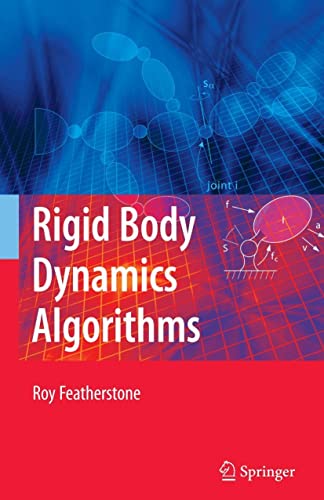
Rigid Body Dynamics Algorithms presents the subject of computational rigid-body dynamics through the medium of spatial 6D vector notation. It explains how to model a rigid-body system and how to analyze it, and it presents the most comprehensive collection of the best rigid-body dynamics algorithms to be found in a single source. The use of spatial vector notation greatly reduces the volume of algebra which allows systems to be described using fewer equations and fewer quantities. It also allows problems to be solved in fewer steps, and solutions to be expressed more succinctly. In addition algorithms are explained simply and clearly, and are expressed in a compact form. The use of spatial vector notation facilitates the implementation of dynamics algorithms on a computer: shorter, simpler code that is easier to write, understand and debug, with no loss of efficiency.
User’s Reviews
Editorial Reviews: Review From the reviews: This book deals with a numerical treatment of different problems in the dynamics of rigid-body systems which arise mainly in robotics . is centered on mechanical models made up of many rigid bodies connected by joints. The book is written in a clear way. Each chapter begins by stating the objectives to be achieved. The algorithms presented are well documented and worked examples are also given. the bibliography close this useful book on the computational approach to the dynamics of rigid-body systems. (A. San Miguel, Mathematical Reviews, Issue 2011 h) From the Back Cover Rigid Body Dynamics Algorithms presents the subject of computational rigid-body dynamics through the medium of spatial 6D vector notation. It explains how to model a rigid-body system and how to analyze it, and it presents the most comprehensive collection of the best rigid-body dynamics algorithms to be found in a single source. The use of spatial vector notation greatly reduces the volume of algebra which allows systems to be described using fewer equations and fewer quantities. It also allows problems to be solved in fewer steps, and solutions to be expressed more succinctly. In addition algorithms are explained simply and clearly, and are expressed in a compact form. The use of spatial vector notation facilitates the implementation of dynamics algorithms on a computer: shorter, simpler code that is easier to write, understand and debug, with no loss of efficiency. Unique features include: • A comprehensive collection of the best rigid-body dynamics algorithms • Use of spatial (6D) vectors to greatly reduce the volume of algebra, to simplify the treatment of the subject, and to simplify the computer code that implements the algorithms • Algorithms expressed both mathematically and in pseudocode for easy translation into computer programs • Source code for many algorithms available on the internet Rigid Body Dynamics Algorithms is aimed at readers who already have some elementary knowledge of rigid-body dynamics, and are interested in calculating the dynamics of a rigid-body system. This book serves as an algorithms recipe book as well as a guide to the analysis and deeper understanding of rigid-body systems.
Reviews from Amazon users which were colected at the time this book was published on the website:
⭐I’m a third year undergraduate mechanical engineering student and I bought this book as my supervisor sugested that I try to implement the concept of 6D spatial vectors into my research project. The book starts out fine, the ideas are sound but I’m having a rather hard time trying to make sense of it due to there being very little use of practical examples in the book and the examples that are in the book are not that well explained; I suspect engineering mathematics students might be able to benefit more from the book but as a mechanical student I find that I’m going to need a lot of assistance to understand the presented material.
⭐This book begins by introducing an algebra for forces and motions which greatly simplifies discussion of dynamics. It proceeds to comprehensively review algorithms for calculating rigid body dynamics with effective and easy to understand mathematics and pseudo-code. The book improves on Featherstone’s previous work in its algebra, and its addressing of closed loop systems. As a graduate student and robotics researcher I highly recommend this book for those interested in control and simulation design.
⭐
Keywords
Free Download Rigid Body Dynamics Algorithms 2008th Edition in PDF format
Rigid Body Dynamics Algorithms 2008th Edition PDF Free Download
Download Rigid Body Dynamics Algorithms 2008th Edition 2008 PDF Free
Rigid Body Dynamics Algorithms 2008th Edition 2008 PDF Free Download
Download Rigid Body Dynamics Algorithms 2008th Edition PDF
Free Download Ebook Rigid Body Dynamics Algorithms 2008th Edition