

Ebook Info
- Published:
- Number of pages:
- Format: PDF
- File Size: 33.17 MB
- Authors: J. Billingham
Description
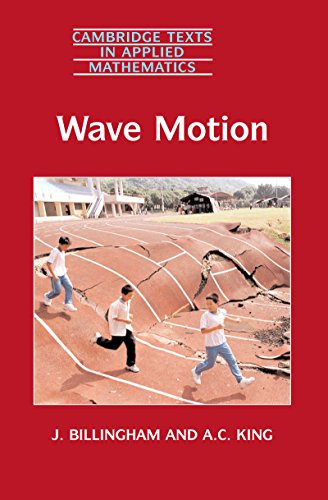
Waves are a ubiquitous and important feature of the physical world, and throughout history it has been a major challenge to understand them. They can propagate on the surfaces of solids and of fluids; chemical waves control the beating of your heart; traffic jams move in waves down lanes crowded with vehicles. This introduction to the mathematics of wave phenomena is aimed at advanced undergraduate courses on waves for mathematicians, physicists or engineers. Some more advanced material on both linear and nonlinear waves is also included, thus making the book suitable for beginning graduate courses. The authors assume some familiarity with partial differential equations, integral transforms and asymptotic expansions as well as an acquaintance with fluid mechanics, elasticity and electromagnetism. The context and physics that underlie the mathematics is clearly explained at the beginning of each chapter. Worked examples and exercises are supplied throughout, with solutions available to teachers.
User’s Reviews
Reviews from Amazon users which were colected at the time this book was published on the website:
⭐This book is not for a person beginning to study waves. Even with a strong mathematical background, many of the physical explanations in the book are vague and often confusing. The authors need to spend a little more time developing the student’s intuition. What seems obvious to them is not obvious to the novice. The book is well-written in the sense that the text flows well, and I imagine especially well for the expert. This book would make a good reference for someone with more experience in the subject matter.
⭐This is book is a little strange but still very good. It could be thought of as a modern version of Lighthill’s “Waves in Fluids”. It first assumes that you are familiar with a pretty wide range of mathematical tools, and also that you have the necessary experience to handle long calculations. If you’re comfortable with the method of stationary phase and contour integration but you’ve never studied acoustics or shocks, then this book is probably a worthwhile read. It’s also good as an introduction to more advanced areas such as solitons, although the book by Johnson and Drazin (Solitons: An Introduction) is probably a better resource. I would have liked a chapter on waves of importance in geophysics though, such as internal gravity waves, Coriolis waves, and Rossby waves. It would have made the book an even better resource.
⭐This modern book has considerable breadth and depth, and is ideally suited as a reference text as well as a text for upper class under graduate and graduate courses. It treats acoustic waves, waves in elastic media, fluid dynamical waves, electromagnetic waves and more. The material is clearly presented, including excellent illustrations. At the same time, it is mathematically rigorous and thereby equally appropriate as a text for applied mathematics as well as engineering courses and study. Each of the book’s twelve chapters ends with a set of homework problems, for which the authors have assembled a comprehensive well organized instructor’s solution manual.
⭐This text has all the basic ingredients for wave theory from the mathematical perspective. A must for all serious applied mathematicians working in the area.
⭐
Keywords
Free Download Wave Motion (Cambridge Texts in Applied Mathematics Book 24) 1st Edition in PDF format
Wave Motion (Cambridge Texts in Applied Mathematics Book 24) 1st Edition PDF Free Download
Download Wave Motion (Cambridge Texts in Applied Mathematics Book 24) 1st Edition PDF Free
Wave Motion (Cambridge Texts in Applied Mathematics Book 24) 1st Edition PDF Free Download
Download Wave Motion (Cambridge Texts in Applied Mathematics Book 24) 1st Edition PDF
Free Download Ebook Wave Motion (Cambridge Texts in Applied Mathematics Book 24) 1st Edition