

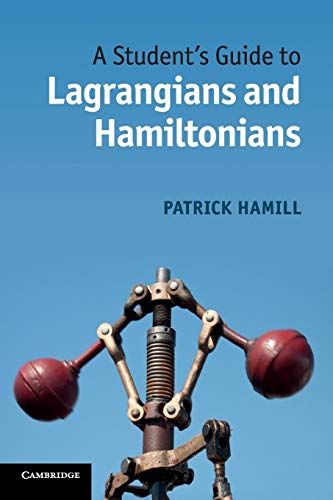
Ebook Info
- Published: 2013
- Number of pages: 181 pages
- Format: PDF
- File Size: 1.19 MB
- Authors: Patrick Hamill
Description
A concise but rigorous treatment of variational techniques, focussing primarily on Lagrangian and Hamiltonian systems, this book is ideal for physics, engineering and mathematics students. The book begins by applying Lagrange’s equations to a number of mechanical systems. It introduces the concepts of generalized coordinates and generalized momentum. Following this the book turns to the calculus of variations to derive the Euler–Lagrange equations. It introduces Hamilton’s principle and uses this throughout the book to derive further results. The Hamiltonian, Hamilton’s equations, canonical transformations, Poisson brackets and Hamilton–Jacobi theory are considered next. The book concludes by discussing continuous Lagrangians and Hamiltonians and how they are related to field theory. Written in clear, simple language and featuring numerous worked examples and exercises to help students master the material, this book is a valuable supplement to courses in mechanics.
User’s Reviews
Editorial Reviews: Review “In a logically clear and physically rigorous way the book highlights the landmarks of the analytical mechanics so that the attentive student can be easily prepared for the exam. It is suitable for studying in intermediate and upper-level undergraduate courses of classical mechanics ” Vladimir I. Pulov, Journal of Geometry and Symmetry in Physics Book Description A concise treatment of variational techniques, focussing on Lagrangian and Hamiltonian systems, ideal for physics, engineering and mathematics students. About the Author Patrick Hamill is Professor Emeritus of Physics at San José State University. He has taught physics for over thirty years and his research interests are in celestial mechanics and atmospheric physics. Read more
Reviews from Amazon users which were colected at the time this book was published on the website:
⭐Some time ago, I had written a review about
⭐by L.N. Hand and J.D. Finch saying that, although it contains the majority of the required material for a classical mechanics course, it is badly written and there is need for a well written textbook. The current book (published by the same publisher) fills this hole. It is indeed well written. It focuses on all fundamental concepts and constructions of classical mechanics and it does so in a concise way. As a result, students will find this book extremely valuable and, most probably, it will become of their favorite books. However, researchers or other people with good knowledge of the subject will not benefit from this book at all. Hence, the preamble to the title `A Student’s Guide to’ is right on target.Trying to present the most essential ideas of the topic, the author has decided to exclude all standard applications such as scattering, central potentials, rigid body, chains of particles, small oscillations, etc. Hence, it cannot be considered a standard textbook and, on its own, it cannot serve as a standalone reading on classical mechanics. In addition, the effort to suppress the size of the book has resulted in not including many examples, solved problems and a thorough end-of-chapter list of problems.Overall, it is a really good book and students should make it part of their recommended reading. However, they should still look for additional texts which include the topics omitted in this one.
⭐I’ve seen this little 180 pager going for almost 80 bucks US, so the natural two questions are:1. Is it worth it?2. What about Kindle?Yes to 1, as it gives a really stripped down, very simplified intro that will help through a LOT of the more difficult aspects of the calculus of variations. The author jokes that even the most overused formulas for acceleration in physics texts use oversimplified accelerations in Cartesian planes to hide the fact that any real, generalized analytic solutions are actually all subsets of advanced Hamilton-Jacobi formulas! Other than the most basic, most motion formula problems actually require numeric rather than analytic methods.For 2– Great news. Although Kindle (and most e readers) slaughter LaTex, this little book on Kindle ROCKS. The publisher took the time and care to be sure the formulas and illustrations worked. Don’t laugh, many do not do this! Yes, you have the minor hassle of a few e-page breaks where you have to go back and forth for an illustration, but the formulas are “blocked” so they are readable on every device I’ve tried, from my Android Note II to cloud/laptop and Kindle Fire. This is good news, because instead of making an $80 text $79 on Kindle like some publishers (grrrr), this sweet little text is about $13 on Kindle at this writing. Go for it!The author recommends a LOT of other titles for the “full” story with more applications and advanced treatments– but two to consider that are just awesome are:
⭐and
⭐.
⭐I haven’t finished the book, and I am not intending to review the mathematical content here and now.I am very disappointed by the Kindle version’s rendering of the equations. They are so tiny as to be almost unreadable. I can’t understand why a book published in 2014 would be presented in electronic form using the stone-age method of displaying the mathematical expressions as images rather than as electronically typeset characters. When viewed on a tablet I can enlarge each such image so as to read it, but that is frustrating, cumbersome and distracting. That option isn’t even available on a PC.To my knowledge, there is no way of expanding the image sizes to coincide with enlarging the font display. Hamill’s book is certainly not the only offender, but it is one of the most egregious.I also want to comment on the post-enlightenment practice of avoiding the pronoun “we” in mathematical texts. To illustrate why this is inferior to the traditional usage consider the following: if I add two plus two I make four. Now, the astute reader will understand that if you add two plus two you make four. If some third party were to add two plus two he will also make four. So, to the enlightened mind, if _we_ add two plus two, we make four.
⭐This is an excellent text; the perfect resource for anyone attempting to follow Leonard Susskind’s Opencourseware Stanford lectures on Classical Mechanics. The text provides much of the information that Susskind either assumes you know or skims over. (The lectures are wonderful, too.) My problem with this “Student’s Guide” is that, unlike Daniel Fleisch’s very fine Student’s Guide to Vectors and Tensors and his even better Student’s Guide to Maxwell’s Equations, answers to the problems are provided, but not detailed solutions to problems are not. I have followed Feynman’s recommendation to his sister when she did not understand certain aspects of physics to reread the text and retry the problems until you do. Still, Fleisch provided a web site which worked you through the solutions in a very thorough fashion. As no such web site or answer book is provided for with this text I sometimes find myself feeling a little like a fish out of water. Perhaps some kind graduate student of Dr. Hamill’s could provide a resource similar to Fleisch’s.
⭐* PhysicalThis book is very well bound for a paperback and has a great clarity in the size of the fonts to the size of the page.* Target AudienceThis is aimed physics, engineering and mathematical 2nd to third year undergraduates with a prerequisite with an ability or comprehension with Vector Calculus and partial differential equations, and perhaps any prior exposure with Calculus of Variations.* Whats covered then?The book starts on basic reminder of calculus equations of motion, then jumps into the Euler – Lagrange equation that is the workhorse of this and other books using Calculus of Variations. This has the usual required level of prior exposure to how the way the Mathematical language is used to explore this topic. The major plank used in the Lagrangian physics defined as the difference between Kinetic and Potential energies and expressed within the standard Lagrangian – Euler equation. You find a constant methodology as applying the ‘principle of superposition’ comes up time and time again.The three most important laws within this books content are ‘Conservation of Linear Momentum’, the ‘Conservation of Angular Momentum’ and the ‘Conservation of Energy’. If you know how each of the laws in symmetry terms as to how they work your O.K. The sections run another exposure to Calculus of Variations and how they can be applied with standard rules. The next parts cover a linking between Calculus of Variations which can be then applied with Lagrangian mechanics. The way these are explained uses a much stricter development with mathematical symbolic notation techniques. If your capable of reading this symbolic stuff its actually better way to take this lot in.This is needed as it generalizes to objects with many coordinates. I must say that explores ‘Constraints and Lagrange’s lambda method’ (p77-83) a real eye – opener has to how this operates.The later parts use a link from Calculus of Variations through Lagrange transformation and into canonical Hamiltonian techniques tougher to take in, but this latter method is described as much more capable method to use in multiple objects, multiple coordinate mechanics. It goes onto three – dimensional techniques in a very efficient way. Some of the Poisson stuff is still a bit vague at the moment, but i am still chugging along and having fun taking it bit – by -bit.There are answers at the back of the book if your up for a challenge.* SummaryThis book is a grand way to explore at a primer level, this important area of applied mechanics and personally its been a treat to read. I started this in September to October 2014. and it been a stimulating book and the price is fine.I reread this book – April – May 2020 as I had advanced in another book and this reread really helped me. I have a deeper understanding than before. Don’t worry about the length of time reading it, as long as you can take it as far as possible, that’s all that matters.
⭐Good book, but it needs the FULL solutions. The Maxwell’s equations is by far the best student guide, why cant they all have a similar structure? I think the series of books would do much better if they followed the example set in Maxwell’s equations guide. Too many times in this book is the answer given for the in chapter questions with no working, or little insight as to how it is obtained. Further, only odd number end of chapter questions are provided, I hate it when books are published in such a format, college professors should be at the level where they can write their own problems for classes! These books are for students after all… “students guide?” That’s miss leading,There is however, a number of good worked examples and the explanations are quite good. Worth the buy in the end, but it could be better.
⭐I don’t understand why anyone would write “a students guide”, to a subject, and think it was ok to not include full, detailed worked solutions to every problem. There are none, the book is utterly useless, avoid.
⭐Good, clear explanation of the mathematics behind this topic. Some worked examples and questions (those questions come with some answers…just the final answer though…not the working). I’ve come across some books on this topic which can twist you in knots. This is clear and unambigious. Recommended.
⭐A very educating and challenging enough book giving an excellent overview of the subject. The two level exercise and problem system worked well and there were difficult enough problems to solve. The only small minus was, that there were fairly many inaccuracies in problems and solutions – however, keeping the reader alert.
Keywords
Free Download A Student’s Guide to Lagrangians and Hamiltonians (Student’s Guides) 1st Edition in PDF format
A Student’s Guide to Lagrangians and Hamiltonians (Student’s Guides) 1st Edition PDF Free Download
Download A Student’s Guide to Lagrangians and Hamiltonians (Student’s Guides) 1st Edition 2013 PDF Free
A Student’s Guide to Lagrangians and Hamiltonians (Student’s Guides) 1st Edition 2013 PDF Free Download
Download A Student’s Guide to Lagrangians and Hamiltonians (Student’s Guides) 1st Edition PDF
Free Download Ebook A Student’s Guide to Lagrangians and Hamiltonians (Student’s Guides) 1st Edition