

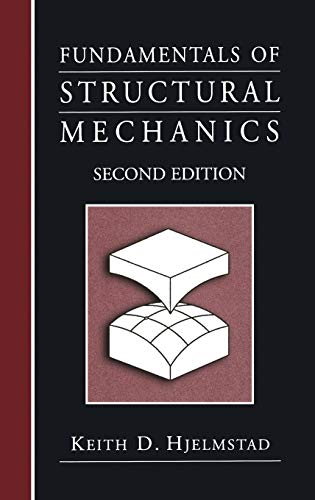
Ebook Info
- Published: 2004
- Number of pages: 494 pages
- Format: PDF
- File Size: 21.28 MB
- Authors: Keith D. Hjelmstad
Description
A solid introduction to basic continuum mechanics, emphasizing variational formulations and numeric computation. The book offers a complete discussion of numerical method techniques used in the study of structural mechanics.
User’s Reviews
Reviews from Amazon users which were colected at the time this book was published on the website:
⭐I love the way concepts have been explained in the book. The author sets up a stage for each concept and then provide mathematical formulation. I never felt bored reading this book because it had plenty of theoretical analogies and examples which helped me relate myself to the subject. The book follow the tensor approach, which I found hard to grasp in the beginning because I did not understand the power of tensors. I would highly recommend to go through the introductory chapter 1 on vectors and tensor thoroughly and attempt all the problems in the exercise. Once you have ample command over vectors and tensors, all the mathematical formulations would be a piece of cake. All the derivations of formulae in three-dimensions becomes very easy with tensors. You might supplement this book with a book on tensor if you are really interested in mathematics. But the thing I liked about this book is the flow of concepts presented in each chapter. I never felt lost and always had an incentive to read the next chapter. I would recommend this book for graduate mechanics class. This is the kind of the book that you would always like to keep as a reference with you, even after the course.
⭐This textbook was a great resource for the theory of structural mechanics, but did not have any examples to follow in the text. This made the problems at the end of each chapter difficult to associate with the theory taught.
⭐Great book
⭐This book is useless.
⭐Until you’ve looked over some of the more advanced solid mechanics texts such as Marsden and Hughes, Love, or Timoshenko, you won’t understand the virtues of this book. Likewise, without a cursory knowledge of FEM, you understand the main thrust of this book, which is to teach the student just enough sold/structural mechanics and mathematics that they can approximate the solution using the Ritz method.The author covers quite a bit of ground in a small amount of space: tensors, tensor calculus, kinematics, equilibrium, constitutive laws, boundary value problems, the Ritz method, beams, plates, energy methods, stability, and nonlinear solution techniques. Dr. Hjelmstad introduces these topics to the reader with lucid prose, and he always gives a physical, logical, or practical justification for the mathematical gymnastics to come. By concentrating on the big ideas, the reader does not drown an abyss of algebra. The author’s clear, direct style is perhaps the most attractive feature for students new to solid mechanics, but because so much is covered in this book, the advanced student will find ideas expanded in later books but in context here.These are the main virtues of the book – it is also the main vice, because the practical step of solving solid mechanics problems is neglected. There are a few dozen solved examples in the book and a few hundred unsolved problems for the student. Without access to someone who knows how to solve these problems, the abstractions and techniques of the book are almost impossible to grasp. It would be a crime to interrupt the flow of the book, but an appendix with solution techniques, methods, and more worked problems for each chapter would be a major improvement as the book doesn’t even include answers to selected problems. I have a few other minor gripes: the index isn’t nearly long enough; too much time is spent on Timoshenko beams and not enough on Bernoulli-Euler beams (especially regarding boundary conditions), and small strain linear elasticity is stressed almost exclusively.If you’re a beginning student in structural mechanics looking for something more than Mohr’s Circle and know someone to assist you in solving the problems, this is an excellent choice. If you want to know the very basic foundation of the computational structural mechanics, you’ll want to read this book. If you want to know how to solve these problems, then you probably need to look elsewhere.
⭐My first exposure to structural mechanics was a graduate course coupled with this book. I recently read this book cover-to-cover to review my mechanics knowledge.This book is well written. The book begins by introducing the reader to the necessary tools for structural mechanics, such a vector and tensor operations and calculus. In this sense, the book is fully self-contained, requiring minimal prerequisites besides basic calculus and a desire to learn structural mechanics. Indicial notation is also introduced early, relaxing the notational requirements of equations later on. A reader not experience in tensors or indicial notation will find everything needed in the first chapter and will quickly realize the beauty in their use.The book then goes on to introduce elementary concepts such as strain, stress and constitution in the framework of 3D continuum mechanics, contrary to the elementary definitions the reader may be accustomed to. With the prerequisite ideas in place, the book gets into the boundary value problem coupled with the Rtiz method, the theory of beams (Timoshenko and Euler), theory of plates, stability and buckling. All of these topics are interesting and will provide insight to a reader familiar with structural engineering.All topics are built on previous topics and covered thoroughly. The figures are clean and enhance understanding of the material. The book is written in a very prose narrative and witty at times. This book is best appreciated with a nice glass of wine and a bean-bag chair.The problems after each chapter are each unique and provide insight into the application of the theory introduced in each chapter. However, the correct “mindset” required to work these problems is not necessarily gained from reading each chapter. A few worked examples would provide the reader a good guide to establishing the typical procedure for solving these problems. These examples (perhaps 40 of them) would be best provided as a supplement, to avoid interrupting the flow of each chapter. I recommend the book to anyone interested in learning about structural mechanics either for the first time or as a review. The book contains all of the required mathematics and notation required, allowing exploration into advanced topics. It is one of few books that provide a narrative to the development of theory.
⭐Prodotto consegnato in ottime condizioni.Il libro è scritto molto bene e l’autore trasmette la propria passione per la meccanica strutturale al lettore.
⭐
⭐many theoretical insight in it, but not for direct use in practice. so just remind: It is a graduate book, not a undergraduate cook book.
⭐L’ho acquistato ad un prezzo veramente vantaggioso. E’ la versione con copertina rigida che ho pagato circa 20€ ed ora è in vendita a più di 70€
⭐
⭐One of the best book in the field. Must read by every mechanicians
Keywords
Free Download Fundamentals of Structural Mechanics 2nd Edition in PDF format
Fundamentals of Structural Mechanics 2nd Edition PDF Free Download
Download Fundamentals of Structural Mechanics 2nd Edition 2004 PDF Free
Fundamentals of Structural Mechanics 2nd Edition 2004 PDF Free Download
Download Fundamentals of Structural Mechanics 2nd Edition PDF
Free Download Ebook Fundamentals of Structural Mechanics 2nd Edition