Ebook Info
- Published: 2012
- Number of pages: 594 pages
- Format: PDF
- File Size: 59.95 MB
- Authors: Alexander L. Fetter
Description
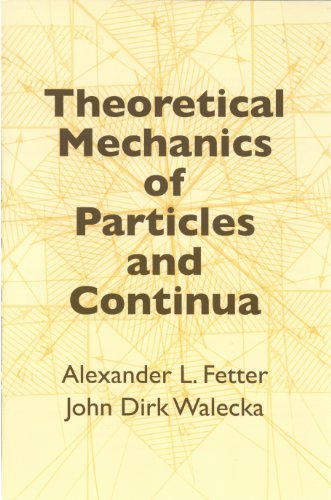
This two-part text fills what has often been a void in the first-year graduate physics curriculum. Through its examination of particles and continua, it supplies a lucid and self-contained account of classical mechanics — which in turn provides a natural framework for introducing many of the advanced mathematical concepts in physics.The text opens with Newton’s laws of motion and systematically develops the dynamics of classical particles, with chapters on basic principles, rotating coordinate systems, lagrangian formalism, small oscillations, dynamics of rigid bodies, and hamiltonian formalism, including a brief discussion of the transition to quantum mechanics. This part of the book also considers examples of the limiting behavior of many particles, facilitating the eventual transition to a continuous medium.The second part deals with classical continua, including chapters on string membranes, sound waves, surface waves on nonviscous fluids, heat conduction, viscous fluids, and elastic media. Each of these self-contained chapters provides the relevant physical background and develops the appropriate mathematical techniques, and problems of varying difficulty appear throughout the text.
User’s Reviews
Reviews from Amazon users which were colected at the time this book was published on the website:
⭐This book covers all the main topics that a mechanics course at the advance undergraduate or graduate level should have and more. It starts with a first chapter on Basic Principles where the authors do a general review about Newtonian mechanics, that is, Newton’s laws, angular momentum, energy, conservation laws, center of mass motion, two body motion with a central potential and scattering. Then follows a chapter on Accelerated Coordinate Systems where you encounter things like the Corioly acceleration and centrifugal forces. Chapter three is a delight, it is about Lagrangian Dynamics where you learn a much powerfull formalism than newton’s equations to solve problems using the Lagrangian function, learning about virtual displacements and generalized coordinates (also D’Alambert and Hamilton’s principle). Chapter four is about Small Oscillations, it is very important since here you learn to work with many-particle systems that are use a lot in condense matter physics, the very well known normal coordinates are here introduced. Chapter five is about Rigid Bodies, chapter six is about Hamiltonian Dynamics, this chapter connects very well with chapter three illustrating yet another method to solve mechanics problems by defining canonically momentas for every generalized coordinates and then finding a set of first orders differential equations involving the hamiltonian (as opposed to chapter three where either D’Alambert or Hamilton principle lead to a system of second order differential equations) The hamiltonian is defined as a Legendre transformation of the Lagrangian function, also the Poisson brackets are introduced here and it is even explained how to do the transition between classical and quantum mechanics and also canonical transformations are introduced. This first six chapters make purchasing this book worthwhile but as if this weren’t enough there are still another seven chapters more! I will just write their names: 7-Strings, 8-Membranes, 9-Sound waves in fluids, 10-Surface waves on fluids, 11- Heat Conduction, 12-Viscous Fluids and 13-Elastic continua. It also brings 5 appendices. This book is very well written and I always come back to it when I have to remember some mechanics formula or issue to re-study, I say that this book, Landau and Goldstein are the best books you can get on classical mechanics.
⭐I found it to be full of the mathematics that explains Theoretical Mechanics. It is so hard to find books that can explain the materials in the way that this book can. Many books claim to explain this material but they fall short. I highly recommend this book to everyone who wishes to learn theoretical mechanics and particle continua. Many claim to answer ones questions but only this book will get one to the finish line.
⭐I have to use this textbook for a class. The text itself isn’t the worst, but the problems are rough. This mismatch is something of an issue; the coverage of material is rather vague compared to the detail of the problems which makes a course based on this text rather frustrating at times. The mechanics texts by Goldstein and Arnold (for those more into mathematics) are superior to Fetter and Walecka while covering most of the same material.
⭐It’s not terrible, but not good either. My standards are pretty low for physics books, as most are terrible. This book does not have many examples, and wastes a lot of space with “proofs”. Definitely not a stand-alone book, but I don’t have anything good to recommend.If this book isn’t required for a class, you would have better luck looking on wikipedia to learn the material, but that’s pretty much a given.
⭐A really superb graduate level classical mechanics and dynamics book. Written by a gifted teacher.
⭐Good book, good examples. Of course, there could always be more example problems.
⭐It is OK. I cannot comment to much for the textbook. About the speed, they delieverd it soon, the book is fine.
⭐Perfect,
Keywords
Free Download Theoretical Mechanics of Particles and Continua (Dover Books on Physics) in PDF format
Theoretical Mechanics of Particles and Continua (Dover Books on Physics) PDF Free Download
Download Theoretical Mechanics of Particles and Continua (Dover Books on Physics) 2012 PDF Free
Theoretical Mechanics of Particles and Continua (Dover Books on Physics) 2012 PDF Free Download
Download Theoretical Mechanics of Particles and Continua (Dover Books on Physics) PDF
Free Download Ebook Theoretical Mechanics of Particles and Continua (Dover Books on Physics)