

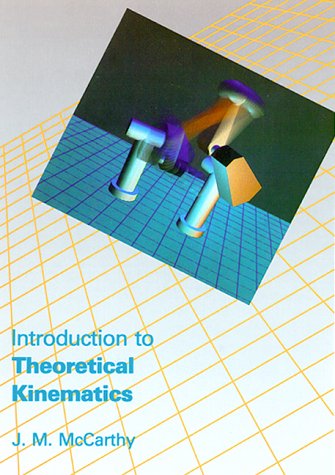
Ebook Info
- Published: 1990
- Number of pages: 145 pages
- Format: PDF
- File Size: 4.49 MB
- Authors: J. M. McCarthy
Description
Introduction to Theoretical Kinematics provides a uniform presentation of the mathematical foundations required for studying the movement of a kinematic chain that makes up robot arms, mechanical hands, walking machines, and similar mechanisms. It is a concise and readable introduction that takes a more modern approach than other kinematics texts and introduces several useful derivations that are new to the literature. The author employs a unique format, highlighting the similarity of the mathematical results for planar, spherical, and spatial cases by studying them all in each chapter rather than as separate topics. For the first time, he applies to kinematic theory two tools of modern mathematics – the theory of multivectors and the theory of Clifford algebras – that serve to clarify the seemingly arbitrary nature of the construction of screws and dual quaternions. The first two chapters formulate the matrices that represent planar, spherical, and spatial displacements and examine a continuous set of displacements which define a continuous movement of a body, introducing the “tangent operator.” Chapter 3 focuses on the tangent operators of spatial motion as they are reassembled into six-dimensional vectors or screws, placing these in the modern setting of multivector algebra. Clifford algebras are used in chapter 4 to unify the construction of various hypercomplex “quaternion” numbers. Chapter 5 presents the elementary formulas that compute the degrees of freedom or mobility, of kinematic chains, and chapter 6 defines the structure equations of these chains in terms of matrix transformations. The last chapter computes the quaternion form of the structure equations for ten specific mechanisms. These equations define parameterized manifolds in the Clifford algebras, or “image spaces,” associated with planar, spherical, and spatial displacements. McCarthy reveals a particularly interesting result by showing that these parameters can be mathematically manipulated to yield hyperboloids or intersections of hyperboloids.
User’s Reviews
Editorial Reviews: About the Author J.M. McCarthy is a professor in the Department of Mechanical and Aerospace Engineering at the School of Engineering, University of California, Irvine.
Reviews from Amazon users which were colected at the time this book was published on the website:
⭐
⭐
⭐
Keywords
Free Download Introduction to Theoretical Kinematics in PDF format
Introduction to Theoretical Kinematics PDF Free Download
Download Introduction to Theoretical Kinematics 1990 PDF Free
Introduction to Theoretical Kinematics 1990 PDF Free Download
Download Introduction to Theoretical Kinematics PDF
Free Download Ebook Introduction to Theoretical Kinematics