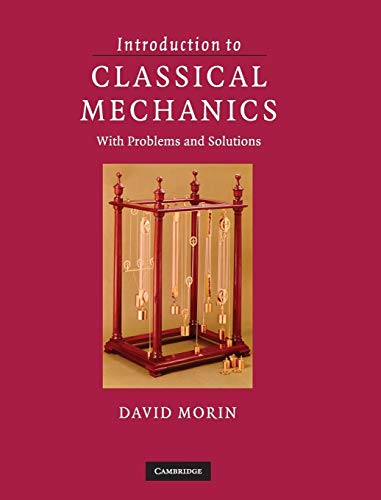
Ebook Info
- Published: 2008
- Number of pages: 734 pages
- Format: PDF
- File Size: 6.14 MB
- Authors: David Morin
Description
This textbook covers all the standard introductory topics in classical mechanics, including Newton’s laws, oscillations, energy, momentum, angular momentum, planetary motion, and special relativity. It also explores more advanced topics, such as normal modes, the Lagrangian method, gyroscopic motion, fictitious forces, 4-vectors, and general relativity. It contains more than 250 problems with detailed solutions so students can easily check their understanding of the topic. There are also over 350 unworked exercises which are ideal for homework assignments. Password protected solutions are available to instructors at www.cambridge.org/9780521876223. The vast number of problems alone makes it an ideal supplementary text for all levels of undergraduate physics courses in classical mechanics. Remarks are scattered throughout the text, discussing issues that are often glossed over in other textbooks, and it is thoroughly illustrated with more than 600 figures to help demonstrate key concepts.
User’s Reviews
Editorial Reviews: Review “I think all undergraduate physics majors will own a copy of this book within a year. It’s that good.” Professor Krsna Dev, Middlebury College”This textbook serves as an introduction to standard undergraduate classical mechanics topics, including Newton’s laws, energy, momentum, oscillators, rotational dynamics and angular momentum. … The real value of this book, however, lies in the extensive set of problems and worked solutions that many students tend to crave and as such is sure to be warmly welcomed.” Contemporary Physics Book Description Supplementary textbook for all levels of undergraduate physics courses in classical mechanics. From the Author For more information, including the Preface (which describes the intended audience) and a new chapter on Hamiltonian Mechanics, please see the author’s Harvard University web page. About the Author David Morin is Lecturer on Physics at Harvard University. He received his Ph.D. in theoretical particle physics from Harvard in 1996. When not writing physics limericks or thinking of new problems whose answers involve e or the golden ratio, he can be found running along the Charles River or hiking in the White Mountains of New Hampshire. Read more
Reviews from Amazon users which were colected at the time this book was published on the website:
⭐Taylor’s Mechancis is exceptionally well written as compared to the other popular mechanics books at about this same level (Kleppner, Morin). However, the book is unrigorous in both its use of mathematics (after all, it’s a physics book!) and its treatment of physics, especially angular rotation and the variational dynamics. That makes it a good follow up to something like Halliday for students who are content to use math and do physics heuristically; that is to say, for most engineering and science students, this book makes for a good, gentle introduction to advanced topics in dynamics.However, Taylor is not suitable as a either and introductory or intermediate text in mechanics for students interested in graduate studies which will depend on this material. Kleppner rigorously derives the classical physics theorems in limited cases, using rigorous but elementary calculus, making it a more suitable introduction to the subject. Morin unrigorously derives the classical physics theorems in generality using huristic vector calculus, making it a much more suitable follow up to Kleppner and prerequisite to Goldstein (which is the standard doctoral text).Notice, though, that Taylor covers significantly more topics than Kleppner and Morin combined. This is in the nature of things: heuristic examples are easier to explain than theorems and proofs, which affords Taylor the time to introduce some amazing applications of the theory, for example nonlinear dynamics and fluid dynamics. If you are looking for a cohesive introduction to these tangential topics, and are content to do things heuristically, there might not be a better book than Taylor.I scored Morin 4/5 because it is the only book at this level which provides a rigorous accounting of physics of angular dynamics in the general case. However, the chatty style–not just the random poems, but also in the excessive number of casual “remarks” throughout–detracts from the physics. In particular, the chapter on Lagrangian Mechanics is terribly written. There again, the treatment is more correct but less clear than in Taylor, but in this instance the line of argumentation is nearly unintelligible on a first reading.However, it should be noted that almost no books prove, in the special cases where such a proof is possible, that Newtonian and Lagrangian physics are equivalent. They all, for whatever reason, simply argue the “if” or the “only if” part of the correspondence. In reality, Morin should probably deal with Lagrangian physics as he does angular physics: break it into two chapters, the first dealing with the most important special case (Cartesian degrees of freedom), the second dealing with the general case (generalized degrees of freedom). As it stands, none of the introductory Lagrangian Mechancis books, including Goldstein, do this–however, Goldstein is at least explicit enough with the definitions so that the untreated correspondence can easily be worked out by a student on a first reading.Furthermore, it should be noted that the treatment of Special Relativity follows the “curious paradox” line of reasoning, rather than the “homomorphic equations” line of reasoning. This is the standard, but by definition it is unintuitive. Since physical–in particular, mechanical and electrical–intuition is of paramount importance in the study and application of physics, I also think this standard treatment is rather useless. Physics Professors seem to insist on treating Special Relativity after Classical Mechanics but before Classical Electromagnetism, which precludes the line of argumentation which seemed to inspire Einstein in the first place: that Maxwell’s Equations, including the constant factors, ought to have the same form under suitable changes of coordinates. For this reason, I think the best treatments of special relativity can be found in books like Griffiths and Jackson, rather than books like Morin and Taylor. (Indeed, Taylor explicitly refers the reader to Griffiths, which is ridiculous since both books deploy the same mathematical machinery).
⭐This is a very well written book. Good problem sets that build student knowledge along with thorough solutions provided after the problem sets.This would not be a good book for either first year physics students or first year honors physics students. They may be using this for first year honors at Harvard, but it is doubtful that the students are absorbing more that 50% of the information. There may be the exceptional student who is already grounded in Calculus and intro diff eqns along with a well developed AP physics, but most first year honors will be in over their heads.With that said, this would be a very good third year mechanics course text. The only real shortcoming is it is missing information on Hamiltonian, non-linear, chaos and such, but that could easily be supplemented during second semester. This treatise is much much better that Taylor’s Classical Mechanics which is overly verbose, introduces other nomenclature at the same time it is introducing mechanics (no need to add to student’s burdens by using different nomenclature than they are used to). Taylor’s examples, problem and answer sets are very weak and add little value to that text.This particular text should be strongly considered for third year physics mechanics along.
⭐One of my favorite textbooks on classical mechanics. I enjoy this textbook because it doesn’t shy away from the derivations of the equations used and it has a lot of insightful footnotes. Some of them point out common misunderstandings of the concepts presented, and others are just interesting ways of looking at the topics presented.I wouldn’t recommend this as a first college textbook on classical mechanics, though. I think it functions better as a second read on classical mechanics. David Morin’s book will help you flesh out the fine details of classical mechanics and really solidify your knowledge.The chapters themselves are very good, but the problems at the end of the chapters are my favorite part. David Morin did a fantastic job collecting what you would call “cute” problems. The problems will really help you build your problem solving skills. You will be forced to be creative (figuring out how to correctly set up the problem), and systematic (checking limits and such).I repeat, the material itself is introductory classical mechanics, but the problems are tougher and not “plug and chug” problems and, in my opinion, should be attempted after already learning from an easier textbook and doing easier problems from another textbook.To reiterate once again…A lot of reviews might complain about this book and give it less stars because they feel like it isn’t introductory. However, the material really is standard classical mechanics. The low reviews are, in my opinion, by people who are frustrated by some of the tougher problems and who don’t have as strong problem solving skills as they initially thought they did. Buy this book if you are looking to really work out your problem solving skills and are aiming to become a physicist. Those who simply want to learn classical mechanics and do simple “plug and chug” problems will have to look elsewhere.
⭐I can’t help but get the feeling that most bad reviews here are from people who are frustrated with the difficulty of the problems in this book.I was initially shocked by the amount of insights contained in every section! Throughout this book, the author presents various helpful examples with proper commentary. He points out the subtle points and he always shares his -at many instances, unique- insights. He is very verbose but everything he mentions is great and very beneficial for the reader!After Dr. Morin has provided the reader with the proper background to solve the exercises (without ever rushing it), he proceeds to solved exercises. There are lots of them in each chapter (about 20-30 each chapter). After this, the author provides the reader with a lot of unsolved exercises for him to solve alone.So, we now come back to the first sentence of this review. Many complain that the problems are diabolically difficult. Well, after so many worked out examples, I think that having difficult problems (with solutions of course) is a natural extension. The reader starts solving easy exercises, and they gradually get more difficult. Moreover, the problems are themselves very interesting and quite a few of them require creative thinking, which is amazing!Furthermore, for the reviewers who found that the exercises were too difficult, it is not expected by every reader to be able to solve the more difficult exercises. This is a book for everyone: from dumb people to really smart; it’s just that the smarter you are, the more exercises you can solve, which is only natural. Mediocre students can skip the various insights and just go over the solved problems and refer to the solutions when they can’t solve them. Anybody at a higher level than them can appreciate the insights, try to solve the solved problems and then proceed to the unsolved ones. Of course, as I said, you can’t expect to solve everything because some exercises are for the really smart reader. But, it’s safe to say that anyone who sticks with this book, no matter what his/her level is, is going to learn a lot about the concepts described here and learn how to solve much more difficult exercises than they thought they would be able to solve. Not being able to solve all of them is only natural for a book that does not assume that its reader is dumb.For me, insightful books like this should be in every physicist’s bookshelf.
⭐David Morin and David Griffith these 2 davids are the one you want for introduction to various topics , (tho Jackson’s classical electrodynamics is good ) but anyways the book maybe over kill for me as a jee adv aspirant the problems are stupendous I am literally in love ,and am willing to solve the book too after my jee ,tho totally overkill for jee , instead I recommend buying physics galaxy for jee , honestly really good book couldn’t recommend it enough plus funny too , humour is always a welcome addition I guess David G and David M do humor the best , idk I know maybe I’m being a fan girl but seriously I love this book , sadly I wasn’t aware if exams like NSEP ,INPHO ,and IPHO during my school so I couldn’t try them out ( cries in the corner ) great book for ipho students too for inpho tho hm the level is not that different for jee adv (leathy problems tho ) so for inpho only go for physics galaxy
⭐This is an excellent book, a must have. David Morin has the gift of crystal clear explaining things that are usually taken for granted in other books but are needed for a fundamental understanding of the matter. This book is full of very interesting problems from simple to very challenging, that help a lot in truly learning the concepts and creating a solid foundation for other physics courses.
⭐This book is amazing, my only drawback is that some of the methods used are not as well explained as I had hoped. I am stuck going through this book because I have used other methods. This is good in a way as there are different methods for the same problem and this is now making me find out more about the methods used herein.
⭐Great
Keywords
Free Download Introduction to Classical Mechanics: With Problems and Solutions 1st Edition in PDF format
Introduction to Classical Mechanics: With Problems and Solutions 1st Edition PDF Free Download
Download Introduction to Classical Mechanics: With Problems and Solutions 1st Edition 2008 PDF Free
Introduction to Classical Mechanics: With Problems and Solutions 1st Edition 2008 PDF Free Download
Download Introduction to Classical Mechanics: With Problems and Solutions 1st Edition PDF
Free Download Ebook Introduction to Classical Mechanics: With Problems and Solutions 1st Edition