

Ebook Info
- Published: 2008
- Number of pages: 368 pages
- Format: PDF
- File Size: 1.43 MB
- Authors: Christine Kenneally
Description
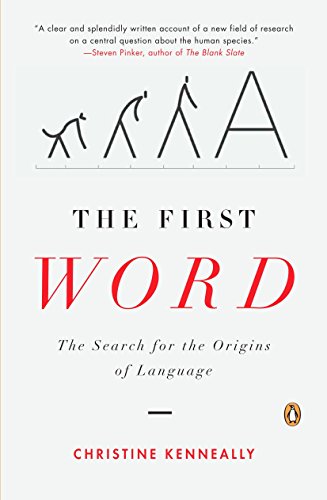
An accessible exploration of a burgeoning new field: the incredible evolution of language The first popular book to recount the exciting, very recent developments in tracing the origins of language, The First Word is at the forefront of a controversial, compelling new field. Acclaimed science writer Christine Kenneally explains how a relatively small group of scientists that include Noam Chomsky and Steven Pinker assembled the astounding narrative of how the fundamental process of evolution produced a linguistic ape-in other words, us. Infused with the wonder of discovery, this vital and engrossing book offers us all a better understanding of the story of humankind.
User’s Reviews
Editorial Reviews: Review ? A clear and splendidly written account of a new field of research on a central question about the human species.? ?Steven Pinker, author of “The Blank Slate” ? A crash course on imitation, gesture, abstract thought, and speech. . . . It is eminently worthy of attention.? ?”Psychology Today” ? Scientists who study the origins of language are a passionate, fractious bunch, and you don?t have to be an egghead to be tantalized by the questions that drive their research: how and when did we learn to speak, and to what extent is language a uniquely human attribute? What [Kenneally] describes is fascinating.? ?”The New York Times Book Review” A clear and splendidly written account of a new field of research on a central question about the human species. Steven Pinker, author of “The Blank Slate” A crash course on imitation, gesture, abstract thought, and speech. . . . It is eminently worthy of attention. “Psychology Today” Scientists who study the origins of language are a passionate, fractious bunch, and you don t have to be an egghead to be tantalized by the questions that drive their research: how and when did we learn to speak, and to what extent is language a uniquely human attribute? What [Kenneally] describes is fascinating. “The New York Times Book Review”a A clear and splendidly written account of a new field of research on a central question about the human species.a aSteven Pinker, author of “The Blank Slate” a A crash course on imitation, gesture, abstract thought, and speech. . . . It is eminently worthy of attention.a a”Psychology Today” a Scientists who study the origins of language are a passionate, fractious bunch, and you donat have to be an egghead to be tantalized by the questions that drive their research: how and when did we learn to speak, and to what extent is language a uniquely human attribute? What [Kenneally] describes is fascinating.a a”The New York Times Book Review”It never hurts to begin with a genius, so the author opens by declaring, “the story of language evolution studies is unavoidably the story of the intellectual reign of Noam Chomsky.” Before Chomsky, linguists searched for new languages, wrote down vocabulary and grammar and compared them to other languages. They never addressed questions about the origin of language because conventional wisdom declared such questions could not be answered. Sixty years ago, Chomsky pointed out that infants learn to talk merely by interacting with those around them for a few years. Since conversation contains too little information to provide rules for this incredibly complex skill, humans must be born with the unique ability to learn to speak. This assertion galvanized a generation of researchers who turned their attention to the roots of language. Since Chomsky asserted that language is a uniquely human phenomenon, he doubted evolution played a role in its origin. So great was his influence that scientists have only recently overcome their inhibitions and turned up fascinating evidence to the contrary. Readers will blink as the author describes studies demonstrating that animals use language and can be taught more. Early, highly publicized experiments with apes gave the field a bad reputation because the animals seemed to be responding to trainers’ cues, but careful studies make it clear that many animals can employ syntax and vocabulary at the level of a three-year-old human. Despite our vastly superior language abilities, researchers have yet to find any speech areas in the human brain that are not present elsewhere in the animal kingdom. Kenneally’s book features a steady stream of brilliant, opinionated people expressing ideas that often contradict those of other brilliant people, but she channels this flood of frequently technical arguments into a comprehensible and stimulating narrative. Lively portrait of a fascinating new scientific field. “Kirkus” All branches of science search for origins. Biologists want to know how life on earth began. Astronomers want to know how the universe got started. Even in mathematics, questions about how different numerical systems came to be constitute a legitimate line of inquiry. Linguists are different. In the middle of the 19th century, the main professional bodies governing linguistic research formally banned any investigation into the origins of language, regarding it as pointless. The topic remained disreputable for more than a century, but in the last decade or so, language evolution has eased toward the front burner, attracting the attention of linguists, neuroscientists, psychologists and geneticists. Their search is the subject of The First Word, Christine Kenneallys lucid survey of this expanding field, dedicated to solving what she calls the hardest problem in science today. One nut to crack is the nature of language itself, and here Ms. Kenneally introduces the unignorable presence in virtually every linguistic debate, Noam Chomsky. Mr. Chomsky and his many adherents regard language as a uniquely human endowment, centered in a specific area of the brain. It gives every living person the ability, unsought, to generate infinite strings of sentences in infinite combinations. Animals, in this view, do not have language, nor do they think. The reasons that humans speak, or how language might have made itsway to the human brain, do not matter. It may simply be that in a linguistic version of the big bang, a language mutation suddenly appeared, and that was that. This view now faces many rivals. The big-bang theory has been countered by linguists who believe that just as the eye evolved to meet a need for vision, language evolved to meet the need for communication. Ms. Kenneally ushers onto the stage researchers who have discovered that many animal species possess languagelike skills previously unimagined and, without benefit of syntax or words, have a complicated inner life. They believe that the study of animal language and gestures could shed light on a possible protolanguage stage in human development. The idea that language is restricted to a specific area of the brain has been more or less discarded. Brain researchers now believe that language tasks are assigned throughout the brain. Moreover, some linguists now believe that language is a two-way street. Its not something emanating from the brain of a communicating human. It actually changes the processes of the brain. Stroke victims suffering from aphasia, a condition involving language loss, do not simply find it difficult to communicate, they also find it more difficult to categorize, remember and organize information. One of Ms. Kenneallys most intriguing scientists, Simon Kirby, a linguist at the University of Edinburgh who works with computer models, has proposed the idea that language might be a self-evolving phenomenon. Somewhat like a computer virus, it changes and adapts to survive. Ms. Kenneally, a linguist trained at the University of Cambridge, covers an enormous expanse of ground as she brings thereader up to date on developments in a wide variety of disciplines touching on language evolution. At times, she lapses into a somewhat mechanical recitation of experiments, papers and positions, which she tries to enliven, in vain, by inserting long, unedited quotations from her interview subjects that could just as well have been paraphrased. On the plus side, she explains difficult ideas concisely and clearly, and she maintains a firm grip on the steering wheel, moving the overall argument along in a straight line. Above all, she is scrupulously fair-minded. Although obviously taken with the idea of language evolution and language acquisition as a continuum seen in primitive form in other species, she gives Mr. Chomsky his due, despite his withering scorn for most of the ideas she presents, and defends him from his most vehement detractors. Best of all, Ms. Kenneally zeroes in on a host of fascinating experiments. What happens when one ape trained in sign language meets another equally proficient ape for the first time? Not communication, it turns out. What resulted was a sign-shouting match; neither ape was willing to listen, Ms. Kenneally reports. Mr. Kirby, the computer modeler, devised an experiment in which subjects were shown objects on a screen along with words describing the objects in what was represented as an invented alien language. The subjects were asked to learn the language. In testing one student after the other, however, Mr. Kirby added new objects to the ones already shown, whereupon the subjects unthinkingly generated new words and combinations. These changes were added to the core list and passed along to successive subjects who, trying to master the language created, in part, by each of their predecessors, made their own additions and changes. Except for the initial random language given to the first subject, there was no alien language, only the contributions of each individual, which were culturally transmitted from generation to generation, Ms. Kenneally writes. Each subject in the experiment believed that he was simply giving back what he had learned, but instead the language was evolving. In similar fashion, researchers have been looking at Internet sites that generate their own protolanguages and linguistic structures. Ms. Kenneally concludes with a little experiment of her own. She asks many of the subjects she interviewed to imagine a group of infants stranded on the Galapagos Islands, provided with all the necessities of life but no access to speech. Would they create a language? How many babies would it take, what might their language be like, and how would it change over the generations? The answers range from no language to sign language to a full-fledged language in three generations. The real point is that Ms. Kenneally could gather 15 linguists willing to think about the problem. Onward to the first Neanderthal dictionary. “The New York Times” (daily) About the Author Author of The Invisible History of the Human Race and The First Word, Christine Kenneally is an award-winning journalist who has written for The New Yorker, the New York Times, Slate, Time, New Scientist, The Monthly, and other publications. Before becoming a reporter, she received a PhD in linguistics from Cambridge University and a BA (with honors) in English and linguistics from Melbourne University. She was born and raised in Melbourne, Australia, and has lived in England, Iowa, and Brooklyn, New York.
Reviews from Amazon users which were colected at the time this book was published on the website:
⭐”The First Word”, Christine Kenneally’s “search for the origins of language” comes with its share of celebrity endorsements. The back cover contains laudatory blurbs from both Steven Pinker (“a clear and splendidly written account …”) and author of “The Ghost Map”, Steven Johnson, (“a rare and delightful mix…”). Then there is the following gem on the inside jacket cover – “The First Word is not only a compelling historical account of our greatest intellectual faculty but a provocative consideration of what it means, finally, to be human”.Well, it seems hardly fair to hold an author accountable for whatever silliness her publishers might assemble on a book’s exterior in the interest of boosting sales. Let’s just say that this book is ambitious in its scope and that the author is obviously academically well-qualified. My own formal qualifications in the field of linguistics are non-existent, so this review is from the point of view of a non-specialist with a keen amateur interest in the topic.An obvious question: `is this a book for the non-specialist?’ I think that the publishers would like to market it as such, and that Dr. Kenneally possibly thinks of it that way. But, much as I wanted to like this book, if it is meant to be accessible to the general reader, I think it falls well short of the mark. This is not to say it’s not interesting – there are parts which I found fascinating. But it gives the distinct impression that the author did not have a well-defined audience in mind, or – if she meant it to be accessible to the general reader – she has not mastered the ability to write effectively for a non-specialist audience.The problems manifest themselves in two main areas. First, the question of scope and organization. There is a definite sense that the author wants this to be a totally comprehensive account of the current state of knowledge. This is fine, but ultimately greatly increases the indigestibility of the book. The book’s structure is unwieldy to the point where one wonders whether Viking actually had an editor read it. A “prelude”, followed by an “introduction”, leading in to a “prologue”? What were they thinking??? The sixteen chapters of the book follow an equally awkward organizational structure. Four are devoted to specific linguists (Chomsky, Pinker & Bloom…). Seven discuss specific features of human language, such as words and syntax, but are clumsily titled. For example, grouped under the blanket heading “If you have human language…” are the “chapters”* You have something to talk about* You have words* You have gestures* You have a human brainThe next three chapters are grouped under the heading “What evolves?”, and are titled* Species evolve* Culture evolves* Why things evolveThat the author finds it necessary to remind us that a human brain is a prerequisite for human language, or does not appear to recognize that “why things evolve” does not answer the question “what evolves?” are, of course, minor details. Nonetheless, these potentially distracting irritants could have been avoided, given a little more aggressive intervention by a professional editor.The second major problem area – and it’s a serious one – is in the author’s style. It would be wrong of me to slam it completely here, there are paragraphs which I found delightful:”Even though humans are more closely related to vervets than vervets are to chickens, it appears that vervets and chickens have converged upon a common tactic for survival. The forces that led them both to this strategy are powerful, but alarm calls were probably not bequeathed to them from a common ancestor. In fact, the most important thing that they share with all the other alarm-call-making animals is that they are small and delicious. Fitch explained: `The things that have alarm calls are little tiny guys who get eaten by lots of things, and the common ancestor of chimps and humans wasn’t in that category. Humans don’t have alarm calls, and apes don’t have alarm calls. It’s not that they don’t have threats, but they don’t have all these different threats where it pays to be able to refer very rapidly to aerial threat versus ground threat. Whether you’re the Snickers bar of the Sahara or the Snickers bar of South Dakota, you’re going to evolve alarm calls'”.Similarly, the opening `Prelude’ to the book is a fluid, evocative tribute to the power, mystery, and magic of human language. Unfortunately, for every paragraph that soars, there are three that amount to nothing more than plodding, indescribably dry accounts of X’s 2006 findings about gesturing in bonobos being a partial refutation of Y’s 2004 study in vervets. We get it, Dr Kenneally, you know your stuff. What you haven’t figured out how to do is to winnow through the assembled evidence and shape it into a reasonable narrative. Laying everything out there for the reader to sift through to find meaning is certainly one strategy for writing a book, but this is not the approach that makes the writing of your colleague Steven Pinker both edifying and fun to read. To reach a broader audience, an author needs to do better than this:”The entropy level indicates the complexity of a signal, or how much information it might hold, such as the frequency of elements within the signal and the ability to make a prediction about what will come next in the signal, based on what has come before. Human languages are approximately ninth-order entropy, which means that if you had a nine-word (or shorter) sequence from, say, English, you would have a chance of guessing what might come next. If the sequence is ten words or more, you’ll have no chance of guessing the next word correctly.”There are several problems with this paragraph. The second sentence is so vague as to be effectively meaningless (“a chance of guessing what might come next” – given even a random guess has some finite chance of being right, how big a chance are we talking about?). There’s the unilluminating, apparently unnecessary insertion of `say, English’. But the real problem is that the combination of the second and third sentences don’t really make any obvious sense. They certainly don’t explain the concept of ninth-order entropy in an intelligible manner.Another example. Early in Chapter 9, there is this sentence:”Until very recently it was believed only we could understand or deploy any of the structural devices found in human syntax, but Kanzi showed that this is not entirely the case.”Sounds like Kanzi is an investigator in the field, and one proceeds, expecting to hear about the details of Kanzi’s study. Well, no, it turns out that Kanzi is a bonobo we learned about in Chapter 2, with an amazing capacity for language. Clearly, Dr. Kenneally expects us to have remembered this. The problem is that the book is full of test animals across the spectrum, from bonobos to dolphins to crows to parrots, many of whom are introduced by name. The reader can be forgiven for not remembering that Betty is the tool-fashioning crow, not to be confused with Alex, the garrulous parrot (or his buddies Griffin and Arthur) or Elodie, the flirtatious elephant. Again, this may seem like a minor quibble, but it is indicative of the repeated failure of Dr Kenneally to be able to put herself in the place of a reader unfamiliar with the material being explained.What is disappointing about these examples, and ultimately about the work as a whole, is the sense that, with stricter editing, this could have been a really fascinating book. As it is, it is an interesting book, but one which is very uneven, requiring the reader to slog through some fairly tedious, unilluminating material to find the good bits, written for the most part in a style which makes little concession to the non-expert.Despite these reservations, I enjoyed the book. I think it doubtful that it will reach as wide an audience as does, for example, the work of Steven Pinker.
⭐The development of our incredible ability to make meanings out scribbles on a rock or a page remains a stunning evolutionary leap. This book is a wonderful outline of some of the factors that went into the development of language. It is also full of interesting insights into the disputes between some of the major experts in the field.Christine Kenneally is a linguist who writes about language for the genera public, and here she stresses the importance of looking at language as a set of abilities, many of which we share with other species. An important key to language, and one that has lead to sometimes fractious debates, is to understand where these abilities overlap with and diverge from those found in species like chimpanzees, monkeys and dolphins. Abstract language may be uniquely human, but most of the neurological machinery that it uses has been present in other species for millions of years.Christine takes us on a journey through gesture and imitation and the evidence that they were important in the development of speech and language. She takes in the whole debate about whether or not speech is the medium of communication with others, while language exists only for communication with ourselves, or whether language and speech are inextricably linked. We learn about the syntax of anima vocalizations and the discovery of FOXP2, a gene of profound importance to the development of human language.Although I have been interested in language for three decades, and thought that I knew quite a lot about it, I finished this book feeling re-energized.After I closed the book I looked again at the title, “The First Word,” and marveled at the extraordinary suite of cognitive abilities that enabled me to take those three words, decode them, link them to other thoughts, images and memories, before finally extracting their meaning.That sequence is in itself quite remarkable. It is even more so when we realize that the sophisticated system that we use every day has likely only existed for a few tens of thousands of years.Christine is an excellent writer who not only understands the issues but can also communicate them with a rare lightness of touch.Highly recommendedRichard G. Petty, MD, author of
⭐This is a very well written and studied book. Kenneally explains the various theories and viewpoints in the study of the evolution of language. After reading this, you will have a great understanding of the field, great insights into language and evolution as well as a deeper appreciation of humans and our place in the world.A side effect of reading this book is some insight into academics and academia. To a certain extent, hunger for fame sometimes results in them not arguing in good faith and the irrationality of everybody makes them seem a lot like religious fundamentalists
⭐Brill
⭐I do research on computer-aided text analysis.So I read fairly arty people like Pinker or Jackendoff on theories of language and reading.However, I never really got into this book, and found it a bit annoyingly discursive. I very much prefer:”Reading in the Brain” 9780143118053 by Stanislas Dehaene, Paperback.This is from a neuroscience/cognitive psychology background, and updates earlier work by Caplan (Harvard Medical School). It relies on the latest brain imaging techniques, to build convincing models of how the brain reads. That must be the only way we can build a theory of the origins of language.However, the way that proto-Sanskrit in the Indus Valley Civilisation around 2000? BC, lent words to Celtic, Latin, and Germanic languages, is a piece of the puzzle where linguists can tell us things that the neuroscientists cannot.I just looked again at Kenneally and saw that she refers to Chomsky, Pinker and Jackendoff. I think the book is worth a quick read and will take it on holiday this summer. Will probably update this review afterwards.
⭐Della stessa autrice conosco ed ho recensito The Invisible History of the Human Race e sono stato indotto a leggere questa sua opera precedente sia dall’interesse che ha per me l’argomento, sia dalla soddisfazione provata nella mia prima esperienza. Certamente non sono stato deluso, anzi, direi che appaia nel primo lavoro ancor più puro il carattere di alto giornalismo scientifico che si riconosce nella “storia della razza umana”. Si tratta infatti di un insieme d’interviste pazientemente e intelligentemente raccolte, criticate e raffrontate fra loro nel corso di alcuni anni, dando voce ai massimi esperti in tutti i campi influenti sull’argomento: filosofi, linguisti, biologi, zoologi, genetisti, evoluzionisti, tutti messi alla prova delle teorie da loro sostenute. Emerge la continuità nella capacità di comunicare fra gli animali – o almeno i mammiferi più evoluti (scimmie, elefanti, cetacei) o addomesticati (cani e gatti), alcuni uccelli – e l’uomo; e con ciò si propone una ragionevole spiegazione dell’emergere, attraverso stadi successivi, del linguaggio e della capacità di ragionare quali sono praticati oggi. Mi ha meravigliato solo la mancanza, salvo qualche cenno fugace, d’un esame di quella parte essenziale del linguaggio che sono la conoscenza dei numeri e le rappresentazioni artistiche. Libro consigliabilissimo a chi abbia cultura e interessi adatti. È apprezzabile lo stile chiaro e vivace.The way of writing is more like a novel
Keywords
Free Download The First Word: The Search for the Origins of Language in PDF format
The First Word: The Search for the Origins of Language PDF Free Download
Download The First Word: The Search for the Origins of Language 2008 PDF Free
The First Word: The Search for the Origins of Language 2008 PDF Free Download
Download The First Word: The Search for the Origins of Language PDF
Free Download Ebook The First Word: The Search for the Origins of Language