

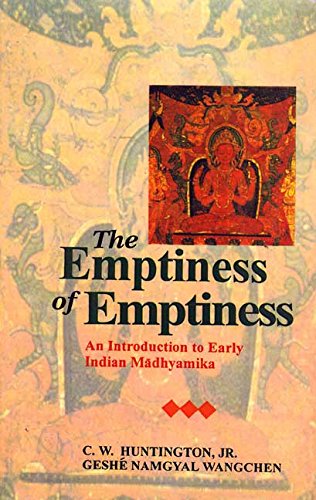
Ebook Info
- Published: 2007
- Number of pages: 303 pages
- Format: PDF
- File Size: 5.18 MB
- Authors: C. W. Huntington
Description
The Madhyamika or Middle Way, a school of Buddhist thought that originated in India in the second or third century, was a decisive influence in the subsequent developement of Mahayana Buddhism. In a new approach to its study, The Emptiness of Emptiness reconsiders the central doctrine of emptiness and shows that the Madhyamika critique of all philosophical views is both subtler and more radical than most Western interpretation indicates. Building on earlier research into Sanskrit and Tibetan sources, the present work also examines the assumptions that have governed the study of Asian soteriological philosophy. In assessing the philosophical significance of the Madhyamika, the author demonstrates that the thrust toward a self-critical awareness of methodological presuppositions lies at the very heart of early Indian Madhyamika. In this analysis, the self-deconstructing categories of Nagarjuna and his immediate followers emerge as an edifying philosophy that may have a great deal to offer to discussion of the related problems of objectivity and relativism issues crucial to current philosophical conversation in the West. The volume also contains the first complete English translation of Candrakirti’s Madhyamakavatara (The Entry into the Middle Way), with extensive exegetical and text-critical notes.
User’s Reviews
Reviews from Amazon users which were colected at the time this book was published on the website:
⭐For the intrepid who take the journey through this work, I believe you will find yourself changed by it. Undone in ways that are not possible to imagine until you’ve reached the ‘far shore’ of this book. And I am tough in my assessments when reviewing books, especially those offering the teachings of the Buddha — even with this full disclosure: I am profoundly blessed to have Geshe Namgyal Wangchen-la as my teacher, so my bias is quite intense. HOWEVER, that said, I am reviewing this in the spirit of an honest recommendation to anyone else who would want to study the work of the great master scholar, Candrakirti, or grasp the teachings of Nagarjuna on emptiness more completely. What a rewarding and overwhelmingly enriching read! This is a comprehensive English translation of the Madhyamikavatara accompanied by a thorough exposition on the work. The text is communicated so profoundly well that this book is nearly enlightening in itself. Seriously. The co-author, Mr Huntington deserves extraordinary praise for communicating a nearly impossible subject in totally lucid and understandable ways. A reader has to work, and I mean relentlessly, to bring your full attention to almost every line. I read this punctuated by extended meditation sessions, and have a hard time imagining how else one would absorb the depths of this book otherwise. Nonetheless, for any committed Western student of the Mahayana, especially in the noble lineage of Tsongkhapa, this work is indispensable and you can learn what might be otherwise inaccessible or simply unavailable to you without it. Each section and chapter takes you, step-by-step, into the pith of the work. Read it in sequence and don’t jump around. It moves more like a teaching than reading material. If you invest yourself in walking steadily through the relatively brief (but densely packed) 150 pages before getting to Candrakirti’s specific text translated masterfully into English, you’ll absorb the text like a seasoned student of the Madhyamikavatara. The benefit of this cannot be overstated. The footnotes, too, are actually worth reading in detail. They are not simply reference or tangents related to the text, they too, add still further clarity. I have read this once, annotated the heck out of it, took notes in a separate notebook, and now I’m reading it again. There is so much meat within, that it’s a course of study unto itself. Again, be forewarned, it’s meant to bring you to a full immersion in Nagarjuna’s insights into emptiness, so not a casual read. Oh, and the chapter titles aren’t the greatest. “Philosophy as Propaganda” is totally misleading as the name of a brilliant chapter on the specific manner and motivation for both Nagarjuna’s and Candrakirti’s writing and method. The chapter on “Ten Perfections of the Bodhisattva Path” left me breathless at times, it was so powerfully communicated. This is a rare work, and not for the feint of heart. I liken Geshe-la to the Einstein or Feynman of Tibetan Buddhism, so this is like reading about physics from one of them. Highest recommendation for the most serious-minded students. Unsurpassed wisdom for the truly committed practitioner.
⭐It is very thorough. Leans towards being very philosophic and the language is probably too highbrow for most readers
⭐this book provides a lot of context for its own writing and valuable background to the modern history of buddhist studies that helped contextualist the approach most works leaves out. definitely an introduction, but the bibliography will be useful for following up!
Keywords
Free Download The Emptiness of Emptiness: An Introduction to Early Indian Madhyamika in PDF format
The Emptiness of Emptiness: An Introduction to Early Indian Madhyamika PDF Free Download
Download The Emptiness of Emptiness: An Introduction to Early Indian Madhyamika 2007 PDF Free
The Emptiness of Emptiness: An Introduction to Early Indian Madhyamika 2007 PDF Free Download
Download The Emptiness of Emptiness: An Introduction to Early Indian Madhyamika PDF
Free Download Ebook The Emptiness of Emptiness: An Introduction to Early Indian Madhyamika