Ebook Info
- Published: 2009
- Number of pages: 44 pages
- Format: Epub
- File Size: 0.07 MB
- Authors: Franz Kafka
Description
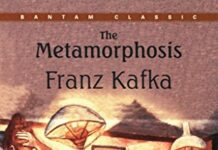
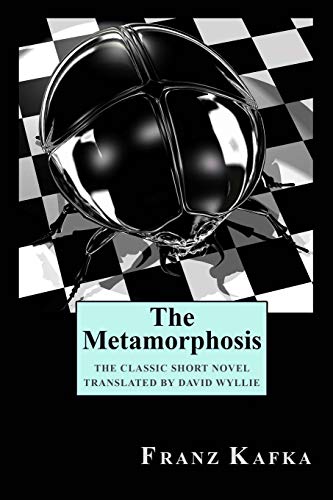
“The Metamorphosis” (original German title: “Die Verwandlung”) is a short novel by Franz Kafka, first published in 1915. It is often cited as one of the seminal works of fiction of the 20th century and is widely studied in colleges and universities across the western world. The story begins with a traveling salesman, Gregor Samsa, waking to find himself transformed into an insect.
User’s Reviews
There is no Editorial Review for this book
Reviews from Amazon users, collected at the time the book is getting published on UniedVRG. It can be related to shiping or paper quality instead of the book content:
⭐ Save your money. It’s not a book, just a few pages brochure. The words are all pushing together and hard to see. What about just go online and read the free version? It’s much better than this cheap made thing!
⭐ I had read Kafka’s “Metamorphosis” a while ago, and while I had found it interesting and morbid, had not thought about it in broader terms. I re-read the story again recently, wondering if it presented parallels for our age of mute communication enabled by the Internet. The Metamorphosis deals with themes of social alienation (often self-imposed) and existential anxiety. It’s worth understanding the context in which the story was written. This context involves Kafka’s own life and personality. Kafka held himself in low self-esteem and thought himself inadequate socially and sexually; he seems to have had several relationships with women but also visited prostitutes. Most importantly in the context of “The Metamorphosis”, he feared that people would find him physically and mentally repulsive and seems to have suffered from an eating disorder.These qualities of self-loathing are inherent in the story. The protagonist Gregor Samsa finds himself transformed into a giant insect who his parents and sister naturally find repellant. He also starts hating most food, including even the rotten food that his loving sister tearfully puts in his room. It is clear that the insect loathes himself and understands why his own family would loathe him and wish him gone. It’s also significant that while Samsa can perfectly understand what his family is saying about him, his own speech is now grotesquely that of an insect and incomprehensible to them. Torn between an inability to communicate and a perfect ability to understand, the insect naturally feels both alienation and existential angst.We should not have to look too far to find parallels in the digital age for most of Kafka’s afflictions. Technology and especially social media has sequestered us away from human contact in the same way that Samsa’s fundamental transformation shut him out. We spend hours on the Internet in our home, and yet can legitimately claim to have no real, human connection to the world outside. This is reflected in our “friendship” with hundreds of people on social media which translates to nihilistic friendlessness outside this medium. We also think that we can perfectly understand what people outside are saying, but just like the insect, keep on banging on the walls of our self-imposed prison because we cannot make ourselves heard above the din outside. We make a lot of noise, but very little sound.A lot of the existential anxiety which we feel results from this dissonance between the clear, one way-mirror of the outside world and the opaque prison of the inside, a prison which nevertheless occasionally gives us the illusion of being able to communicate before the whole façade regularly comes tumbling down. Just like the giant insect, our minds are torn between wanting to communicate and wanting to believe that we can.Most deaf are the technology companies which in our age seem to play the role of Samsa’s family; they claim to know what we are saying and even pretend to love us, but what they are offering us is a diet of information addiction and distraction which is being force fed to us. Like Samsa, we find ourselves in a love-hate relationship with these companies; on one hand we want to reject their sustenance, but on the other we find ourselves increasingly unable to survive without it. We hate ourselves for craving the food that the tech companies send our way, and we pity ourselves if we don’t have it.The role of Samsa’s parents can also be ascribed to the global internet community which pretends to be our friend but whose main function is to publicly shame, vilify and abandon us the moment we say something they disagree with. The sense of alienation which Samsa feels partly comes from not being able to communicate with his parents and partly from their anger and disgust at his transformation. Similarly, the global internet community pretends to care about us because we are part of the same digital ecosystem, while being able to turn on us in disgust and indignation in a moment when we undergo our own transformation, a transformation perhaps to an unpopular social or political viewpoint. Veering away from the community and tech companies’ groupthink will be our version of the Metamorphosis. Is is therefore not surprising that we find ourselves suffering extreme feelings of alienation, facing censure, ostracism and indifference from a community that from the outside seems to look just like us but which really is so different as to be an actual alien species, again like Samsa’s giant insect.The end of “The Metamorphosis” involves Samsa becoming infected and rueful and finally dying from shame, neglect and self-imposed starvation. A similar fate would likely befall the Gregor Samsas of today’s globally connected world, signified perhaps by these modern day vermin turning into brainwashed internet addicts who have completely surrendered their privacy, creative potential and personal dignity to both Internet companies and the global social media community. The original Gregor Samsa died, but this kind of complete surrender of mind and body would likely be a fate worse than death, perhaps not appreciated fully by the victims because of their delusional state, but real nonetheless.However it need not be so. Gregor’s mistake was in pretending that his family would want a normal relationship with him even after his transformation. While it would have been difficult, it would not have been impossible for him to be proactive in severing his connections with them, perhaps running away into the sewers or streets and starting an independent existence as a free insect. Such a lifestyle would have been challenging to say the least, but it would have led to a strange and exhilarating kind of freedom from dependence on his parents’ approval and love.The metaphor for our Internet age would be freedom from both the tech companies’ and the digital community’s feigned love toward us. The more we keep craving their approval, the more we will keep on becoming a victim of our own self-imposed existential angst. That way would lie catastrophe. Severing the bond with these two entities would not be easy and I don’t know what the best way to do it is. But there have certainly been some opinions offered toward this goal. What I do know is that when a Gregor Samsa from this world decides to escape, even into the sewers, he or she would find it much easier if other Gregor Samsas are already waiting in there.
⭐ This story has a lot to offer! It isn’t very long, but there’s a lot to digest. Kafka uses symbolism so well and the plot provides an unsettling insight into society and humanity. There is a sense of despair throughout the story which really does a lot to sell the mood and circumstances of the protagonist. I highly recommend this!I’ve had to write extensively about this story and the accompanying essays and it has helped me shape my understanding and opinion. The essays included after the story are thought provoking although I disagree with some interpretations of the story.
⭐ Awful translation and I cannot believe it is the translation listed in the product description since there are numerous mistakes and grammatical errors and horrible syntax. I was also suspicious when there were no credits given whatsoever in the book to the translator. Plus, the Kindle illustrations, though unnecessary, are impossible to view on a dedicated Kindle device e-reader. It does not give you the option to zoom the picture as is usually the case.Other than that, the brilliant Kafka short story survives this butchery.
⭐ Incredibly sad story about loneliness and maybe even illness. Wasn’t crazy about the ending, but I was definitely interested from the first sentence.I’m adding to this review because I’ve since re-read it several times and have actually fallen in love with the story. I no longer mind the ending and found that it’s a story I couldn’t get out of my head.
⭐ Although I have an interpretation of this story that gives it richness beyond belief — it is my interpretation alone however. That’s what’s great about this work: it’s yours to own and make of what you will.
⭐ One of the best things ever written IMOI love franz Kafka but sometimes his longer novels are a bit much, this one is my favorite (even though it’s mainstream lol)This copy is good quality
⭐ The work is still wonderful, but the critical edition includes topics and thought-provoking essays. I bought this when my granddaughter was reading it in high school and wanted to discuss it with me.
⭐ Masterpiece plus some worthwhile material.
⭐ I did like this edition. The pages are long and the font small making the book very thin. I know that this books is small in content but this version makes it looks not so enjoyable.
Keywords
Free Download The Metamorphosis in Epub format
The Metamorphosis Epub Free Download
Download The Metamorphosis 2009 Epub Free
The Metamorphosis 2009 Epub Free Download
Download The Metamorphosis Epub
Free Download Ebook The Metamorphosis