

Ebook Info
- Published: 1999
- Number of pages: 474 pages
- Format: PDF
- File Size: 40.05 MB
- Authors: Shoryu Katsura
Description
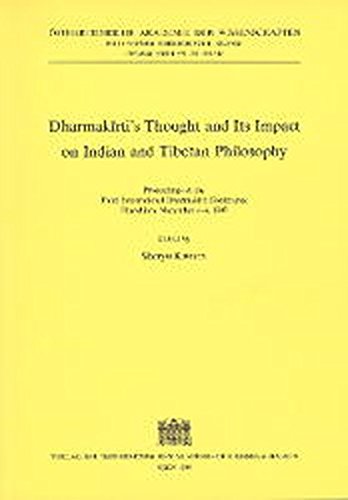
The proceedings of the Third International Dharmakirti Conference held in Hiroshima in 1997 collect a number of papers devoted to the study of the great seventh-century Buddhist philosopher, Dharmakirti, and his impacts upon the succeeding generations of both Buddhist and non-Buddhist philosophers in India and Tibet. The Second International Dharmakirti Conference was held in Vienna, and its proceedings, Studies in the Buddhist Epistemological Tradition, have been published in this same series. The present volume contains the results of the important researches made by the major Dharmakirtian scholars in the world since the last conference, so that the readers can discover the present state of affairs in the field of Buddhist epistemology and logic. Some papers are concerned with the epistemological topics, such as the notion of perceptibility, and others with the purely logical problems like an empty subject. Some deal with the Buddhist theory of language called apoha in comparison with the views of Nagarjuna, Bhartrhari and others, while others are devoted to the ontological questions, such as how to determine the causal relationship. Several papers discuss Dharmakirti in the light of criticism made by Jaina, Nyaya or Minamsa philosophers. And finally the most remarkable feature of the present volume is the increase of number of contributions devoted to the study of Tibetan tradition of Buddhist epistemology and logic which has been developed under the great influence of Dharmakirti.
User’s Reviews
Reviews from Amazon users which were colected at the time this book was published on the website:
⭐College book requirement. Interesting book. I majored in Political Science and this book is engaging and easy to read. If you like the topic, it helps a lot
⭐I need this book for my Public Administration class and it was very useful when I needed to take my test. It gives you a good understanding of how Congress is run and what each key members roles are. Very recommendeddcasill4sportsblog.blogspot.com
⭐This book is very not worth with information. It highlights the constitution as it should be understood. It is a good read.
⭐so i purchased this book for my class at school. all the info was there and i used it like it should have been. shipping was great.
⭐Great book. Very detailed. Good book for those who want to know more how Congress works. Good book for poly sci majors.
⭐I ordered this book with about a dozen other text books, and this was the first one to arrive, and it was brand new. Thanks.
⭐The authors are acknowledged experts on the mechanics of the U.S. Congress. They convey acquaintance with the human side of the institution through a folksy style and many anecdotes. They describe “two Congresses”, the first relating to constituents, and the second to colleagues. What about performance? What about effectiveness?Polls now (2008) record an all-time low of 9% for Congress’s approval rating. This highlights the authors’ glaring myopia and essential omission of the reason for the existence of Congress – to manage the affairs of the nation in a balanced and efficient way.No doubt, most Senators and Representatives do an excellent job of helping their constituents. They know that reelection depends on this service. The U.S. Congress is probably unique in the world in citizens’ access to effective assistance in interfacing with government on a personal level.But it was not until I recently had occasion to compare U.S. lawmaking with that in leading European nations’ parliaments that I realized – to my shock – the arbitrary, serendipitous, and dysfunctional way Congress has come to function since the 1960s. In EU nations’ parliaments the party in power initiates a concept for a new major law by first sending it to a relevant ministry. There the concept gets a careful assessment: short-term, long-term impact, vetting with various constituencies affected by the proposed policy, cost, etc. A draft law with the assessment comes back to the governing party or coalition. It is then submitted to the full parliament for debate, amendment, and vote. The pre-analysis process catches conflicts with earlier laws, policies that will generate problems or hostilities gaps and other weaknesses. Dialoging and communication is key.The post-1970s U.S. system could not be more different. ~10,000 bills [pour into each (2-year) Congress. The majority get no action at all in the standing committees- many are framl;u introduced mainly to register activity and concern about issues with constituents. Many are blatantly partisan and narrowly drawn. Even more carefully written bills are rarely coordinated with other authors – or similar initiatives in other committees. Except for assessing cost and links to existing law the fate of bills is largely at the discretion of committee chairpersons and majority leaders. Partisan gridlock has largely paralyzed Congressional activity in the big issues. In these or noncontroversial areas Members feel free to write fragmentary, intrusive, micromanaging laws in areas where Congress has no formal expertise – like science, environment, that should rightfully be in the hands of professional agencies. With the enormous crush of new bills and other activities that every committee and the Congress as a whole must manage, there is no way Congress can maintain continuous oversight over detailed programs initiated by past enacted legislation.So it is no wonder that in the past 30 years or more the landscape has become littered with failed or foundered Congressional initiatives – each of which may have begun with enthusiasm and often substantial funding outlays.It’s shocking but part of the reason that the U.S. is in the trouble it is in, that experts like the authors, as well as politicians, can absorb themselves in their special interests and forget all about “minding the store”. Three stars for mechanics – zero for the rest.
⭐”Congress and Its Members” is an excellent textbook for any government student wanting a thorough introduction into the actions and events of the United States’ Senate and House of Representatives. The discussion found in the book ranges from the differences between the two houses, their procedures, methods of governance, etc… This book is very easy to read and comprehend what the authors convey.
Keywords
Free Download Dharmakirtis Thought and its Impact on Indian and Tibetan Philosophy (Beitr’age Zur Kultur- Und Geistesgeschichte Asiens) in PDF format
Dharmakirtis Thought and its Impact on Indian and Tibetan Philosophy (Beitr’age Zur Kultur- Und Geistesgeschichte Asiens) PDF Free Download
Download Dharmakirtis Thought and its Impact on Indian and Tibetan Philosophy (Beitr’age Zur Kultur- Und Geistesgeschichte Asiens) 1999 PDF Free
Dharmakirtis Thought and its Impact on Indian and Tibetan Philosophy (Beitr’age Zur Kultur- Und Geistesgeschichte Asiens) 1999 PDF Free Download
Download Dharmakirtis Thought and its Impact on Indian and Tibetan Philosophy (Beitr’age Zur Kultur- Und Geistesgeschichte Asiens) PDF
Free Download Ebook Dharmakirtis Thought and its Impact on Indian and Tibetan Philosophy (Beitr’age Zur Kultur- Und Geistesgeschichte Asiens)