

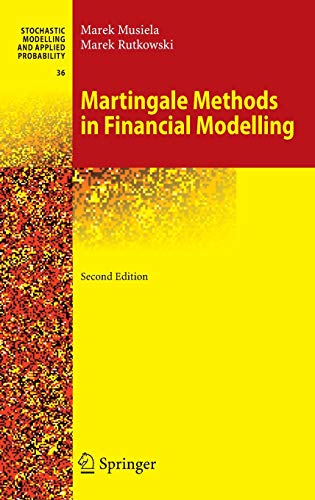
Ebook Info
- Published: 2004
- Number of pages: 636 pages
- Format: PDF
- File Size: 31.46 MB
- Authors: Marek Musiela
Description
A new edition of a successful, well-established book that provides the reader with a text focused on practical rather than theoretical aspects of financial modellingIncludes a new chapter devoted to volatility riskThe theme of stochastic volatility reappears systematically and has been revised fundamentally, presenting a much more detailed analyses of interest-rate models
User’s Reviews
Editorial Reviews: Review From the reviews: ” …This book is an impressive work of scholarship in mathematical finance in the area of option pricing. …contains the latest results and references. …The presence of many explicit formulae, for various types of derivatives, will make this book attractive to practitioners; and its breadth of content will make it useful for anyone who considers research in mathematical finance.” (The Australian and New Zealand Journal of Statistics) ” …On the whole, this book presents a very wide range of topics and will appeal to both practitioners and mathematicians. …the second part gives an excellent overview of the state of the art in term structure research and will set a clear standard for some time to come.” (MathSciNet) ” …The book contains a wealth of material expressed in a clear mathematical way. A definite bonus is the very extensive list of references which gives the reader a most welcome basis from which to explore further the realm of mathematical finance. …The book can be used ideally both as an introductory and as an advanced text on mathematical finance.” (Short Book Reviews) ” …This book is a comprehensive and up-to-date presentation of the martingale approach for pricing and hedging derivative securities. …provides a wide range of topics and will appeal to both practitioners and mathematicians. When only special cases or models are provided, the authors give useful references that will help researchers to obtain even more insight in the topics.” (ZentralblattMATH)From the reviews of the second edition:”The book starts at an elementary level of mathematics as well as of market and product knowledge. … In summary, the book gives a very broad insight into advanced modern financial mathematics, in particular fixed income models. … It will serve as a basic source of knowledge of the described topics in financial mathematics.” (Ludger Overbeck, Mathematical Reviews, Issue 2005 m) From the Back Cover This book provides a comprehensive, self-contained and up-to-date treatment of the main topics in the theory of option pricing. The first part of the text starts with discrete-time models of financial markets, including the Cox-Ross-Rubinstein binomial model. The passage from discrete- to continuous-time models, done in the Black-Scholes model setting, assumes familiarity with basic ideas and results from stochastic calculus. However, an Appendix containing all the necessary results is included. This model setting is later generalized to cover standard and exotic options involving several assets and/or currencies. An outline of the general theory of arbitrage pricing is presented. The second part of the text is devoted to the term structure modelling and the pricing of interest-rate derivatives. The main emphasis is on models that can be made consistent with market pricing practice.In the 2nd edition, some sections of the former Part I are omitted for better readability, and a brand new chapter is devoted to volatility risk. In the 3rd printing of the 2nd edition, the second Chapter on discrete-time markets has been extensively revised. Proofs of several results are simplified and completely new sections on optimal stopping problems and Dynkin games are added. Applications to the valuation and hedging of American-style and game options are presented in some detail.As a consequence, hedging of plain-vanilla options and valuation of exotic options are no longer limited to the Black-Scholes framework with constant volatility.Part II of the book has been revised fundamentally. The theme of volatility risk appears systematically. Much more detailed analysis of the various interest-rate models is available. The authors’ perspective throughout is that the choice of a model should be based on the reality of how a particular sector of the financial market functions. In particular, it should concentrate on defining liquid primary and derivative assets and identifying the relevant sources of trading risk.This long-awaited new edition of an outstandingly successful, well-established book, concentrating on the most pertinent and widely accepted modelling approaches, provides the reader with a text focused on the practical rather than the theoretical aspects of financial modelling. About the Author . Read more
Reviews from Amazon users which were colected at the time this book was published on the website:
⭐This advanced text provides an excellent account of the current state-of-the art of options pricing/hedging models and interest rate term structure models. The book is accessible to both advanced practitioners of mathematical finance as well as to pure researchers in the field.The book is in written in a mathematical style and contains rigorous proofs of many results. However, the main focus of the text is to describe the frontier of knowledge in the subject. Each section contains copious references to the literature and is so current that several references are to working papers. Many sections detail open problems and other areas suitable for scholarly research.In their second edition, the authors provide an extremely useful critique of each modeling paradigm that they investigate. They also provide evidence for their position in the form of literature references which instruct the reader as to the shortcomings/limitations of a particular model. This information should prove quite valuable to model practitioners and implementers.The authors assume an advanced background from the field of stochastic analysis, although they do provide an appendix which summarizes key results needed from the field. For the stochastic calculus prerequisites, I recommend Rogers & Williams
⭐and
⭐. Suitable prerequisites are also covered by Karatzas and Shreve in
⭐. A good foundation in arbitrage pricing theory is also needed. I recommend the nice treatment by Bjork in
⭐.The book is divided into two parts. The first part deals with options pricing in equity markets. Chapter 1 sets premlinaries required for the arbitrage theoretic framework, while Chapter 2 has a very nice treatment of discrete time models and finite financial markets.In Chapter 3, the authors develop the Black-Scholes model along with the Bachelier model using arbitrage techniques. The models are compared and used as benchmark continuous time models and form the basis for all subsequent analysis.Chapter 4 provides a nice survey of techniques used to price/hedge options in foreign equity and currency markets. The authors assume familarity of the basic workings of foriegn markets.Chapter 5 is a terrific chapter on valuing American-style options. The American call option is thoroughly studied and approximation techniques for the American put option are introduced. The explicit derivations of the formulas are referenced to the literature.Chapter 6 provides an introduction to exotic options, although the authors vary their use of the term ‘exotic’ to meaning ‘not a standard European-style or American-style’ in this chapter to meaning ‘no readily available liquid market’ in Chapter 7. The descriptions are quite accessible and the basic properties of the options are described along with pricing formulas (assuming the Black-Scholes framework).Chapter 7 provides as complete an accounting as I have ever seen of the generalizations of the Black-Scholes model and motivates this from the point of view of volatility surfaces. Many of the well-known models are studied in detail, such as CEV, local volatility, and mixture models. The strengths and weaknesses of each model are analyzed. The stochastic volatility models of Wiggins (via Orenstien-Uhlenbeck processes), Hull-White, and Heston are studied, as is the SABR model. The chapter wraps up with a study of the SIV models, describes how the stochastic volatility models can be obtained via limits of GARCH models and surveys Jump-diffusion processes and Levy processes.The second part of the book is concerned with term structure models and interest rate derivatives. The authors are quite well-know for their many contributions to this study and their treatment is authoritative.
⭐I’ve ordered this item to get the 3rd printing of 2nd edition as of 2011. According to Springer, it has different number of pages (2.5 times larger Appendix, highly amended 2nd chapter and so on) Vs just second edition as of 2005.However, I got 2005 version.
⭐This book takes you through the math of finance step-by-step, passing through very simple examples first and then slowly adding complexity to the models studied. It is written very clearly and the prerequisites to reading this book are only some basic notions of probabilities (sigma-fields, probability measures).Sometimes, the problem with math books is that they are “dry” and contain only a succession of theorems and proofs. In this one, the authors make a point of explaining in detail how different theorems and models relate to each other, and make extensive comparisons between them so that you get a better feel for how they work in practice.The book is primarily a math book and can be light on market specifics. Do not buy this book as a practical “howto” in derivatives trading.
⭐It was good condition same as described and good cost.Also, it takes exactly what they said to be shipped.Thank you.
⭐A comprehensive book, well structured and easy to follow.
Keywords
Free Download Martingale Methods in Financial Modelling (Stochastic Modelling and Applied Probability, 36) 2nd Edition in PDF format
Martingale Methods in Financial Modelling (Stochastic Modelling and Applied Probability, 36) 2nd Edition PDF Free Download
Download Martingale Methods in Financial Modelling (Stochastic Modelling and Applied Probability, 36) 2nd Edition 2004 PDF Free
Martingale Methods in Financial Modelling (Stochastic Modelling and Applied Probability, 36) 2nd Edition 2004 PDF Free Download
Download Martingale Methods in Financial Modelling (Stochastic Modelling and Applied Probability, 36) 2nd Edition PDF
Free Download Ebook Martingale Methods in Financial Modelling (Stochastic Modelling and Applied Probability, 36) 2nd Edition