

Ebook Info
- Published: 1993
- Number of pages: 255 pages
- Format: PDF
- File Size: 5.73 MB
- Authors: Robert J. Valenza
Description
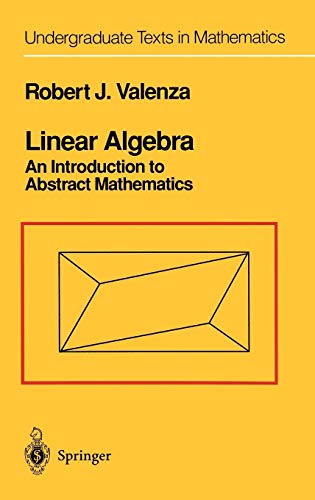
Based on lectures given at Claremont McKenna College, this text constitutes a substantial, abstract introduction to linear algebra. The presentation emphasizes the structural elements over the computational – for example by connecting matrices to linear transformations from the outset – and prepares the student for further study of abstract mathematics. Uniquely among algebra texts at this level, it introduces group theory early in the discussion, as an example of the rigorous development of informal axiomatic systems.
User’s Reviews
Reviews from Amazon users which were colected at the time this book was published on the website:
⭐Great book. As a former college math professor who taught linear algebra to both math majors and non-majors, I wish this book had been available for use with the math majors. Linear algebra is often taught as a series of cookbook exercises involving using matrices to solve systems of equations, but that approach misses the beauty of the subject. Math majors should see linear algebra as a building block for abstract algebra, and this book performs that task very well.
⭐This was the textbook for an honors course in linear algebra I took my second semester in college, and my introduction to real, abstract mathematics– also one of the reasons I switched from chemistry to math. Without this book, I might never have realized how much I love the subject, nor gone on to study it in depth. I still remember the feeling I had, when, after struggling for a couple months with this book’s level of abstraction, I began to grasp what was going on. I had hated math before, so it felt like a whole new world had been opened up to me. So, I’m sentimental about this book, but I think that sentimentality is well warranted. In fact, I struggled that entire semester, and eventually emerged with a pretty shaky understanding of linear algebra. It wasn’t until I went back to this book in my spare time–working through every exercise and proof– that I gained a full appreciation for the beauty of this subject, the power of abstraction, and the quality of Robert Valenza’s exposition. To anyone in my position: don’t give up! It requires a lot of work, but understanding will come, and it is well worth it.At some point I intend on reading Sheldon Axler’s
⭐for comparison purposes, as that book is probably the main competitor to this one, and it would be interesting to see how Axler develops the material, though there are definite similarities. As in Axler’s book, Valenza’s approach is highly abstract and non-computational. I can’t make a direct comparison, but it would be hard (and probably a bad idea) to use matrices less than Valenza does. For a student first taking lin alg, they should supplement with computation problems (preferably those they create themselves), though the pure math approach via abstract linear transformations is what gives this book the ability to convey a full, intuitive, conceptual and deep understanding of the subject– one that doesn’t require any memorization. The best (and perhaps only) way to truly understand linear functions is in the abstract, as this gives you the fluency required to seamlessly convert between linear maps and their matrix representations with respect to a basis. Valenza’s treatment of the subject serves as an exemplar of theory and abstraction and gives students much needed early insight into what math is actually about. Being able to understand the correspondence between linear maps and matrices as an isomorphism of k-algebras is a wonderful thing. :)One of my favorite things about this book is that it includes a full chapter on group theory, (in addition to the excellent and completely necessary 1st chapter on sets and functions), before ever introducing a vector, a vector space, or any of the fundamental notions of lin alg. The best way to understand a vector space is in terms of its underlying additive group structure, and this is a great example of the conceptual ‘encapsulation’ (to borrow a CS term) required to properly develop material in math. In truth, there are so many masterful details and aspects of the presentation, that I have had to limit myself here.Additionally, math is in no way just theorems and proofs, and Valenza’s conceptual discussion of the subject is as helpful as any I’ve ever read. The discussion here (and the short, very accessible appendix section on category theory) gave me the beginnings of a full philosophical appreciation of what pure math is– especially the duality between generality and specificity involved in making fundamental and descriptive definitions. For the most part, no other math textbook or class has cared to do that, which is a shame, as I think this is a fundamental part of meaningfully being a mathematician.The one weakness of this book (that I can think of) is the exercises. Most of the exercises are very good, but there are still too few, and there is an unfortunate lack of challenging problems. An average student first working through them will probably struggle, as I did, though this largely depends on one’s understanding of the chapter material. When I went through the book a second time, working through everything, the exercises were too easy. Students who aren’t challenged should supplement. Another seemingly worthwhile criticism is that the exercises could be more integrated into the exposition in each chapter.Aside from the exercises, the length of this book seems to be perfect. It’s a beautiful, concise and covers a surprising amount of material. I’ve probably said enough, so…For anyone working through this (or any other abstract math book, especially one on algebra) for the first time, I HIGHLY HIGHLY recommend finding an empty classroom, and working through the proofs in the first few chapters on the blackboard, again and again and again, until they start to become second nature. This will begin to give you a mathematical fluency that will stay with you the rest of your life.
⭐As a person who has a healthy interest in mathematics and has taken many classes, this is definatley one of the best! Professor Valenza taught it (he has been teaching this Linear Algebra class at CMC for ten years) and his book is essentially an excellent compilation of the lecture notes from his class. It takes a very different tack from most linear algebra texts: Usually, a linear algebra text begins by inroducing matrices and solving simultaneous equations, teaching computational methods. Prof. Valenza starts with the structure BEHIND all of that math however: Sets, Groups, and Vector Space properties. This structure is absolutely essential to knowing what’s going on: My father took a (less superior) linear algebra class many years ago, and he never understood the concepts behind the mathematical manipulations; I actually sat down with him and taught him the things that I learned in Prof. Valenza’s class. I really think that the knowledge in this book is invaluable to someone who wants to know what Linear Algebra is really about.Just a few examples of the truly deep knowledge that this book communicates follows. For instance (this will ring a bell for those who have taken calculus) the “constant of integration” that must be added when doing an antiderivative is actually a property of group homomorphisms. The “absolute value” that must be introduced when taking square roots is structurally THE SAME property of group homomorphisms. Also, we all know that you can’t divide by zero; it’s just not allowed. But, the reason for that is ultimatley rooted in group theory; namely, the real numbers are NOT a group under multiplication. This type understanding has EVERYTHING to do with matrices and systems of equations! For instance, the fact that only square matrices can be inverted is a trivial consequence of a property of function mappings called “bijectivity.” (a mapping from three- to two- dimensional space can’t be bijective, for example) Many seemingly complex linear system problems can be simplified to a trivial questions by, for example, investigating the “span” of the column vectors of a matrix. There are countless problems that simply can’t be understood without the kind of structural knowledge that Prof. Valenza’s book gives.Understanding the basic properties that underlie so many mathematical objects has been a true delight for me, and anyone who wants to know what is really going on “behind the scenes” with linear equations would be wise to investigate Prof. Valenza’s book. It’s no accident that he also wrote a book on Fourier Analysis; understanding structure is simply the key to higher math.
⭐I have just had a glimpse of all the three reviews here, and wonder whether the reviews are really true. I am now an undergraduate and taking a course which uses this textbook. Frankly speaking, I think this book sucks. If you carefully compare this book with Friedberg, Insel and Spencer’s Linear Algebra, you will know the difference. This book misses out many things I consider important. Also, it does not contain many interesting and essential results, like all infinite-dimensional vector space has a basis. I don’t think Zorn’s lemma should not be mentioned in a book like this one.Also, I can’t really accept that it starts matrices like that. We all know that matrices come from linear transformations. Matrix multiplication comes from the composition of linear transformatiosn. This book does not mention this and start it right away. This approach is quite bad in my opinion.Finally, I think that this book is messy. I think it is quite difficult to include introduction of linear algebra and abstract algebra at the same time, but if it’s so difficult to do it, why don’t you study it separately? I think the author tried hard to combine these two stuff, but failed to do that successfully. All my friends who have linear algebra and abstract algebra background agree with me. I definitely wont’ recommend this book.
Keywords
Free Download Linear Algebra: An Introduction to Abstract Mathematics (Undergraduate Texts in Mathematics) in PDF format
Linear Algebra: An Introduction to Abstract Mathematics (Undergraduate Texts in Mathematics) PDF Free Download
Download Linear Algebra: An Introduction to Abstract Mathematics (Undergraduate Texts in Mathematics) 1993 PDF Free
Linear Algebra: An Introduction to Abstract Mathematics (Undergraduate Texts in Mathematics) 1993 PDF Free Download
Download Linear Algebra: An Introduction to Abstract Mathematics (Undergraduate Texts in Mathematics) PDF
Free Download Ebook Linear Algebra: An Introduction to Abstract Mathematics (Undergraduate Texts in Mathematics)