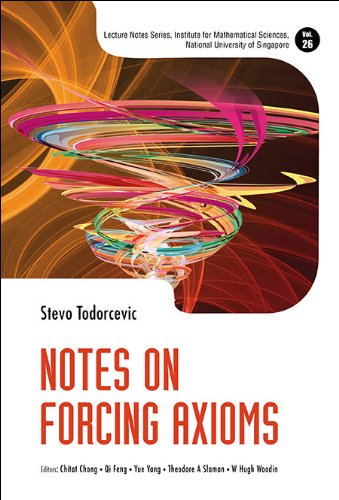
Ebook Info
- Published: 2013
- Number of pages: 236 pages
- Format: PDF
- File Size: 1.46 MB
- Authors: Stevo Todorcevic
Description
In the mathematical practice, the Baire category method is a tool for establishing the existence of a rich array of generic structures. However, in mathematics, the Baire category method is also behind a number of fundamental results such as the Open Mapping Theorem or the Banach-Steinhaus Boundedness Principle. This volume brings the Baire category method to another level of sophistication via the internal version of the set-theoretic forcing technique. It is the first systematic account of applications of the higher forcing axioms with the stress on the technique of building forcing notions rather than on the relationship between different forcing axioms or their consistency strengths.
User’s Reviews
Reviews from Amazon users which were colected at the time this book was published on the website:
⭐I bought this book in the hope that it might provide a course on forcing axioms from the beginning, but I does not start with an explanation of the subject and I found it very hard to follow. Unless you are a specialist in set theory, I would not recommend this book.
Keywords
Free Download Notes On Forcing Axioms (Lecture Notes Series, Institute For Mathematical Sciences, National University Of Singapore Book 26) in PDF format
Notes On Forcing Axioms (Lecture Notes Series, Institute For Mathematical Sciences, National University Of Singapore Book 26) PDF Free Download
Download Notes On Forcing Axioms (Lecture Notes Series, Institute For Mathematical Sciences, National University Of Singapore Book 26) 2013 PDF Free
Notes On Forcing Axioms (Lecture Notes Series, Institute For Mathematical Sciences, National University Of Singapore Book 26) 2013 PDF Free Download
Download Notes On Forcing Axioms (Lecture Notes Series, Institute For Mathematical Sciences, National University Of Singapore Book 26) PDF
Free Download Ebook Notes On Forcing Axioms (Lecture Notes Series, Institute For Mathematical Sciences, National University Of Singapore Book 26)