

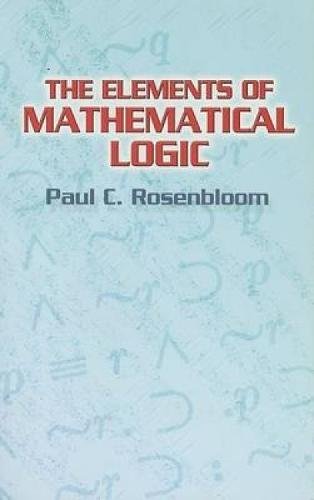
Ebook Info
- Published: 2005
- Number of pages: 224 pages
- Format: PDF
- File Size: 26.10 MB
- Authors: Paul C. Rosenbloom
Description
An excellent introduction to mathematical logic, this book provides readers with a sound knowledge of the most important approaches to the subject, stressing the use of logical methods in attacking nontrivial problems.Its chapters cover the logic of classes (including a section on the structure and representation of Boolean algebras, which are applied in the following chapters to the study of deductive systems), the logic of propositions, the logic of propositional functions (summarizing the methods of Russell, Quine, Zermelo, Curry, and Church for the construction of such logics), and the general syntax of language, with a brief introduction that also illustrates applications to so-called undecidability and incompleteness theorems.Other topics include the simple proof of the completeness of the theory of combinations, Church’s theorem on the recursive unsolvability of the decision problem for the restricted function calculus, and the demonstrable properties of a formal system as a criterion for its acceptability.
User’s Reviews
Reviews from Amazon users which were colected at the time this book was published on the website:
⭐This 1950 book ”
⭐” by Paul Charles Rosenbloom is quite quirky in many ways, but it has many useful historical and philosophical insights. It is not suitable as a 21st century introduction to logic. It is mostly of value as historical and motivational background for concepts which have been learned in a more modern way, in a more modern notation. Of particular interest, in my opinion, is the intertwining of semantic and linguistic axioms in a way which is not often seen.Rosenbloom claims in the preface to present the “most important approaches” to mathematical logic. This may have been true in 1950. There are indeed several different approaches in this book, but these don’t seem to be a full survey of the subject. For example, the Gentzen natural deduction approach seems to be absent. The 1963 book ”
⭐” by Curry has a very credible claim to cover “the most important approaches”, and Curry’s book is much more substantial and more modern.The content of this book by Rosenbloom includes the following.* Page 1. A set of 20 axioms for propositional logic. Then many theorems from these.* Page 9. A Boolean algebra of classes, emphasizing closure of both the space of propositions and the space of objects.* Axiomatisation of Boolean algebra.* Metatheorems about Boolean algebra.* Page 21. Zorn’s lemma is presented as an axiom!* Pages 28-51. Propositional logic. Uses truth tables, then axioms and logical deduction.* The Łukasiewicz axioms are on page 31 and pages 38-39.* On page 38, semantics is abandoned and replaced with deduction.* Pages 51-68. Intuitionism.* Pages 69-91. Predicate calculus. This is an intertwined mixture of semantics and syntax. This is not at all like the modern clear split between proof theory and model theory. Rosenbloom combined semantic axioms and rules with the linguistic axioms and rules.* A particular formulation of predicate calculus is on pages 74-88.* Pages 91-94: A logical system attributed to Church.* A system attributed to Russell/Whitehead, including a theory of types.* Pages 101-103. A system attributed to Quine for class theory.* Page 105. A logical system attributed to Zermelo, including a specification axiom and a power set axiom.* Pages 109-127. A presentation of the issue of substitution.The author makes numerous comments on the history and motivational background of the subject.* Pages 51-64. Comments on many valued logics, modal logics and intuitionism. Some comment (page 58) on the intuitionist programme of Brouwer, Weyl, etc, “redoing” classical mathematics.* Page 109. The author claims that the works of Hilbert/Ackerman, Hilbert/Bernays, Quine, and Gödel, were incorrect in regard to substitution rules. This seems quite likely true. I’ve read something similar elsewhere.* Pages 146-151. Some interesting notes on the history and psychology of the Axiom of Choice.* Page 147. The independence of the axiom of choice from the other set theory axioms is attributed to Fraenkel, although this wasn’t proved until 1963 by Cohen.Some drawbacks of this book are as follows.* The use of the Peano dot-notation which made Whitehead/Russell and many other early logic books difficult to read.* All of the references are to reviews in the Journal of Symbolic Logic. So if you don’t have access to those journals, you don’t get any of the references apart from just author names.There is a fair amount of political propaganda.* Pages 54-55. Accusations against someone called Hjalmar Schacht, claiming that he is a Nazi, although the wikipedia page about Schacht seems to disagree.* Page 147. A somewhat negative comment about the attitude of Texans.* Page 149. Some negative comments about the intelligence of President Truman and the attitude of the Republican party.
⭐THE PERSPECTIVE IN THIS BOOK IS “THE LANGUAGE OF LOGIC”IT COVERS A WHOLE RANGE OF TOPICS IN LOGIC — THAT ARE RELEVANT TO THEORY OF COMPUTATION — FROM THE FORMAL LOGIC POINT OF VIEW. YOU WOULD NEED TO BE ABLE TO WORK THROUGH THESE AS LOGIC BACKGROUND. WHAT ROSENBLOOM WRITES IS THE RIGHT ANGLE FROM WHICH TO CONSIDER LOGIC. IT HAS A BIAS BECAUSE HE IS HEADING TOWARDS TH. COMPSCI.THIS BOOK IS NOT ENOUGH MATERIAL TO READ SUBSTANTIAL THEORETICAL COMP-SCI TEXT SUCH AS TOMAS GERGELY’S. YOU WOULD NEED BOOK BY EBBINGHAUS — PLUS STANDARD TEXT IN MATHEMATICAL LOGICREF:TOMAS GERGELY First-Order Programming Theories (Monographs in Theoretical Computer Science. An EATCS Series)EBBINGHAUS — https://www.amazon.com/Mathematical-Logic-Undergraduate-Texts-Mathematics/dp/1475723571/ref=dp_ob_title_bk
⭐I bought this because it has brief treatments of combinatory logic and the lambda calculus. I was dissapointed, however, because of the rather idiosyncratic notation; I had to go back and start nearly from the beginning to see how he was developing his formal systems. I’ve had logic, so I felt that it was inconvenient to have to read chapters just to get a handle on his notation and outlook. When I did finally arive at the sections on combinators and lambda, the treatment was too superficial to be a benefit. Should’ve just bought Hindley.The problems stated, I found the author’s discussion of early research informative and interesting. This book was written before an interpretation was formally defined in Tarski (1956), so the different research directions to escape this problem I thought were neat. There is much discussion about purely syntactical systems vs. systems where semantics are defined.
Keywords
Free Download The Elements of Mathematical Logic in PDF format
The Elements of Mathematical Logic PDF Free Download
Download The Elements of Mathematical Logic 2005 PDF Free
The Elements of Mathematical Logic 2005 PDF Free Download
Download The Elements of Mathematical Logic PDF
Free Download Ebook The Elements of Mathematical Logic