Ebook Info
- Published: 1995
- Number of pages: 158 pages
- Format: PDF
- File Size: 12.31 MB
- Authors: Raymond M. Smullyan
Description
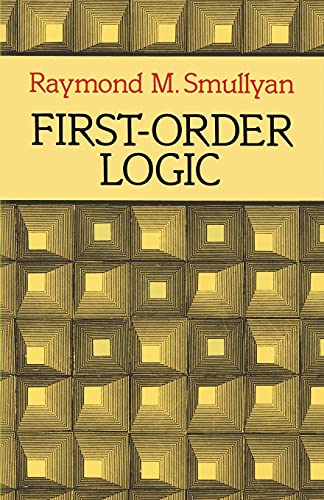
This completely self-contained study, widely considered the best book in the field, is intended to serve both as an introduction to quantification theory and as an exposition of new results and techniques in “analytic” or “cut-free” methods. Impressed by the simplicity and mathematical elegance of the tableau point of view, the author focuses on it here.After preliminary material on tress (necessary for the tableau method), Part I deals with propositional logic from the viewpoint of analytic tableaux, covering such topics as formulas or propositional logic, Boolean valuations and truth sets, the method of tableaux and compactness.Part II covers first-order logic, offering detailed treatment of such matters as first-order analytic tableaux, analytic consistency, quantification theory, magic sets, and analytic versus synthetic consistency properties.Part III continues coverage of first-order logic. Among the topics discussed are Gentzen systems, elimination theorems, prenex tableaux, symmetric completeness theorems, and system linear reasoning.Raymond M. Smullyan is a well-known logician and inventor of mathematical and logical puzzles. In this book he has written a stimulating and challenging exposition of first-order logic that will be welcomed by logicians, mathematicians, and anyone interested in the field.
User’s Reviews
Editorial Reviews: About the Author Raymond Smullyan received his PhD from Princeton University and taught at Dartmouth, Princeton, Indiana University, and New York’s Lehman College. Best known for his mathematical and creative logic puzzles and games, he was also a concert pianist and a magician. He wrote over a dozen books of logic puzzles and texts on mathematical logic. Raymond Smullyan: The Merry Prankster Raymond Smullyan (1919–2017), mathematician, logician, magician, creator of extraordinary puzzles, philosopher, pianist, and man of many parts. The first Dover book by Raymond Smullyan was First-Order Logic (1995). Recent years have brought a number of his magical books of logic and math puzzles: The Lady or the Tiger (2009); Satan, Cantor and Infinity (2009); an original, never-before-published collection, King Arthur in Search of His Dog and Other Curious Puzzles (2010); and Set Theory and the Continuum Problem (with Melvin Fitting, also reprinted by Dover in 2010). More will be coming in subsequent years. In the Author’s Own Words:”Recently, someone asked me if I believed in astrology. He seemed somewhat puzzled when I explained that the reason I don’t is that I’m a Gemini.” “Some people are always critical of vague statements. I tend rather to be critical of precise statements: they are the only ones which can correctly be labeled ‘wrong.'” — Raymond Smullyan
Reviews from Amazon users which were colected at the time this book was published on the website:
⭐This is a book by a man I knew for his books of puzzles-chatty books of great originality that have fun with the paradoxical possibilities of logic. Here he is the teacher of logic, and aside from an occasional phrase, the serious mathematician. However, Smullyan’s originality shines through in this book as well. He presents logic as a branch of mathematics rather than an abstraction of ordinary language. And he uses a method from the recent literature, tableaux, to build his proofs in a simple and satisfying way. He gets directly to the main result as to the provability of valid sentences using this method for both the propositional calculus and the predicate calculus.Smullyan procedes rapidly because he makes some assumptions about the reader’s knowledge. The reader must understand the difference between mathematics and meta-mathematics-that is, should be able to separate out the talking about the sentences of the system, which may contain (among other signs) the conjunction, disjunction, and negation, from the more-or-less informal arguments that prove assertions about these sentences using natural language, with its “and”, “or”, and “not”. Moreover, the concept of “proof” is used at two levels: the particular tableau that constitutes a proof of a sentence, and the “proofs” about tableaux and other concepts of the “system”.Besides this, the reader should have a good feel for recursive definitions, which are used everywhere. Finally, this model reader should know the difference between countably-infinite sets and uncountably-infinite sets.I knew all that, but still found the text slow going, maybe because I have been away from mathematics for decades. But there is another reason, too. Smullyan has divorced logic from its roots: logics are simply recursively-defined sets of sentences and mappings, and that is that. No discussions, ala WvO Quine, on the history or linguistic difficulties of a concept, just definition and proof. This is an abstraction of a subject which is already an abstraction. So I usually found myself trying to understand what it all meant, in other than these stark set-and-mapping terms. On the other hand, many difficulties caused by the details of historical development of the subject vanish, and the results stand-… simple, directly derived.This is a slender Dover volume, of high quality and low cost. I would have given the book 5 stars, but for two things. The exercises are too hard, sometimes, and without answers, and the index is very poor. Still, I think the treatment is the best around for those who want to use logic as a basis for studying incompleteness or proof theory. It is not to be confused with a more full-blown treatment that also treats logic as a branch of the humanities.
⭐Smyllyan broughts a most important topics in first-order logic as well as some theory not teached in standard university classes education programs. For a self education, it is irreplaceble. One get’s a more widened view to such topics as: Hintikka sets etc. in basic theories and advanged theory reviews some more interesting and important logical machineries and theories of the FOL.
⭐This book covers a lot of territory with very few words, and most of those words are so unexplanatory that, if one doesn’t have a good understanding of formal logic aforehand, he or she will be lost in the brevity. Brevity generally facilitates clarity, but here the loss of language to hang one’s hat on leaves the reader looking at symbols without sufficient reference to give them meaning, much less answer the question, Why? This is NOT an introductory text, which may be implied by the phrase “first-order” in the title. This is boolean and mathematical throughout.
⭐Smulyan is the master! I am his padawan!
⭐I mainly bought this book because of the influence it has had on numerous modern-day logic texts. If you are unfamiliar with the tableaux method for structural proofs, then you will gain alot from reading this, as it provides a different perspective from the more popular Hilbert-system approach. Tableaux systems, of course, have been made popular because they are easy to program with a computer. Please see Gallier’s “Logic for Computer Scientists” for more on this matter.
⭐Rest in peace Mr. Smullyan, your book introduced me to logic and I am indebted to you for it.
⭐Everything was right. I reccomend the seller and the product!
⭐great book but it does speak over my head
⭐Very pleased with my purchase. Many thanks!
⭐If you want a mathematical study of the use of truth-trees in classical logic, this is a classic. Unfortunately, the author’s style gives priority to formal elegance and brevity over intuitive “geometric” perception. But the two can live side by side, and although the latter is missing from the book, a good instructor can supply it in the classroom.
⭐… A thrill if you can cope with the high-speed, no fuss, complete but concise style, i.e. Smullyan’s way at its best !This is the best treatment of tableaux I have come across, nicely covering both propositional logic and first-order logic.Concerning price, contents and clarity of exposition, one can simply forget about the two unjustifiably-praised “preachers” of the logic world, i.e. Enderton and Mendelson, and use this book instead.Smullyan covers so much territory and goes so far that the reader — if not an expert — will only try to catch the concepts of the last 3 chapters while skipping proofs and details…Concerning this edition : the book is too small, so the text is packed, i.e. titles, sections, paragraphs, important conclusions are not well separated, hence my rating.
⭐Good enough
⭐Guten Tag, ich danke Ihnen für das gute Produkt. Gerne bestelle ich wieder bei Ihnen. Vielen Dank und bis zum nächsten Mal.
⭐
Keywords
Free Download First-Order Logic (Dover Books on Mathematics) in PDF format
First-Order Logic (Dover Books on Mathematics) PDF Free Download
Download First-Order Logic (Dover Books on Mathematics) 1995 PDF Free
First-Order Logic (Dover Books on Mathematics) 1995 PDF Free Download
Download First-Order Logic (Dover Books on Mathematics) PDF
Free Download Ebook First-Order Logic (Dover Books on Mathematics)