

Ebook Info
- Published: 2012
- Number of pages: 374 pages
- Format: PDF
- File Size: 20.57 MB
- Authors: Elias Wegert
Description
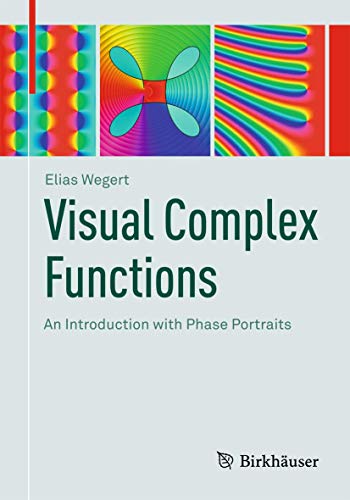
This book provides a systematic introduction to functions of one complex variable. Its novel feature is the consistent use of special color representations – so-called phase portraits – which visualize functions as images on their domains.Reading Visual Complex Functions requires no prerequisites except some basic knowledge of real calculus and plane geometry. The text is self-contained and covers all the main topics usually treated in a first course on complex analysis. With separate chapters on various construction principles, conformal mappings and Riemann surfaces it goes somewhat beyond a standard programme and leads the reader to more advanced themes.In a second storyline, running parallel to the course outlined above, one learns how properties of complex functions are reflected in and can be read off from phase portraits. The book contains more than 200 of these pictorial representations which endow individual faces to analytic functions. Phase portraits enhance the intuitive understanding of concepts in complex analysis and are expected to be useful tools for anybody working with special functions – even experienced researchers may be inspired by the pictures to new and challenging questions.Visual Complex Functions may also serve as a companion to other texts or as a reference work for advanced readers who wish to know more about phase portraits.
User’s Reviews
Editorial Reviews: Review From the reviews:“This textbook is an introduction to the classical theory of functions of one complex variable. Its distinctive feature are the graphical representations of functions, being the most useful tool in teaching and generally in mathematics. … The self-sufficiency of the textbook and the broad range of graphical examples makes the book useful for students as well as teachers of mathematics. … the book can be warmly recommended both to experts and to a new generation of mathematicians.” (Stanislawa Kanas, Zentralblatt MATH, Vol. 1264, 2013)“Anyone who works with complex variables should read this book. … Visual Complex Functions is a beautiful and careful presentation of an entire advanced introduction to complex analysis based on phase portraits and, where appropriate, other kinds of computer-generated pictures. … My understanding of many ideas and phenomena deepened through reading this book.” (Lloyd N. Trefethen, SIAM Review, Vol. 55 (4), 2013) From the Back Cover This book provides a systematic introduction to functions of one complex variable. Its novel feature is the consistent use of special color representations – so-called phase portraits – which visualize functions as images on their domains.Reading Visual Complex Functions requires no prerequisites except some basic knowledge of real calculus and plane geometry. The text is self-contained and covers all the main topics usually treated in a first course on complex analysis. With separate chapters on various construction principles, conformal mappings and Riemann surfaces it goes somewhat beyond a standard programme and leads the reader to more advanced themes.In a second storyline, running parallel to the course outlined above, one learns how properties of complex functions are reflected in and can be read off from phase portraits. The book contains more than 200 of these pictorial representations which endow individual faces to analytic functions. Phase portraits enhance the intuitive understanding of concepts in complex analysis and are expected to be useful tools for anybody working with special functions – even experienced researchers may be inspired by the pictures to new and challenging questions.Visual Complex Functions may also serve as a companion to other texts or as a reference work for advanced readers who wish to know more about phase portraits. About the Author Elias Wegert is a Professor of Mathematics at the Technische Universität Bergakademie Freiberg. His main research interests are in Complex and Nonlinear Analysis; he is the author of a book on nonlinear Riemann-Hilbert problems and their applications. Wegert has experience in mathematical teaching at different levels for about 30 years. He is also committed to mathematical competitions for high school students. Read more
Reviews from Amazon users which were colected at the time this book was published on the website:
⭐I was hoping for better visual presentations of complex functions, specifically, three dimensional magnitude plots with quadrant based colored phase information instead of flat topographic tri-color phase maps. The tricolor (Primary colors) phase representation is less intuitive that other colored phase schemes. Color quadrants is an easier to interpret method of discerning phase information. The NIST handbook of mathematical functions uses both phase color representations and it’s much easier to perceive phase with quadrant hues. Quadrant hues on magnitude maps was what I was hoping for. It’s still a landmark book, but it could have been better, something as profound as Tristan Needham’s profoundly original and beautiful “Visual Complex Analysis”.
⭐An excellent complementary to traditional complex analysis text. Estheticslly enjoyable to read on its own right, but also gets you to think deep into the math.
⭐I’d recommend this book as a supplement to your favorite complex analysis textbook. It’s main feature is the use of “phase portraits” to visualize analytic functions. I’m a huge fan of these phase portraits, and this book inspired me to start creating my own plots on Mathematica (which, for the record, is not that difficult to do). You’ll learn (among other things) how to identify singularities, determine the order of zeros (of the function and its derivative) just by seeing the phase portrait. You’ll gain a more intimate feel for the various analytic functions: rational functions, trigonometric functions, the Riemann zeta function, Weierstrass p-functions, etc. And it’s hard not to be impressed by the sheer beauty of the many pictures.Wegert’s book also tries to double as a complex analysis textbook. In this respect it is less effective, and I’d recommend that you stick to a standard textbook. Wegert also has a slight tendency to “oversell” the book, for example with statements like “the notion of a Riemann surface becomes inevitable once we take the vantage point of phase portraits”.Notwithstanding, the usefulness of these phase portraits is enough to merit a five-star rating. This is an innovation I believe ought to be incorporated in other complex analysis textbooks (even if it requires them to be printed in color!).Finally, this book might get compared to Needham’s “Visual Complex Analysis”. I’m less impressed with Needham’s book, which introduces a lot of nifty original concepts but gets comparatively little mileage out of it. A beginning undergraduate student might enjoy Needham’s book, but I believe that’s the extent of the books usefulness. Wegert’s book has much to offer for a graduate-level student.
⭐This is an amazing book. In 345 extraordinary pages it presents the foundations of the subject of complex variables — also known as complex analysis or function theory — through the powerful medium of the color pictures known as “phase portraits”.Prof. Wegert would like his book to be suitable as an introduction to this field, and perhaps it may be. But for my money the importance of this book is for people who have already been introduced to complex variables and now want to _really_ understand them, to work with them. Every topic is enhanced by this treatment. There is nothing else like this book (apart from Wegert’s own three annual calendars to date of “Complex Beauties”). In particular it is very different from Tristan Needham’s 1997 text Visual Complex Analysis, which also takes a geometric tack but is not full of actual displays of actual functions.Wegert’s book is so striking that I assumed Birkhauser would have priced it at an absurd level, so that individuals would never buy a copy. Instead it is just around 60 dollars or 40 pounds. Amazing.If you work with complex variables, buy this book. (- Nick Trefethen, Professor of Numerical Analysis, Oxford University)
⭐This is a very good introductory and intermediate lecture into complex analysis and Riemann Surfaces. Only this book is one of a kind, since it introduces these concepts by many, many beautiful pictures. But this is not only a picture book, the proofs are all there. A perfect amalgam between pure mathematics and graphics, and a very good visual tour on complex functions, which is only possible since the latest computer technology.
⭐Beautiful!
⭐interesting
⭐Das Buch von Elias Wegert ist eine wunderschöne Einführung in die Funktionentheorie. Die Visualisierung über Phasendiagramme (phase plots) ist sehr anschaulich und hat mir beim Verständnis des Inhalts sehr geholfen. Ich empfehle auf jeden Fall die Papierversion zu kaufen, oder das E-Book auf einem farbigen Bildschirm zu lesen. In Grautönen verlieren die Phasendiagramme ihre Wirkung.
⭐
Keywords
Free Download Visual Complex Functions: An Introduction with Phase Portraits 2012th Edition in PDF format
Visual Complex Functions: An Introduction with Phase Portraits 2012th Edition PDF Free Download
Download Visual Complex Functions: An Introduction with Phase Portraits 2012th Edition 2012 PDF Free
Visual Complex Functions: An Introduction with Phase Portraits 2012th Edition 2012 PDF Free Download
Download Visual Complex Functions: An Introduction with Phase Portraits 2012th Edition PDF
Free Download Ebook Visual Complex Functions: An Introduction with Phase Portraits 2012th Edition