

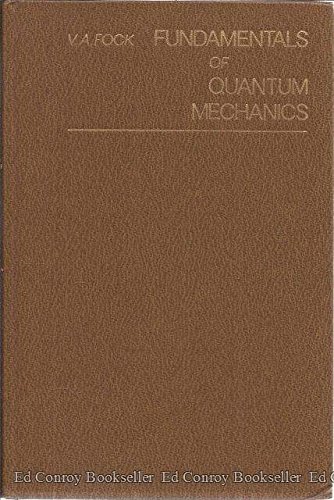
Ebook Info
- Published: 1978
- Number of pages: 367 pages
- Format: PDF
- File Size: 8.47 MB
- Authors: Vladimir A. Fock
Description
User’s Reviews
Reviews from Amazon users which were colected at the time this book was published on the website:
⭐An unparalleled achievement, encompassed within span of approximately 350 pages, in five parts: Basics in 100 pages, Schrodingeroccupies us in the following 120 pages, Pauli’s electron in 30 pages, next, 20 pages of many-electron atoms, finally, Dirac Equation.It is apparent that this is a compact presentation. Mathematics is not eschewed. In fact, the first part, that is, the exposition of matrices, operators, eigenvalues and probability can claim completeness in preparing the way for thorough foundation in all that follows.(1) Part One concludes with this statement : ” Summarizing, we can say that the purpose of the main concept of Quantum Mechanics,the concept of a state described by a wave function, is to analyze objectively all potential possibilities inherent in the micro-object.” (Page 95)(2) Second part begins with solution of the Harmonic Oscillator (direct series solution of the differential equation ) followed byexpositions of Perturbation Theory, Coulomb Field, Spherical Harmonics, Asymptotics; Part Two concludes with a brief discussionof Superposition : ” The Superposition Principle is necessary if we want to derive, starting from a general principle, the dual natureof light and matter, which manifest themselves as waves and as particles…the probabilities will be proportional to the squares of the amplitudes.” (Page 231).(3) Part three incorporates (electron) Spin: “….an internal degree of freedom connected with its intrinsic angular momentum, which doesnot depend on its motion in space.” Fock begins with commutation relations and finishes on this note referencing the Pauli Exculsion Principle: “… it is then evident that the need for spin arises already in the nonrelativistic theory.” (Page 256).(4) Part four: Atoms, beginning with Exclusion Principle and Symmetry: “The most significant corollary of this interrelation is thedetermination of the symmetry transformation group for the hydrogen atom.” (Page 279).(5) Part five: Derivation of the Dirac Equation, Lorentz Covariance, use of Dirac Equation in physical problems; that is, free electron,then electron on homogeneous magnetic field followed by spherical symmetry and spherical harmonics, selection rules, Zeeman effectand splitting of energy levels. Read: ” Since the derivation of the Pauli equation from the Dirac equation is interesting in itself,we will do it here although we already know the result.” (Page 308).Finally, the preface: “…endeavored to avoid using images from the classical theory…attempted to familiarize the reader with thebasic concepts underlying a quantum description of the states of atomic systems…a fairly detailed examination of the mathematics…”Obviously, this is not a first initiation into the subject matter.However, the prose is unambiguous, mathematical derivations clear as a bell, and the author’s philosophy clearly elucidated.Highly recommended for it’s detailed analysis of quantum physical problems.
⭐
Keywords
Free Download Fundamentals of Quantum Mechanics in PDF format
Fundamentals of Quantum Mechanics PDF Free Download
Download Fundamentals of Quantum Mechanics 1978 PDF Free
Fundamentals of Quantum Mechanics 1978 PDF Free Download
Download Fundamentals of Quantum Mechanics PDF
Free Download Ebook Fundamentals of Quantum Mechanics