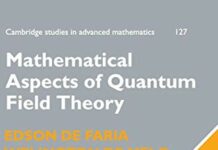
Ebook Info
- Published: 2010
- Number of pages: 314 pages
- Format: PDF
- File Size: 3.08 MB
- Authors: Edson de Faria
Description
Over the last century quantum field theory has made a significant impact on the formulation and solution of mathematical problems and inspired powerful advances in pure mathematics. However, most accounts are written by physicists, and mathematicians struggle to find clear definitions and statements of the concepts involved. This graduate-level introduction presents the basic ideas and tools from quantum field theory to a mathematical audience. Topics include classical and quantum mechanics, classical field theory, quantization of classical fields, perturbative quantum field theory, renormalization, and the standard model. The material is also accessible to physicists seeking a better understanding of the mathematical background, providing the necessary tools from differential geometry on such topics as connections and gauge fields, vector and spinor bundles, symmetries and group representations.
User’s Reviews
Editorial Reviews: Review “The authors do quite a good job of giving a complete, yet concise treatment of this field theory that is crucial in our understanding of the world of particle physics.” Walter D. van Suijlekom, Mathematical Reviews”… a brief, but careful, reasonably balanced, and representative introduction for mathematicians to QFT as it is used in physics.” The Mathematical Intelligencer Book Description This book presents some of the basic ideas and tools of quantum field theory to a mathematical audience. About the Author Edson de Faria is a Professor in the Instituto de Matemática e Estatística at the Universidade de São Paulo.Welington de Melo is a Professor in the Instituto de Matemática Pura e Aplicada in Rio de Janeiro. Read more
Reviews from Amazon users which were colected at the time this book was published on the website:
⭐A book of this sort is difficult to write. You have to determine if you are writing it as a mathematics book or a physics book. This book starts out well down the track of a mathematics book but it strays and gets confused by about half way through. It doesn’t give the physicists the insights to why certain mathematical constructs are used nor does it give the mathematical rigor that should be present for the mathematical. However, with all its short comings it is a good mathematical survey of quantum field theory.
⭐This product reviews in a perfect way gauge theory and the standard model and gives a very clear background of the mathematical machinrey behind it.Congratulations to those who will read it.
⭐Es handelt sich hierbei um ein “nettes” Buch. Ich denke, jeder mathematisch orientierte Lerner der QFT sollte einen Blick in dieses Buch riskieren. Im Gegensatz zu dem sehr guten Buch von Gerald Folland, das sich ebenfalls an Mathematiker richtet, wird in diesem Buch tatsächlich eine weitgehend rigorose Behandlung der QFT bis hin zum Standardmodell angestrebt. Das Buch stellt in größtmöglicher Knappheit Methoden der Differentialgeometrie (Differentialformen, Darstellungen, Zusammenhänge auf Hauptfaserbündeln) und der Funktionalanalysis (Spektralsatz für unbeschränkte Operatoren wird formuliert und in einem Anhang bewiesen; kurze Behandlung der C*-Algebren) vor. Der Ansatz ist nett gemeint und absolut einmalig. Das Buch würde glatt fünf Sterne von mir bekommen, wenn die Umsetzung ebenso gut wie die Idee wäre. Das ist sie aber nicht. Das Buch enthält viele Fehler. Dabei geht es um Kleinigkeiten wie die falsche Angabe der Dirac-Matrizen, die jeder aufmerksame Leser bemerken und leicht korrigieren können wird. Es geht aber auch um richtig grobe Schnitzer: Die Vertauschung von Gruppenelementen und Inversen etwa bei der Definition der adjungierten Darstellung wird den Leser davon abhalten, Intuition zu gewinnen. Ein Vergleich etwa mit dem Buch “Analysis, Manifolds and Physics” hilft hier aber weiter. Unrettbar falsch ist hingegen die Darstellung der Zusammenhänge auf Hauptfaserbündeln. Hier hilft nur eins: Ein richtiges Differentialgeometriebuch (etwa “Curvature in Mathematics and Physics” von Shlomo Sternberg) zu lesen! Angesichts der großen Dichte von Fehlern unterschiedlicher Schwere kann dieses Buch auf keinen Fall als zuverlässige Referenz dienen. Auch als Lehrbuch ist es nicht geeigne. Gut geeignet ist es als Leitfaden, mit welchen Themen man sich in welcher Reihenfolge beschäftigen kann. Dafür finde ich es allerdings etwas zu teuer.Äußerlich hat das Buch eine gute Qualität.Ich kann zusammenfassen: In der Bibliothek sollte man nicht daran vorbeilaufen (wenn man es denn dort findet); ob man das Buch kaufen sollte, muß angesichts des Preises jeder selbst beurteilen. Ich bereue den Kauf nicht direkt, bin aber auch nicht super glücklich darüber. Ich hoffe allerdings, daß es eine korrigierte Neuauflage geben wird, wo dann hoffentlich Fehler behoben sind. Ich werde den Autoren in Kürze meine Fehlerliste zukommen lassen.
Keywords
Free Download Mathematical Aspects of Quantum Field Theory (Cambridge Studies in Advanced Mathematics, Series Number 127) 1st Edition in PDF format
Mathematical Aspects of Quantum Field Theory (Cambridge Studies in Advanced Mathematics, Series Number 127) 1st Edition PDF Free Download
Download Mathematical Aspects of Quantum Field Theory (Cambridge Studies in Advanced Mathematics, Series Number 127) 1st Edition 2010 PDF Free
Mathematical Aspects of Quantum Field Theory (Cambridge Studies in Advanced Mathematics, Series Number 127) 1st Edition 2010 PDF Free Download
Download Mathematical Aspects of Quantum Field Theory (Cambridge Studies in Advanced Mathematics, Series Number 127) 1st Edition PDF
Free Download Ebook Mathematical Aspects of Quantum Field Theory (Cambridge Studies in Advanced Mathematics, Series Number 127) 1st Edition