

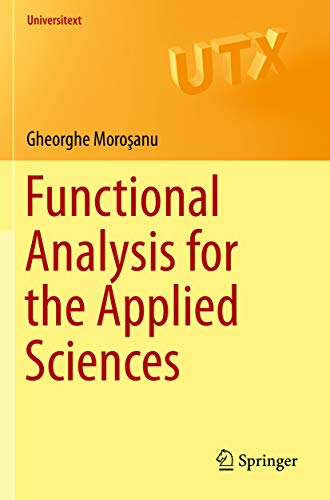
Ebook Info
- Published: 2019
- Number of pages: 444 pages
- Format: PDF
- File Size: 3.55 MB
- Authors: Gheorghe Moroşanu
Description
This advanced graduate textbook presents main results and techniques in Functional Analysis and uses them to explore other areas of mathematics and applications. Special attention is paid to creating appropriate frameworks towards solving significant problems involving differential and integral equations. Exercises at the end of each chapter help the reader to understand the richness of ideas and methods offered by Functional Analysis. Some of the exercises supplement theoretical material, while others relate to the real world. This textbook, with its friendly exposition, focuses on different problems in physics and other applied sciences and uniquely provides solutions to most of the exercises. The text is aimed toward graduate students and researchers in applied mathematics, physics, and neighboring fields of science.
User’s Reviews
Reviews from Amazon users which were colected at the time this book was published on the website:
⭐When I read this book, I felt that the textbook is fairly self-contained in the following aspects:1. This book develops the functional analysis to the point of application in differential and integral equation DIRECTLY, reflected by not including the abstract on each topic such as general topological space. general measure space, other properties of Hilbert space which require the notion of C*-algebra, and etc. In fact, aforementioned topics worth the substantial amount of time to study in depth, especially you are analyst or probability theorist (for general measure space theory in particular), but their generality and abstraction seems to be apart from the purpose of building a solid theoretical tools for solving ODE, PDE, and integral equations.2. It assumes some background from undergraduate-level real analysis and linear algebra, not too intimidating for the target groups of audience and target application of this book. Basic real analysis up to the level of baby Rudin (or Abbott’s superb book on real analysis) and linear algebra are the prerequisite to study any physical science along with multivariate calculus. Even though I read this book for brushing up myself some mathematical tools before starting my semester in Ph.D. finance Program (I have background in Economics and Mathematics) and some applications herein this book may not fit my usage, the parts of underlying theory are still sufficient for my purpose.3. The proof is clear, no non-trivial step is missed. Some proofs may refer to other textbook (eg. On page 114, boundedness of Friedrich’s mollifiers requires Fubini-Tonelli theorem. The author refers to Yosida’s Functional Analysis book) , but these do not distract the process of proof and just a few number of proofs require reference from other books.4. There exists a crude solution manual and hints for the problems in this book. To learn mathematics, one cannot master the content by just proving stuffs within the chapters. However, an ideal solution manual should point out a key non-trivial step, not provide full detail of the proof: too sketchy solution can’t help reader while too detailed may kill the motivation to workout the problem without copying the solution directly.A few thing frustrating me are, firstly, development of measure space theory in this book and, secondly, the lack of index. The first one, in my opinion, is not serious since many textbook developing analysis for solving PDE (considering Jost’s “Postmodern Analysis” which I found that it did a great job by just Lebesgue measure theory on R^n on the integration theory side) , but to apply the integration theory, more practical tools such as Fubini-Tonelli theorem, Change of Variable formula for multivariate real-value function integration are needed. And, as a practitioner in the field of economics and finance, general measure theory is more natural to link with probability theory, other main tool. The second problem, lack of index, is a bit more problematic for me,. Although this book has only 339 pages excluding solution manual and bibliography, finding some detail by flipping over the whole section or chapter is not convenient.All in all, I think that Morosanu’s functional analysis book is a great self-contained book for studying functional analysis, especially who aim for use it in ODE, PDE, and integral equation. Despite of some issues, one is regarding to my personal opinion on some more practical tool and the second one is not concerning to the quality of content, I could recommend this well-written book even undergrad who would like to take a glimpse on functional analysis in an entry-level.
⭐I was really surprised a book on functional analysis didn’t cover variational calculus but maybe that’s just me.
Keywords
Free Download Functional Analysis for the Applied Sciences (Universitext) in PDF format
Functional Analysis for the Applied Sciences (Universitext) PDF Free Download
Download Functional Analysis for the Applied Sciences (Universitext) 2019 PDF Free
Functional Analysis for the Applied Sciences (Universitext) 2019 PDF Free Download
Download Functional Analysis for the Applied Sciences (Universitext) PDF
Free Download Ebook Functional Analysis for the Applied Sciences (Universitext)