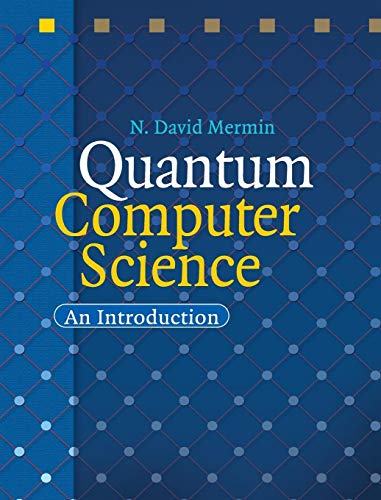
Ebook Info
- Published: 2007
- Number of pages: 233 pages
- Format: PDF
- File Size: 3.63 MB
- Authors: N. David Mermin
Description
In the 1990’s it was realized that quantum physics has some spectacular applications in computer science. This book is a concise introduction to quantum computation, developing the basic elements of this new branch of computational theory without assuming any background in physics. It begins with an introduction to the quantum theory from a computer-science perspective. It illustrates the quantum-computational approach with several elementary examples of quantum speed-up, before moving to the major applications: Shor’s factoring algorithm, Grover’s search algorithm, and quantum error correction. The book is intended primarily for computer scientists who know nothing about quantum theory, but will also be of interest to physicists who want to learn the theory of quantum computation, and philosophers of science interested in quantum foundational issues. It evolved during six years of teaching the subject to undergraduates and graduate students in computer science, mathematics, engineering, and physics, at Cornell University.
User’s Reviews
Editorial Reviews: Review “…what it treats, it treats extremely well, with rigor and attention to detail that reveals a deep understanding of the subject… “I truly hope that Mermin’s book will nurture the next generations of scientists in their understanding of things quantum computational — or even just plain quantum.” Barbara Terhal, IBM T.J. Watson Research Center for PHYSICS TODAYPre-Publication Endorsement: “… will be a standard for instruction and reference for years to come. … The book is suffused with Mermin’s unique knowledge of the history of modern physics, and has some of the most captivating writing to be found in a college textbook.” David DiVincenzo, IBM T. J. Watson Research CenterPre-Publication Endorsement: “… a gentle introduction to quantum computation especially aimed at an audience of computer scientists and mathematicians. … Mermin has always been an entertaining and comprehensible writer, and continues to be in this book. I expect it to become the definitive introduction to this material for non-physicists.” Peter Shor, Massachusetts Institute of TechnologyPre-Publication Endorsement: “… Mermin’s lucid prose and gentle humor cajole [students] toward a sound intuition for what it all means, not an easy task for a subject superficially so counterintuitive.” Charles Bennett, IBM T. J. Watson Research CenterPre-Publication Endorsement: “This is one of the finest books in the rapidly growing field of quantum information. Almost every page contains a unique insight or a novel interpretation. David Mermin has once again demonstrated his legendary pedagogical skills to produce a classic.” Lov Grover, Bell Labs”The text, the mathematics and the (many, many) circuit diagrams are impeccably laid out; the tone is enthusiastic without resorting to hyperbole; and the writing is clear and a joy to read. Indeed, the reader is well taken care of in this book.” Wim van Dam, American Scientist”…an excellent introductory book…” – James W. Harrinton, Mathematical Reviews Book Description A concise introduction to quantum computation for computer scientists who know nothing about quantum theory. Book Description Quantum physics has some spectacular applications in computer science, and this book is a concise introduction to quantum computation. It develops the basic elements of computational theory without assuming any background in physics, and so is ideal for computer scientists who know nothing about quantum theory. About the Author N. David Mermin is Horace White Professor of Physics Emeritus at Cornell University. He has received the Lilienfeld Prize of the American Physical Society and the Klopsteg Award of the American Association of Physics Teachers. He is a member of the U. S. National Academy of Sciences and the American Academy of Arts and Sciences. Professor Mermin has written on quantum foundational issues for several decades, and is known for the clarity and wit of his scientific writings. Among his other books are Solid State Physics (with N. W. Ashcroft, Thomson Learning 1976), Boojums all the Way Through (Cambridge University Press 1990), and It’s about Time: Understanding Einstein’s Relativity (Princeton University Press 2005). Read more
Reviews from Amazon users which were colected at the time this book was published on the website:
⭐I’m not a big fan of the whole ‘we leave it as an exercise to show…’, ‘it can be shown with straightforward algebra manipulation that…’, and other rubbish that one finds in physics books. I’m a working professional that wants to learn a new discipline in a very limited amount of time, and if I had the time to derive everything from scratch, I I wouldn’t need to purchase a textbook.This book nails it. The author shows his work. I’m not spending hours trying to fill in skipped steps or trying to figure out notation that’s unclear or introduced without definition.Wonderful work. Highly recommended.
⭐Good coverage of the basics. I like the comp science centric approach. A little hard to follow some of the finer details. Really thorough coverage of error correction. The author has an unusual view on the nature of quantum states, and insists on using qbit rather than qubit throughout. Be wary.
⭐Mermin’s explanations are among the clearest available, as is usual for him, and his treatment has many original features (including alternative quantum gates), and nuggets of insight. Some of his insights are not found in other books, but some are quoted by all of the other textbooks on quantum computing that appeared after his. Some of his terminology is favored by logic, but is non-standard: Qbit for what others write as ‘qubit’. The only missing topic is Fault-Tolerant Quantum Computing, which can be viewed as an outgrowth of error-correcting codes for quantum computing, which he treats very well. This is one of the indispensible books on the subject.
⭐A must read for every IT and/or Cyber Security Professional as a major shift in computing will occur within the next 5 to 10 years. Now is the time to embrace quantum computing as those in the know will reap the benefits of being part of a small group of people who will be in a position to change the world. Great introductory book and can be considered a stepping stone into the quantum computing world.
⭐The book itself is fantastic, five stars for content, but the kindle version has some serious issues– many symbols that should be superscripts are not, some mathematical expressions have distorted layout, or worse, appear as scanned images–sometimes of such low resolution as to make the indices illegible. For the forty dollars I paid it’s a slap in the face. Again I want to stress the high quality of the writing and content, but think twice before investing in the kindle version.
⭐Great Intro …Mermin gets right into the thick of it quickly …this is one of the best physics/computer science books I have ever read over the past 50 years !
⭐Inconsistent with definitions and several terms are used before they are defined.
⭐This book is fantastic. Wonderfully clear and short enough to actually read. I wish all science texts were like this.A course in quantum mechanics is recommended. It might not be necessary but I doubt much could be understood without some understanding of the physics behind the building blocks of the theory and what might be required in actually building a functioning quantum computer. I know it’s not necessary and someone who accepts the superposition of states easily could get through the book, but I don’t think they would really have grokked the fullness (but for that matter nor do I).The book builds up some basic QM and the actions of the various gates acting on a Qbit, then goes through several introductory problems to demonstrate how a quantum computer is capable of fundamentally different computations than its classical counterparts. This works up to Shor’s Algorithm (with a very nice demonstration of why it is robust to small errors in the phase), Grover’s search, and Quantum Error Correction.The appendices are also full of some of the best explanations I have ever read for many small calculations, tools, and puzzles. Bell states, GHZ, and other examples of quantum weirdness are covered well and it drives home the point that the most fundamental aspects of QM are easily illustrated without the bookkeeping associated with infinite dimensional Hilbert spaces.
⭐Mermin’s intro may not be for the absolute beginner but if you supplement its reading with another more accessible handbook then you ll surely benefit from it…in any case you can’t achieve mastery with just one book …so this should be on your list along with Kitaev’s intro to Quantum (the one published by AMS)…I would also recommend to make a pass from G. Strang’s Linear Algebra Intro that covers most of the Algebra you need at this level….
⭐Like many such book this has “an introduction to” in the title. It clearly is not an introduction. However I actually did want some depth in explanation and so is ok
⭐This is a must have textbook.
⭐Pas de commentaires sur le contenu. Par contre, le Kindle format est abominable : formules illisibles, … Shame on Kindle !
⭐
Keywords
Free Download Quantum Computer Science: An Introduction 1st Edition in PDF format
Quantum Computer Science: An Introduction 1st Edition PDF Free Download
Download Quantum Computer Science: An Introduction 1st Edition 2007 PDF Free
Quantum Computer Science: An Introduction 1st Edition 2007 PDF Free Download
Download Quantum Computer Science: An Introduction 1st Edition PDF
Free Download Ebook Quantum Computer Science: An Introduction 1st Edition