Ebook Info
- Published: 2014
- Number of pages: 456 pages
- Format: PDF
- File Size: 6.43 MB
- Authors: Edward B. Magrab
Description
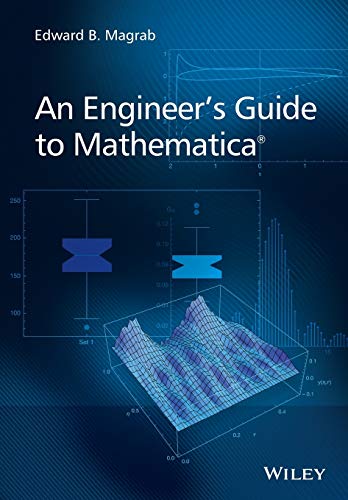
Free Mathematica 10 Update Included! Now available from www.wiley.com/go/magrabUpdated material includes:- Creating regions and volumes of arbitrary shape and determining their properties: arc length, area, centroid, and area moment of inertia- Performing integrations, solving equations, and determining the maximum and minimum values over regions of arbitrary shape- Solving numerically a class of linear second order partial differential equations in regions of arbitrary shape using finite elements An Engineer’s Guide to Mathematica enables the reader to attain the skills to create Mathematica 9 programs that solve a wide range of engineering problems and that display the results with annotated graphics. This book can be used to learn Mathematica, as a companion to engineering texts, and also as a reference for obtaining numerical and symbolic solutions to a wide range of engineering topics. The material is presented in an engineering context and the creation of interactive graphics is emphasized. The first part of the book introduces Mathematica’s syntax and commands useful in solving engineering problems. Tables are used extensively to illustrate families of commands and the effects that different options have on their output. From these tables, one can easily determine which options will satisfy one’s current needs. The order of the material is introduced so that the engineering applicability of the examples increases as one progresses through the chapters. The second part of the book obtains solutions to representative classes of problems in a wide range of engineering specialties. Here, the majority of the solutions are presented as interactive graphics so that the results can be explored parametrically.Key features:Material is based on Mathematica 9Presents over 85 examples on a wide range of engineering topics, including vibrations, controls, fluids, heat transfer, structures, statistics, engineering mathematics, and optimizationEach chapter contains a summary table of the Mathematica commands used for ease of referenceIncludes a table of applications summarizing all of the engineering examples presented.Accompanied by a website containing Mathematica notebooks of all the numbered examplesAn Engineer’s Guide to Mathematica is a must-have reference for practitioners, and graduate and undergraduate students who want to learn how to solve engineering problems with Mathematica.
User’s Reviews
Editorial Reviews: From the Inside Flap An Engineer’s Guide to Mathematica enables the reader to attain the skills to create Mathematica 9 programs that solve a wide range of engineering problems and that display the results with annotated graphics. This book can be used to learn Mathematica, as a companion to engineering texts, and also as a reference for obtaining numerical and symbolic solutions to a wide range of engineering topics. The material is presented in an engineering context and the creation of interactive graphics is emphasized. The first part of the book introduces Mathematica’s syntax and commands useful in solving engineering problems. Tables are used extensively to illustrate families of commands and the effects that different options have on their output. From these tables, one can easily determine which options will satisfy one’s current needs. The order of the material is introduced so that the engineering applicability of the examples increases as one progresses through the chapters. The second part of the book obtains solutions to representative classes of problems in a wide range of engineering specialties. Here, the majority of the solutions are presented as interactive graphics so that the results can be explored parametrically. Key features: Material is based on Mathematica 9Presents over 85 examples on a wide range of engineering topics, including vibrations, controls, fluids, heat transfer, structures, statistics, engineering mathematics, and optimizationEach chapter contains a summary table of the Mathematica commands used for ease of referenceIncludes a table of applications summarizing all of the engineering examples presented.Accompanied by a website containing Mathematica notebooks of all the numbered examplesAn Engineer’s Guide to Mathematica is a must-have reference for practitioners, and graduate and undergraduate students who want to learn how to solve engineering problems with Mathematica. From the Back Cover An Engineer’s Guide to Mathematica enables the reader to attain the skills to create Mathematica 9 programs that solve a wide range of engineering problems and that display the results with annotated graphics. This book can be used to learn Mathematica, as a companion to engineering texts, and also as a reference for obtaining numerical and symbolic solutions to a wide range of engineering topics. The material is presented in an engineering context and the creation of interactive graphics is emphasized. The first part of the book introduces Mathematica’s syntax and commands useful in solving engineering problems. Tables are used extensively to illustrate families of commands and the effects that different options have on their output. From these tables, one can easily determine which options will satisfy one’s current needs. The order of the material is introduced so that the engineering applicability of the examples increases as one progresses through the chapters. The second part of the book obtains solutions to representative classes of problems in a wide range of engineering specialties. Here, the majority of the solutions are presented as interactive graphics so that the results can be explored parametrically. Key features: Material is based on Mathematica 9Presents over 85 examples on a wide range of engineering topics, including vibrations, controls, fluids, heat transfer, structures, statistics, engineering mathematics, and optimizationEach chapter contains a summary table of the Mathematica commands used for ease of referenceIncludes a table of applications summarizing all of the engineering examples presented.Accompanied by a website containing Mathematica notebooks of all the numbered examplesAn Engineer’s Guide to Mathematica is a must-have reference for practitioners, and graduate and undergraduate students who want to learn how to solve engineering problems with Mathematica. About the Author Dr. Magrab is Emeritus Professor of Mechanical Engineering at the University of Maryland, College Park, Maryland. Before joining the University of Maryland, he was Chief of the Sound Section, head of the Robot Metrology Group, and led the development of the vertical machining workstation in the Automated Manufacturing Research Facility at the National Institute of Standards and Technology (NIST). He went to NIST after being a professor in the Department of Mechanics at the Catholic University of America in Washington DC. Dr. Magrab is a Life Fellow of the American Society of Mechanical Engineers and a registered professional engineer in Maryland. He has authored eight other textbooks, published numerous journal articles, and has over 35 years of university-level teaching experience on many engineering subjects. His research interests include analytical and experimental investigations in vibrations, acoustics, and the integration of design and manufacturing. He holds one patent. Read more
Reviews from Amazon users which were colected at the time this book was published on the website:
⭐Well written, clear book on engineering applications of mathematica. It does start with the basics of the language and covers a good range of topics- list, vectors matrices- functions-symbolic operations-numerical solutions to equations-graphs-interactive graphicsEngineering applications (e.g.vibrations, statistics, control systems, heat transfer and some simple one dimensional fluid mechanics).Personally, I probably should have gotten a book that focuses more on mathematica than applications. I’d love more basic illustrations of how to manipulate partial differential equations by combination of variables, separation of variables, method of characteristics etc. There is virtually nothing on variational methods, perturbations or matched asymptotic expansions. But the author is not responsible for my expectations. He has done a good job writing a book that covers what it says it does. He earned his five stars.
⭐It contains what I need to make myself an Math user.
⭐Très bon livre, et l’auteur a même réalisé une mise au point téléchargeable pour tenir compte de l’évolution très importante de Mathematica après parution…
⭐
Keywords
Free Download An Engineer’s Guide to Mathematica 1st Edition in PDF format
An Engineer’s Guide to Mathematica 1st Edition PDF Free Download
Download An Engineer’s Guide to Mathematica 1st Edition 2014 PDF Free
An Engineer’s Guide to Mathematica 1st Edition 2014 PDF Free Download
Download An Engineer’s Guide to Mathematica 1st Edition PDF
Free Download Ebook An Engineer’s Guide to Mathematica 1st Edition