Ebook Info
- Published: 1996
- Number of pages: 161 pages
- Format: PDF
- File Size: 3.66 MB
- Authors: Catharine A. MacKinnon
Description
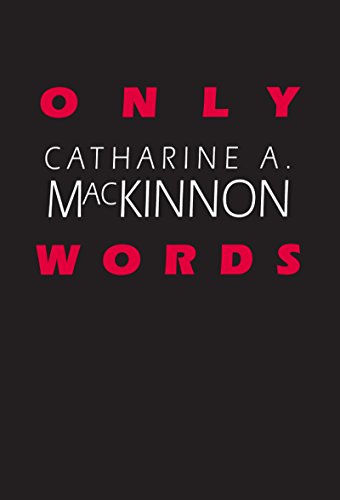
MacKinnon contends that pornography, racial and sexual harassment, and racial hate speech are acts of intimidation, subordination, terrorism, and discrimination, and should be legally treated as such.
User’s Reviews
Reviews from Amazon users which were colected at the time this book was published on the website:
⭐This small, thin book on hate speech and pornography is unpleasant to read, not just because of its topic but because of its stridency. There are far more outraged references to dirty words, body parts, and violent acts than seem necessary. This no doubt reflects the feelings of the author herself, but I felt something more was involved, requiring more effort to understand. She is a professor of law and a famous authority in her field, so the book requires attention..The core of the argument is taken from a book by the English philosopher J. L. Austin, ‘How to do Things with Words”, which appeared in 1955. He observed that many so-called “statements” are really actions in addition to being words put together in a grammatical way. For example, when King Arthur taps Launcelot on the shoulder with a sword and says “I dub thee Knight”, the speech is making Launcelot a different sort of person. Austin called such statements “performatives” and pointed out that to be a valid action, a performative must satisfy a number of conditions: “There must be an accepted conventional procedure having a certain conventional effect …”, “the particular persons and circumstances must be appropriate …”, and so on for a total of six conditions. Later philosophers have elaborated on Austin’s classifications, and even tried to view all language as action.The author mentions Austin once, in a footnote at the end of the book. Uninterested in subtleties, she declares over and over that certain offensive pictures, words, and films are acts in themselves. Pornographic materials “subordinate women through pictures or words.” (p. 22) (Apparently we should forget that there is a lot of pornography that does not involve subordination.) Or: “Speech acts. It makes no difference from the action side either. Acts speak. In the context of social inequality, so-called speech can be an exercise of power which constructs the social reality in which people live, from objectification to genocide.” (pp. 30-31) The author ignores the conditions that Austin pointed out for performatives to be effective. To her, a film showing a woman being raped is essentially rape itself and therefore a criminal act. By declaring pornography more than “only words”, she has placed it out of the protection of First Amendment law on freedom of expression.This argument leads to absurdities. Is a film showing a man chopping down a tree equivalent to an act of war on nature? The author does not appear to specify limits to the equivalence of acts and expressions but I observe that all of her examples arise in one context: social subordination. If we are good American liberals, the phrase “social inequality” apparently decides the matter. The Fourteenth Amendment of the U.S. Constitution forbids any State to “deny any person within its jurisdiction the equal protection of the laws.” Hate speech and pornography are expressions of subordination. She sees the performativity concept is a tool with which the civil rights advocate might be able to make the equality issue predominate over the First Amendment. For example, in connection with campus “hate speech codes”, she says, “That these procedures might vindicate a constitutional interest in equality which is as important as, or part of, the speech interest used to demolish them is not considered.” (p. 87) Once the First Amendment has been put in its place, where does the equality interest stop? Should the university’s janitors be paid as much as the professors?This triad — First Amendment, Fourteenth Amendment, and the equivalence of word and act — is played out throughout “Only Words”, along with the repeated invocation of porn films, rape, sexual harassment at work, and racial epithets. In the end the book becomes a torture to read. But its influence is undeniable. Twenty years after publication, students are demanding “safe spaces” where they are safeguarded from not just from blows by words but reference to anything that might be unpleasant to hear about.
⭐Clear and effective response to some earlier critiques of her position. A powerful presentation of that position. Ultimately cant overcome her deterministic approach to interpretation or the slippery speech action conflation.
⭐A brilliant exposition of the problems surrounding hate speech. MacKinnon explains how racist and sexist speech creates a problem for equality, and that protecting virulent forms of such speech interferes with the equality guarantees in the Constitution. No one who is interested in free speech can get around this argument, which constitutes one of the major contributions to how we think about our essential freedoms and equality in this country.
⭐The book is not well thought out. The law MacKinnon and Dworkin drafted is so broad and subjective it would never work.She makes a number of logical leaps that just don’t make sense.
⭐This book is painful to read. I’m glad I bought this before taking a class with Catharine MacKinnon so I could drop her class before the semester started. She has extreme views that do little more than essentialize and generalize.
⭐Catharine Alice MacKinnon (born 1946) is an American feminist legal scholar, activist, and author, who is Professor of Law at the University of Michigan Law School, and a Visiting Professor of Law at Harvard Law School. She first became widely-known for her opposition to pornography.She wrote in the ‘Acknowledgements’ section of this 1993 book, “Originally presented as the Christian Gauss Memorial Lectures in April 1992 at Princeton University, these three discussions took their current form as a result of the instigation and inspiration of that forum. Later, the Columbia Legal Theory Workshop … and Feminist Legal theory class at Yale Law School provided supportive settings for their development and clarification.”She notes, “What pornography does, it does in the real world, not only in the mind… it should be observed that it is the pornography industry, not the ideas in the materials, that forces, threatens, blackmails, pressures, tricks and cajoles women into sex for pictures. In pornography, women are gang raped so they can be filmed. They are not gang raped by the idea of a gang rape… Empirically… it is only pornography, not its ideas as such, that… support aggression against women in particular.” (Pg. 15-16)She observes, “Empirically, all pornography is made under conditions of inequality based on sex, overwhelmingly by poor, desperate, homeless, pimped women who were sexually abused as children. The industry’s profits exploit, and are an incentive to maintain, these conditions. These conditions constrain choice rather than offering freedom.” (Pg. 20)She points out, “Suppose lynchings were done to make pictures of lynchings. Should their racist content protect them as political speech, since they do their harm through conveying a political ideology?… If the lunching includes rape, is it, too, potentially speech?… Why, consistent with existing speech theory, are these activities not expressive? If expressive, why not protected?” (Pg. 34-35) Later, she argues, “Child pornography is not considered the speech of a sexually dissident minority, which it is, advocating ‘ideas’ about children and sex, which it does.” (Pg. 91)She states that pornography is “the power of women over women, expressed through unequal sex, sanctioned both through and prior to state power.” (Pg. 40) Later, she adds, “What is wrong with pornography is that it hurts women and their equality. What is wrong with obscenity law is that this reality has no role in it.” (Pg. 88)This is one of the most influential feminist books opposing pornography, and will be “must reading” for anyone studying the issue.
Keywords
Free Download Only Words in PDF format
Only Words PDF Free Download
Download Only Words 1996 PDF Free
Only Words 1996 PDF Free Download
Download Only Words PDF
Free Download Ebook Only Words