

Ebook Info
- Published: 2017
- Number of pages: 304 pages
- Format: PDF
- File Size: 0.99 MB
- Authors: Venkat Venkatasubramanian
Description
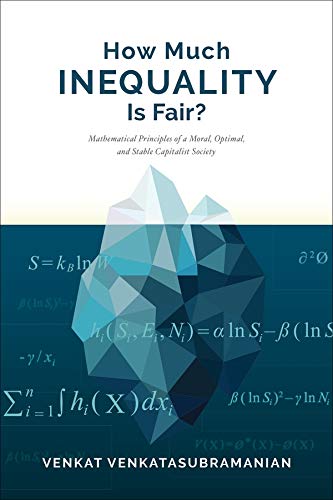
Many in the United States feel that the nation’s current level of economic inequality is unfair and that capitalism is not working for 90% of the population. Yet some inequality is inevitable. The question is: What level of inequality is fair? Mainstream economics has offered little guidance on fairness and the ideal distribution of income. Political philosophy, meanwhile, has much to say about fairness yet relies on qualitative theories that cannot be verified by empirical data. To address inequality, we need to know what the goal is―and for this, we need a quantitative, testable theory of fairness for free-market capitalism.How Much Inequality Is Fair? synthesizes concepts from economics, political philosophy, game theory, information theory, statistical mechanics, and systems engineering into a mathematical framework for a fair free-market society. The key to this framework is the insight that maximizing fairness means maximizing entropy, which makes it possible to determine the fairest possible level of pay inequality. The framework therefore provides a moral justification for capitalism in mathematical terms. Venkat Venkatasubramanian also compares his theory’s predictions to actual inequality data from various countries―showing, for instance, that Scandinavia has near-ideal fairness, while the United States is markedly unfair―and discusses the theory’s implications for tax policy, social programs, and executive compensation.
User’s Reviews
Editorial Reviews: Review Venkat Venkatasubramanian’s unusual argument, which draws on both mathematical and philosophical principles to propose a model of a fair society, is itself worthy of remark. Whether or not you agree with it, it is clearly and fairly presented. It’s one of the best books of its kind. — Simon DeDeo, Carnegie Mellon UniversityA thoughtful book, with unique philosophical insights, that is refreshing for the ways in which it is different from standard economic theory. It addresses one of the major questions of our day―indeed, of the past two hundred years―and does so in a readable, thought-provoking way. — Robert Axtell, George Mason UniversityStands out in originality, interdisciplinary focus, and crisp phrasing. ― Journal of Philosophical Economics About the Author Venkat Venkatasubramanian is Samuel Ruben–Peter G. Viele Professor of Engineering at Columbia University.
Reviews from Amazon users which were colected at the time this book was published on the website:
⭐This is a really disappointing book. I think the author is advancing ideas that are relevant and important for addressing social structures for the 21st century. However, the text alternates between long and somewhat repetitive philosophical discussions, and mathematics that is opaque in the worst technical-paper way. I should note that I am an engineer and scientist with four decades of commercial practice, 3 books and 40 technical publications to my credit — and I can’t follow the derivations half the time. It’s true that I know what I need to do to figure out what he is saying — but the reader should not have to pull out Octave or MATLAB and reconstruct the thought process, that’s the writer’s job. At the very least, the book needs pictures to clarify the basic concepts. Show us what a log-normal distribution looks like and how it differs from actual income or wage distributions. How does maximum entropy look in contrast to low-entropy solutions? So I hope the author will work with a collaborator to reframe this work so that it can have the impact that it deserves in a second, elaborated edition.
⭐An exceptional work that covers both mathematical and philosophical aspects equally deftly. For long, fairness and social justice were firmly in the domain of philosophical works. What is amazing is that this work shows that one could approach fairness with mathematics. It is deeply satisfying to know that fairness is not merely a social contract.
⭐This is a seminal study on the most pressing problem of the world today. Prof Venkat has used an interdisciplinary approach to study and analyze income inequality and provide empirical solutions. This is a must read for any one wanting to find real solutions.
⭐The growth of economic inequality in society has been studied by political and social scientists for decades. The proposed solutions thus far seem either incomplete or too complex to implement. Finally, this author has come up with a quantitative method of measuring inequality potentially acceptable to all layers of society.It is a fallacy to believe that inequality can be eliminated. Fair inequality is the most acceptable solution.
Keywords
Free Download How Much Inequality Is Fair?: Mathematical Principles of a Moral, Optimal, and Stable Capitalist Society in PDF format
How Much Inequality Is Fair?: Mathematical Principles of a Moral, Optimal, and Stable Capitalist Society PDF Free Download
Download How Much Inequality Is Fair?: Mathematical Principles of a Moral, Optimal, and Stable Capitalist Society 2017 PDF Free
How Much Inequality Is Fair?: Mathematical Principles of a Moral, Optimal, and Stable Capitalist Society 2017 PDF Free Download
Download How Much Inequality Is Fair?: Mathematical Principles of a Moral, Optimal, and Stable Capitalist Society PDF
Free Download Ebook How Much Inequality Is Fair?: Mathematical Principles of a Moral, Optimal, and Stable Capitalist Society