Ebook Info
- Published: 2014
- Number of pages: 336 pages
- Format: PDF
- File Size: 18.51 MB
- Authors: Wilhelm Röpke
Description
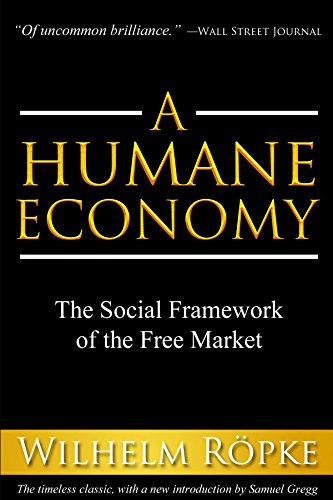
A HUMANE ECONOMYThe Social Framework of the Free Market WILHELM RÖPKE Here is one of the most accessible and compelling introductions to economics ever written. The masterwork of the great economist Wilhelm Röpke, A Humane Economy cuts through the jargon that mars most economic writing to show exactly how economies operate. Röpke’s brilliant, sweeping work highlights both market mechanics and moral philosophy.
User’s Reviews
Editorial Reviews: Review “Like a seminar on integral freedom conducted by a professor of uncommon brilliance.” ―Wall Street Journal “An excellent starting point for the noneconomist reader.” ―First Things “If any person in our contemporary world is entitled to a hearing it is Wilhelm Röpke.” ―New York Times About the Author Wilhelm Röpke (1899–1966) was a professor of economics and the principal architect of Germany’s post–World War II “economic miracle.”
Reviews from Amazon users which were colected at the time this book was published on the website:
⭐“They are all under the spell of a myth whose pseudo-religious content is unmistakable—even without the recent incident when an election poster blasphemously put the “sovereign” people in the place of God and parodied the Bible by declaring: “The fear of the people is the beginning of wisdom.” It is ominous that much the same used to be said by the leaders of National Socialist Germany.’’This ‘pseudo-religious’ idea from the French Revolution replaces God with the ‘people’.Preface – “One group of critics will reject the book en bloc because it is in flat contradiction with their more or less collectivist and centrist ideas.”Still valid.“Another will tell me that in this book, they really appreciate only what is to be found in the world of supply and demand—the world of property—and not what lies beyond. These are the inveterate rationalists, the hard-boiled economists, the prosaic utilitarians, who may all feel that, given proper guidance, I might perhaps have attained to something better.”This, broader vision sets Röpke apart.“Third, there will be those who, on the contrary, blame me for being a hard-boiled economist myself and who will find something worth praising only in that part of the book which deals with the things beyond supply and demand. These are the pure moralists and romantics, who may perhaps cite me as proof of how a pure soul can be corrupted by political economy.”Nevertheless, he does not dismiss the clear, trenchant insights of economics.“Finally, there may be a fourth group of readers who take a favorable view of the book as a whole and who regard it as one its virtues to have incurred the disapproval of the other three groups. It would be sheer hypocrisy on my part not confess quite frankly that the last group is my favorite.” —Wilhelm Röpke Geneva, January 1960Keen analysis!Introduction – “Röpke was shaped by his military service in World War 1. That experience had a profound influence on his thought. Initially, Röpke’s anti Nationalism and antiwar positions translated into support for socialism. To his surprise, however, his university studies (especially his study of Mises) led him to conclude that his protest against war and nationalism mandated “a commitment to liberalism in the sphere of international economic relations; in other words, to free trade.” (140)Mises, Hayek, Wolfe and many traveled the same road.“The same reaction also aroused in Röpke “a great wariness about the powers of the modern state and, along with this, about the powers of the various pressure groups within the nation.” (140)This ‘wariness’ is explained in this work.“His work reflects his long-standing interest in Western intellectual history and his conviction that the seeds of current problems were buried deep in Europe’s past. He saw Hitler’s rise, for example, as part of a wider chain of events, including certain inadequacies in economic liberalism. Similarly, Röpke traced a straight line between France’s Jacobin revolutionaries of the 1790s and the expansive welfare states that began to characterize Western European democracies in the mid-twentieth century.’’ (140)Many scholars agree with this connection with the French Revolution and modern politics.“A Humane Economy represents the fullest fruition of Röpke’s “economic humanism” and his critique of mainstream economic thought and practice. Economics, from Röpke’s standpoint, was not an ideology, philosophy, or religion. Instead it was a social science capable of providing society with powerful insights into reality but incapable of encapsulating reality in its entirety.”His effort to combine both ethics and results creates a fascinating work.“He opposed collectivist policies not simply because economic science told him they were bound to inflict misery on millions. He also regarded collectivism as incompatible with authentic human freedom. Summarizing his view on economics’ relationship to morality, Röpke wrote: We need a combination of supreme moral sensitivity and economic knowledge. Economically ignorant moralism is as objectionable as morally callous economism.” (182)Chapter I—REAPPRAISAL AFTER FIFTEEN YEARSPersonal Old and New VistasMarket Economy and CollectivismChapter II—MODERN MASS SOCIETYMass and World Population MassAcute and Chronic Mass CultureMass and Society Boredom and Mass SocietyChapter III—THE CONDITIONS AND LIMITS OF THE MARKETSocial RationalismThe Spiritual and Moral Setting Nobilitas naturalisThe Asymmetry of the Market EconomyThe Political Framework of the Market EconomyChapter IV—WELFARE STATE AND CHRONIC INFLATIONLimits and Dangers of the Welfare StateThe Problem of Social Security in a Free SocietyThe Welfare State on the International PlaneThe Theoretical Background of Chronic InflationThe Nature of Chronic Inflation Wage Inflation Conclusions and ProspectsChapter V—CENTRISM AND DECENTRISMThe Dividing Lines in Social Philosophy and Economic PolicyThe Web of Human RelationsInternational CentrismReckoning Without Man”For Röpke, economics was not simply about studying the growth of wealth; it also concerned how to create and use this wealth to facilitate the freedom and happiness of all. Hence, although Röpke regarded positive economic science as having its own worth, he recognized its limits for determining the appropriate course of action in given circumstances. Röpke believed not just that economics ultimately should serve certain values—most notably liberty and order—but also that the economy, like all facets of human existence, is not self-sufficient.”What is the foundation?”In A Humane Economy he wrote: The market economy, and with it social and political freedom, can thrive only as a part and under the protection of a bourgeois system. This implies the existence of a society in which certain fundamentals are respected and color the whole network of social relationships: individual effort and responsibility, absolute norms and values, independence based on ownership, prudence and daring, calculating and saving, responsibility for planning one’s own life, proper coherence with the community, family feeling, a sense of tradition and the succession of generations combined with an open-minded view of the present and the future, proper tension between individual and community, firm moral discipline, respect for the value of money, the courage to grapple on one’s own with life and its uncertainties, a sense of the natural order of things, and a firm scale of values.”Wow! ” Röpke supported free markets rather than socialism not merely because markets were more efficient from the standpoint of utility. Markets also allowed people to exercise their freedom in ways that brought a certain order to human affairs, while simultaneously solving the economic problem of scarcity. In part, Röpke’s conclusions were derived from empirical observation concerning the operations of markets and planned economies and their respective consequences for political order. Yet they also owed something to his long observation of human nature and certain conclusions that he reached about the character of human beings. Humans, he claimed, were driven to a large extent by the type of enlightened self-interest Alexis de Tocqueville portrayed in Democracy in America. But Röpke’s understanding of man—his philosophical anthropology—is also rooted in what might be called the tradition of Christian realism often associated with St. Augustine.”This is a deep, broad, through synthesis of human life.Röpke is not obscure, but is writing for scholars or the erudite reader. Mentions Pascal six times, Marx ten, Acton five, Smith five, Mises thirteen, Hayek thirteen, Burke eleven. Ortega y Gassett is referenced five times; however, his ”Revolt of the Masses” plays a key role in Röpke’s thought. This is almost an extension of that earlier writing.About one hundred thirty notes. Same extensive and worth examining for themselves! The links worked great on my iPad.Detailed index with working links.
⭐This book is somewhat dated, but it is still worth reading. Roepke was a Vienna School Economist like Frederick Hayek. He approaches the problem of socialism from the “social” angle, that is the moral questions which arise when you assume that a handful of bureaucrats are going to be put in charge of the entire economy of a nation, making all the most important decisions for the rest of us. He was very concerned with the dehumanizing of labor and social life under such a system, as was demonstrated in the Soviet Union. Frederick Hayek does a better job of analyzing this problem, however. Roepke reacted to it with strong moral repugnance, without the analysis of it’s structural causes. He’s somewhere between Hayek and Hannah Arendt as a thinker. Much of the value of the book lies in his being a firsthand observer, like them, and unlike ourselves. Since all this theoretical stuff started in Germany Roepke discusses the various German versions of socialism as they evolved over time, especially the post WW1 era and the Weimar Republic. When you consider that Karl Marx advocated many reforms in his time which would be considered Bourgeoisie reaction by today’s Marxists, this book helps to understand the history of economics and how understanding of various issues has changed over time. I found the style a little too polemical, but not such as to discourage us from reading it.
⭐Trying to understand the causes and reality of our current political and economic times. Would recommend it to anyone who values the context of history in understanding current affairs
⭐Political freedom presupposes the existence of market economy. At the same time,the two pillars of market economy,namely private property and free competition require a social and moral fracture that stands outside the demand/supply concept. Röpke examines exactly that: the moral foundations of the free market. An outstanding work! Highly recommended!
⭐Ropke rightly claims co-authorship of the “Wirtshaftswunder” of post-War West Germany. But by the time he wrote this magnum opus he had grown disgusted with the consumerism those reforms had brought about. He’s given to ranting about that, and to reminiscing about the halcyon days of his youth prior to the Great War – but has little to say about the Nazis, whose depredations he watched from save haven in Switzerland. His absence from that horrific scene perhaps accounts for the residual racism that permeates this book, especially in his treatment of European integration, a measure of which is necessary, he tells us, if Western civilization is to defend itself from the “colored” masses that might otherwise overwhelm it.
⭐Even as a conservative i was generally disappointed with this book. Röpke says very few things which are original and doesn’t make any particularly developed points. He simply just keeps repeating that western culture is in crisis but provides few concrete ways of actually reversing this trend
Keywords
Free Download A Humane Economy: The Social Framework of the Free Market in PDF format
A Humane Economy: The Social Framework of the Free Market PDF Free Download
Download A Humane Economy: The Social Framework of the Free Market 2014 PDF Free
A Humane Economy: The Social Framework of the Free Market 2014 PDF Free Download
Download A Humane Economy: The Social Framework of the Free Market PDF
Free Download Ebook A Humane Economy: The Social Framework of the Free Market