

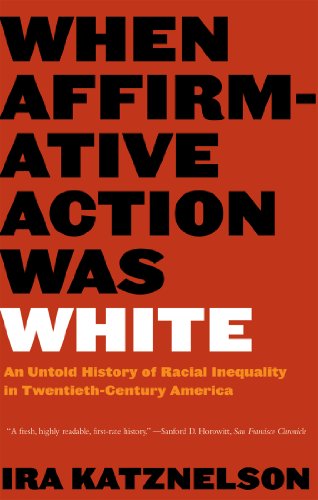
Ebook Info
- Published: 2006
- Number of pages: 253 pages
- Format: PDF
- File Size: 1.34 MB
- Authors: Ira Katznelson
Description
A groundbreaking work that exposes the twisted origins of affirmative action.In this “penetrating new analysis” (New York Times Book Review) Ira Katznelson fundamentally recasts our understanding of twentieth-century American history and demonstrates that all the key programs passed during the New Deal and Fair Deal era of the 1930s and 1940s were created in a deeply discriminatory manner. Through mechanisms designed by Southern Democrats that specifically excluded maids and farm workers, the gap between blacks and whites actually widened despite postwar prosperity. In the words of noted historian Eric Foner, “Katznelson’s incisive book should change the terms of debate about affirmative action, and about the last seventy years of American history.”
User’s Reviews
Reviews from Amazon users which were colected at the time this book was published on the website:
⭐When Affirmative Action was White explains the ways in which black people have been excluded from society. It was so good that I had to reference it in my book: The Real Wakandas of Africa: Dr. John Henrik Clarke vs. Herman Cain. When Affirmative Action Was White discusses a number of small and large ways that Black people have been kept from American wealth and resources. Ultimately, this has led to the black community becoming impoverished within the framework of a very wealthy American nation. This book details the history of welfare laws that were skewed toward white people in America, and were designed to exclude black people. In addition, it points out that homeownership was often denied to African-Americans. You will be left shocked by these policies that existed. In all, this book provides a phenomenal discussion about the ways in which African-Americans were excluded and are still kept from the benefits of American society. It is a worthy read.
⭐The book is extremely well-written, and the sources are very well documented. Without question, the federal government chose for a couple of decades in the 20th century to massively invest in its citizens, but because of the machinations of some (mostly) Southern US politicians, opportunities for African-americans under these programs were severely restricted. These local bosses wanted to keep the sources of cheap and docile wage labor in place in their Southern states so as to keep their local hierarchies of race and class intact – it may have been a small totem pole in their communities, but at least they were on top of it and in control!In contrast, many poorer whites outside the South were able to leapfrog into the middle class, and many descendants of immigrant Jews, Italians, and Slavs were able to become more fully integrated into US social and economic life. This book obviously makes some whites defensive, because the sources of this book demonstrate that they had LOTS of help achieving middle class status, and they would rather that we all settle into a collective amnesia about these facts regarding their past receipt of government assistance. (Well, maybe it isn’t really amnesia — some of these past beneficiaries will at present fight for more largesse under Social Security and Medicare). But they will still not admit they got government help – no!, they say, we earned it!!I would differ from the author’s statistical emphasis on averaging together all whites versus all African-americans, as this would obscure important differences of class within races. A frequent criticism of present affirmative action programs is that its beneficiaries are usually from amongst the more affluent and middle class members of the targeted groups, while the more poor segments continue to be shut out. Perhaps a different type of affirmative-action, based on focusing on underprivileged classes (irrespective of race) make more sense for 21st century America. That type of affirmative action would look a lot more like the affirmative action described in Mr. Katznelson’s book.
⭐Americans especially white Americans benefitted from two federal sponsored programs designed to help them move into the middle class these programs were the Social Security Act of 1935 and The Servicemen’s Readjustment Act of 1944 nicknamed The G I Bill of Rights the amazing thing about the Social Security Act is that it intentionally excluded domestic workers and farm workers as stated on page 43 “Unfortunately, the great majority of blacks were left out. Most African Americans, we have seen, were farm workers or domestics, and people in these categories did not qualify.” “Not until 1954, when Republicans controlled the White House, the Senate, and the House of Representatives, and the southern Democrats finally lost their ability to mold legislation, were the occupational exclusions that had kept the large majority of blacks out of the Social Security system eliminated.” As for The G I Bill even though this was a federal program the administrative duties and distribution of funds was handled and left up to the individual states on page 114 “To be sure, the G I Bill did create a more middle-class society, but almost exclusively for whites.Written under southern auspices, the law was deliberately designed to accommodate Jim Crow. Its administration widened the country’s racial gap. The prevailing experience for blacks was starkly differential treatment.” An individual example of this differential treatment can be found on page 139 read “The case of Reuben Thompson of Rome, Georgia,” And on page 140 “these impediments were not confined to the South. In New York and northern New Jersey suburbs, fewer than 100 of the 67,000 mortgages insured by the G I Bill supported home purchases by non-whites”. This is a perfect example of how white people were able to advance into middle-class status, the material in this book is a major part of American history.
⭐Katznelson painstakingly describes the systematic infusion of federal funding into the hands of the white population in the US – beginning during the era between the two wars. These systems – which deliberately excluded blacks at the request of the southern states in order to protect Jim Crow laws – have created a marked gap in opportunity and generational wealth between blacks and whites in America. I am baffled by the likes of those (such as Justice Clarence Thomas) who oppose federally funded programs to rectify these deliberate obstacles that were put in place to inhibit progress for blacks in this nation.
⭐excellent book that fits the time that we live in. The difference in people and ideas- hate is hate; poor is poor.
Keywords
Free Download When Affirmative Action Was White: An Untold History of Racial Inequality in Twentieth-Century America in PDF format
When Affirmative Action Was White: An Untold History of Racial Inequality in Twentieth-Century America PDF Free Download
Download When Affirmative Action Was White: An Untold History of Racial Inequality in Twentieth-Century America 2006 PDF Free
When Affirmative Action Was White: An Untold History of Racial Inequality in Twentieth-Century America 2006 PDF Free Download
Download When Affirmative Action Was White: An Untold History of Racial Inequality in Twentieth-Century America PDF
Free Download Ebook When Affirmative Action Was White: An Untold History of Racial Inequality in Twentieth-Century America