

Ebook Info
- Published: 2007
- Number of pages: 288 pages
- Format: PDF
- File Size: 1.44 MB
- Authors: Eric A. Finkelstein
Description
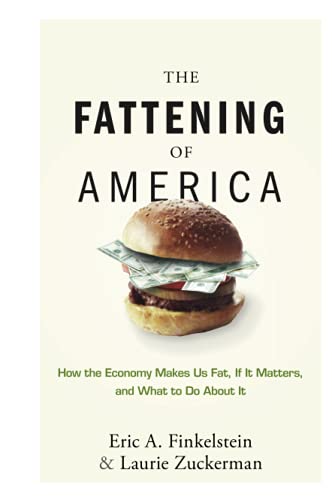
In The Fattening of America, renowned health economist Eric Finkelstein, along with business writer Laurie Zuckerman, reveal how the U.S. economy has become the driving force behind our expanding waistlines. Blending theory, research, and engaging personal anecdotes the authors discuss how declining food costs—especially for high-calorie, low-nutrient foods—and an increasing usage of technology, which make Americans more sedentary, has essentially led us to eat more calories than we burn off.
User’s Reviews
Editorial Reviews: From Publishers Weekly Everyone knows Americans are growing fatter, but health economist Finkelstein crunches the economic figures behind the nation’s obesity epidemic and the results aren’t pretty. Along with health-care writer Zuckerman, researcher Finkelstein delves into how modern technology reduces the cost of producing higher-calorie processed goods, decreases our activity level and puts our health in danger. Finkelstein debunks myths about the long-range cost of food production and consumption and scrutinizes the impact of genetics and U.S. fiscal policy on the nation’s waistline, frequently using economics metrics in his analysis. Generous with summaries of major points, Finkelstein simplifies current stats to explain how the country’s thunderous weight gain is straining Medicare and Medicaid and hurting our military readiness. The only positive effect he sees from the obesity epidemic is the creation of the ObesEconomy—a market sustained by gyms, diet drugs and other products and services designed to curb weight gain. Horrified by studies that reveal that obese children have a quality of life similar to children with cancer, the investigatory economist even throws in some health tips on dropping pounds. Despite a frequent reliance on economic tools and indicators, this combination study/motivational guide makes for a pleasant educational read, comparable to a vegetable puree snuck into a dessert. (Jan.) Copyright © Reed Business Information, a division of Reed Elsevier Inc. All rights reserved. Review “Fatty, fat, fat, fat,” chants Bart Simpson. He has a point. Americans are getting fatter. But health economist Finkelstein (public health economics program, Research Triangle Inst.; coauthor, with Phaedra S. Corso and Ted R. Miller, The Incidence and Economic Burden of Injuries in the United States) and business writer Zuckerman (coauthor with Mary Cantando, Nine Lives: Stories of Women Business Owners Landing on Their Feet) analyze the finances behind the fat. They trace some of the familiar causes of the bulging American waistline that Greg Critzer identified in Fat Land: How Americans Became the Fattest People in the World. They weigh in on the economics of obesity, which they trace back to predictable sources such as school lunch rooms, fast food, television, commuting, and working moms. Then they target some surprising causes, including health insurance. On the flip side, they detail the economic consequences of obesity. For instance, obese employees take more sick days than do normal-weight employees-and their paychecks are slimmer. The authors highlight fascinating new scientific research into the causes of obesity and offer tips on lightening your load over the long haul. This book serves up a healthy selection for public and academic library business collections.—Carol J. Elsen, Univ. of Wisconsin, Whitewater (Library Journal, January 2008) Everyone knows Americans are growing fatter, but health economist Finkelstein crunches the economic figures behind the nation’s obesity epidemic and the results aren’t pretty. Along with health-care writer Zuckerman, researcher Finkelstein delves into how modern technology reduces the cost of producing higher-calorie processed goods, decreases our activity level and puts our health in danger. Finkelstein debunks myths about the long-range cost of food production and consumption and scrutinizes the impact of genetics and U.S. fiscal policy on the nation’s waistline, frequently using economics metrics in his analysis. Generous with summaries of major points, Finkelstein simplifies current stats to explain how the country’s thunderous weight gain is straining Medicare and Medicaid and hurting our military readiness. The only positive effect he sees from the obesity epidemic is the creation of the “ObesEconomy”—a market sustained by gyms, diet drugs and other products and services designed to curb weight gain. Horrified by studies that reveal that obese children have a quality of life similar to children with cancer, the investigatory economist even throws in some health tips on dropping pounds. Despite a frequent reliance on economic tools and indicators, this combination study/motivational guide makes for a pleasant educational read, comparable to a vegetable puree snuck into a dessert. (Jan.) (Publishers Weekly, December 3, 2007)“Finkelstein’s tone is chatty and accessible…obesity is ultimately bad economics.” (Financial Times, Saturday 16th February 2008)“The authors show there is a casual relationship between the growth of the waistline and the changing shape of the economy.” (Securities & Investment Review, March 2008) From the Inside Flap Over two-thirds of Americans are overweight or obese. What’s alarming about this statistic is not just the volume of Americans who have tipped their scales—but the velocity at which they’re doing it. Over the past three decades, the number of obese Americans has more than doubled. The increase occurred up and down the socioeconomic spectrum, for all racial and ethnic groups, and, most dramatically, for America’s children. What’s behind the sudden, explosive rise in obesity rates? In a word, it’s economics. Author Eric Finkelstein, a renowned health economist who has spent much of his career studying the economics of obesity, with the help of coauthor Laurie Zuckerman, reveals why America’s growing waistline is a by-product of our economic and technological success. Because of declining food costs, especially for high-calorie, low-nutrient foods, and increasing usage of technology, which make Americans more sedentary, the environment has changed in such a way that we’re eating more calories and burning off less. The issue is not that Americans don’t care about their increasing waistlines—quite the opposite, in fact. But the reality is that in America’s (and increasingly the world’s) obesity-inducing environment, the sustained changes in behavior required to lose the weight and keep it off are simply too difficult—and becoming more difficult all the time. Moreover, generous insurance coverage and vastly improved medical treatments have lowered the health costs, if not the monetary costs, of excess weight. So carrying a few extra pounds is not as bad for one’s health as it used to be. Finkelstein and Zuckerman blend theory, research, and engaging—sometimes hilarious—personal anecdotes to break down the causes and the consequences of America’s obesity epidemic. One by one, they explore the media’s claim that obesity is making our businesses less competitive, pushing good jobs overseas, hurting our military readiness, increasing our taxes, and helping to bankrupt the Medicare and Medicaid programs. Along the way, the authors also reveal how the obesity epidemic has spurred tremendous demand for all sorts of new products and services, creating a flourishing new market that they call “The ObesEconomy.” The Fattening of America outlines the issues we must deal with to confront obesity. The authors explore the role that business and policymakers play in America’s obesity epidemic, and explain that successful obesity prevention strategies need to do exactly the opposite of where the economy is taking us. They need to make it cheaper and easier to be thin—not fat. However, because obesity is a natural by-product of an expanding economy, the authors question whether or not obesity prevention efforts, even if successful, would actually leave some individuals worse off. From the Back Cover Over two-thirds of Americans are overweight or obese. What’s alarming about this statistic is not just the volume of Americans who have tipped their scales—but the velocity at which they’re doing it. Over the past three decades, the number of obese Americans has more than doubled. The increase occurred up and down the socioeconomic spectrum, for all racial and ethnic groups, and, most dramatically, for America’s children. What’s behind the sudden, explosive rise in obesity rates? In a word, it’s economics. Author Eric Finkelstein, a renowned health economist who has spent much of his career studying the economics of obesity, with the help of coauthor Laurie Zuckerman, reveals why America’s growing waistline is a by-product of our economic and technological success. Because of declining food costs, especially for high-calorie, low-nutrient foods, and increasing usage of technology, which make Americans more sedentary, the environment has changed in such a way that we’re eating more calories and burning off less. The issue is not that Americans don’t care about their increasing waistlines—quite the opposite, in fact. But the reality is that in America’s (and increasingly the world’s) obesity-inducing environment, the sustained changes in behavior required to lose the weight and keep it off are simply too difficult—and becoming more difficult all the time. Moreover, generous insurance coverage and vastly improved medical treatments have lowered the health costs, if not the monetary costs, of excess weight. So carrying a few extra pounds is not as bad for one’s health as it used to be. Finkelstein and Zuckerman blend theory, research, and engaging—sometimes hilarious—personal anecdotes to break down the causes and the consequences of America’s obesity epidemic. One by one, they explore the media’s claim that obesity is making our businesses less competitive, pushing good jobs overseas, hurting our military readiness, increasing our taxes, and helping to bankrupt the Medicare and Medicaid programs. Along the way, the authors also reveal how the obesity epidemic has spurred tremendous demand for all sorts of new products and services, creating a flourishing new market that they call “The ObesEconomy.” The Fattening of America outlines the issues we must deal with to confront obesity. The authors explore the role that business and policymakers play in America’s obesity epidemic, and explain that successful obesity prevention strategies need to do exactly the opposite of where the economy is taking us. They need to make it cheaper and easier to be thin—not fat. However, because obesity is a natural by-product of an expanding economy, the authors question whether or not obesity prevention efforts, even if successful, would actually leave some individuals worse off. About the Author ERIC A. FINKELSTEIN, PHD, MHA, is a nationally acclaimed expert on the subject of economics and obesity. He is a health economist with the research organization RTI International in Research Triangle Park, North Carolina, and teaches health economics at Duke University. His work focuses on the economic causes and consequences of health-related behaviors, with a primary emphasis on obesity. Finkelstein has published over thirty peer-reviewed articles on the economics of obesity and related behaviors. His research has been featured on the front page of USA Today and has been covered in the Economist, the New York Times, Forbes, the Washington Post, and many other newspaper, radio, and television outlets. LAURIE ZUCKERMAN left her corporate PR job in 1999 to make writing her full-time career. She contributes columns and feature articles to a number of business journals and lifestyle magazines, and writes for businesses ranging from Fortune 500s to startups, with a focus on health care, high tech, and business. Read more
Reviews from Amazon users which were colected at the time this book was published on the website:
⭐The topic of this book is great and the author certainly has done a lot of very good academic work in analyzing data related to the prevalence, outcomes, and costs of obesity (I have done some work in the field and am quite familiar with his academic work).The book does a good job laying out why obesity has increased from the perspective of the individual — it has become easier to eat more food as food has been less expensive, people lack time to prepare meals, and there is a huge industry willing to serve us larger portions of cheap food. A lot of this can be tied to the personal choices people make and the way in which food suppliers/processors/restaurants have reacted.After discussing some of the reasons we are becoming increasingly overweight, the book thens turns to policy (from the standpoint of governments and companies that cover employee health insurance). The book is pretty good here, in that it describes the important role of incentives in influencing behavior. The discussion is good, but a lot of it reads like an economics text in which an economic concept is introduced (e.g., moral hazard, the reasons for the government intevene in markets) and obesity is presented as the example as to how these concepts may play out in the real world.When I picked up the book and saw that it would cover policy topics, I had hoped to get a better sense of what policy initiatives really are, how often they are implemented, what the actual experience with different policies is. The book is quite light on these.One thing that bothers me in the book is that it is written too informally at times in a way that is bothersome, particularly the endless discussion of how Uncle AL and Cousin Carl (are these real people?) make their food and exercise choices. Reading comments about these two in nearly every paragraph for many pages got quite weary — I just checked Amazon’s “Search inside this book” feature and the words “Uncle Al” showed up on 83 pages and “Cousin Carl” showed up on 30 pages – a lot for a book of about 240 pages!This is a good but not great book. It gives the reader a good sense of how prevalent obesity has become (especially in the author’s family) and some of the reasons various policies may or may not work. It would be a better book if it were a bit more focused on presenting and interpreting data and perhaps less personal in trying to use an individual’s name (the cartoonish Uncle Al) to make far far too many points.Note: If you are interested in learning more about obesity, the notes and references in the book are excellent.
⭐Let me start by saying that I very much like the trend of economists writing books about the things around us. I bought this book after reading about it on an economist’s blog. (Sorry, I can’t find the pointer.) It does deliver the promised economic analysis, and makes some interesting points. But overall I’m disappointed with it for three reasons.1) Rationality bias. The authors fail to properly weight the non-rational ways that humans relate to food. For example, although they make reference to Brian Wansink–whose own book
⭐documents many research studies showing that many factors beneath our consciousness affect how we consume food–they essentially dismiss this research evidence in favor of their own opinions. To some extent I understand this, because a lot of economic analysis is predicated on the idea of rational decision making, but I found it high-handed.2) A whopping blind spot with respect to childhood obesity. Here again, they ignore research (see, for example, anything by Ellyn Satter) which shows that the sort of intervention they favor is counterproductive. The anecdote about the obese boy in England, and the primary author’s statement that he would favor taking the child away from the mother, has chilling parallels to a case described by Satter in which a foster mother managed to starve an overweight boy down to a lower weight, while the professionals all ignored the reasons this child overate and ate poorly in the first place.3) Poor fact-checking. I practically threw the book in the trash can when I encountered this one: “…according to a press release issued by the National Restaurant Association, a sandwich consisting of just five items can be ordered 120 different ways. Throw in five condiment options–such as lettuce, ketchup, mustard, onions, and oil–and now you have more than 3.6 million combinations.”OK, strictly speaking, the “fact” is that the press release exists. Its contents are spurious, however, and as every PhD I have ever met has been required to take a statistics course, he should have had no trouble understanding and debunking the numbers. The only way a sandwich with 5 items can be ordered 120 different ways is if the order of the items matters–i.e. putting the cheese on top of the ham is considered different than putting the ham on top of the cheese. Ridiculous. The correct numbers are 31 different combinations of 5 items and 1023 combinations of 10. An error of that magnitude, when made by the Restaurant Association, is “spin.” But when it’s repeated unchecked by a researcher, it’s irresponsible.Don’t get me wrong–it’s an enjoyable read–but don’t take too much of it on faith.
⭐Riveting book and well worth the read
⭐I enjoyed this book, as he went over every aspect of what could be causing the fattening of america, before he zeroed in on a couple of very probable ideas. It makes you realize how much corn syrup is in EVERYTHING, and has you start reading labels.
⭐Arrived quick just in time for class. Good book!
⭐Amazing
⭐Examines the problem of obesity from an economic viewpoint using plain language, logic and humour. Highly recommended especially for non-economists.
Keywords
Free Download The Fattening of America in PDF format
The Fattening of America PDF Free Download
Download The Fattening of America 2007 PDF Free
The Fattening of America 2007 PDF Free Download
Download The Fattening of America PDF
Free Download Ebook The Fattening of America